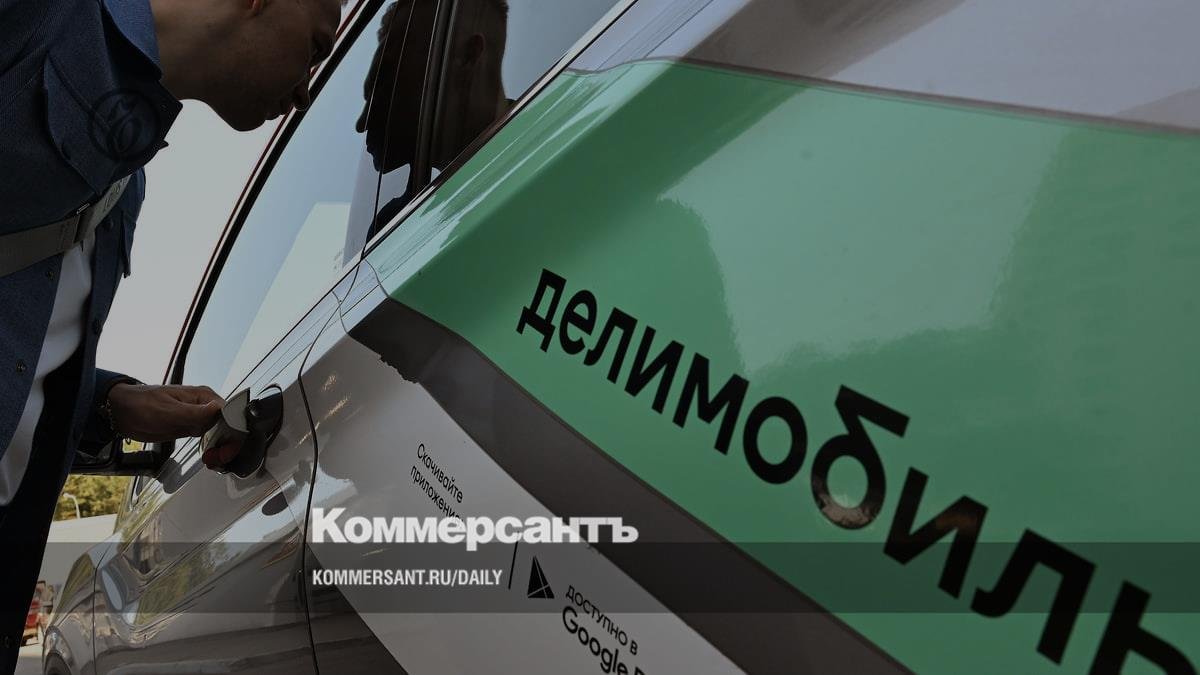
The fall in demand in the largest regional market – in Moscow – led to the fact that in January-April 2026, the total car sharing turnover decreased by 17.7%, to 17.3 billion rubles. Consumers cannot withstand rising prices for services and restrictions on the operation of the mobile Internet. Car sharing operators are trying to develop their business by expanding into other regions.
The turnover of the Russian carsharing market in January-April amounted to 17.3 billion rubles, having decreased by 17.7% year-on-year, according to Rosstat data. A year earlier, the same value increased by 21.6%. The decline was primarily due to the Moscow market, where revenue from the car sharing market lost 18.9% year-on-year, amounting to RUB 16.6 billion in January-April. In the Moscow region, total user costs decreased by 8.3%, to 50.1 million rubles.
According to Delimobil, in January-March 2026, the car sharing market in Moscow decreased by 25%, to 15 million trips. Yandex Drive claims that in January-April 2026, the service’s revenue, on the contrary, increased by 24%, and the number of minutes rented by 54%.
The founder of Delimobil, Vincenzo Trani, attributes the drop in demand for carsharing to the unbalanced pricing policy of operators, including a direct increase in tariffs.
Users in Moscow are price sensitive due to the developed public transport and taxi system, notes Anna Litvinenko, partner in the Corporate Finance practice at Strategy Partners. The editor-in-chief of the Thrushering publication, Polina Volkova, explains that car sharing was initially considered as a choice for drivers who do not want to buy a car. “But now many people cannot afford comfort, and people prefer the metro,” she says.
In January 2026, the average bill for car sharing services, according to the OFD Platform, was 719 rubles. Year on year the value increased by 8% (see “Kommersant” dated February 6). Analysts estimated the average bill for a taxi at the beginning of February at 681 rubles. Ms. Volkova notes that the cost of car sharing services has increased significantly following the rise in prices for cars, their maintenance, gasoline, as well as the fiscal burden. The average price of a new passenger car in Russia in March 2026 was 3.54 million rubles, having increased by 14% year-on-year, according to Autostat data. The average consumer price of AI-95 gasoline, according to Rosstat, as of June 8 was 70.4 rubles. per liter, increasing year-on-year by 13.7%.
Demand for car rentals can also be hampered by limitations in the operation of the mobile Internet, which is required to open and close the car through the application, as well as to navigate in the city. In March, Kommersant’s interlocutor in the IT market estimated the total damage to various business sectors in Moscow over five days in the range from 3 billion to 5 billion rubles, based on the share of the digital economy in the gross regional product and the scale of restrictions.
Due to limited demand, players in the car sharing market are becoming more careful: the emphasis is shifting from increasing the fleet to loading each car, redistributing cars between cities, developing the economy segment and entering regions with the best unit economics, says Anna Litvinenko.
The growth of the carsharing market in the regions is still maintained due to a low base. In the Ural Federal District, according to Rosstat, its turnover in January-April 2026 increased three times year-on-year, to 74.6 million rubles, in the south of the country – by 32.2%, to 424.1 million rubles, in the Volga region – by 6.3%, to 7.1 million rubles, in the North-West – by 2.2%, to 31.7 million rubles. In the Far East, car sharing operators earned only 3.3 million rubles—1.7% less year-on-year. At Delimobil, the increase in the number of trips in the first quarter of 2026 in Samara was 59%, in Perm – 93%, and in Ufa – 151%, clarifies Vincenzo Trani. It is the regions that he now considers as a direction for business growth.
“Delimobil” was released in Yaroslavl, Krasnodar, Chelyabinsk and dozens of satellite cities in 2025. BelkaCar has doubled its geographic presence, launching in Izhevsk, Tyumen, Nizhny Novgorod, Perm, Chelyabinsk and Kaliningrad. Yandex Drive started working in Nizhny Novgorod, Chelyabinsk, Perm, and at the beginning of 2026 – in Tyumen. Anna Litvinenko notes that public transport in the regions is less developed than in Moscow. This could contribute to the development of carsharing.
Despite the disastrous start to the year, market participants are forming a positive forecast. The fundamental growth drivers for car sharing remain the same – a personal car has become an expensive asset; for many, short-term rental remains a more affordable alternative to purchasing, notes Anna Litvinenko. Mr. Trani does not expect a drop in demand for carsharing throughout 2026.