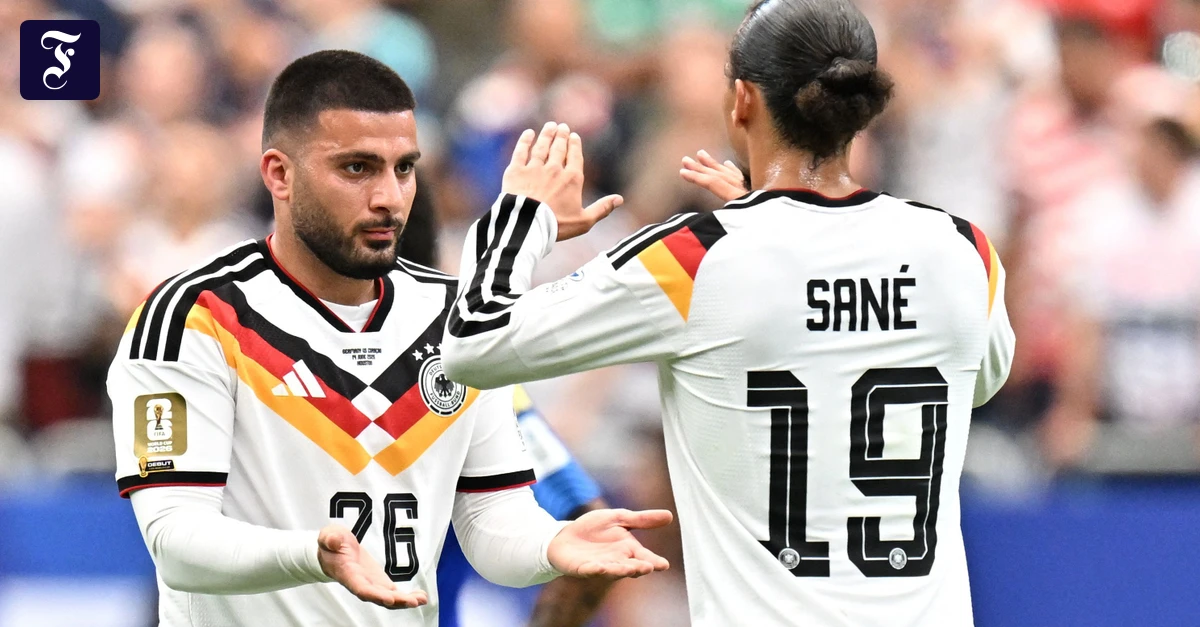
When Deniz Undav had to describe what the national coach expected of him before the German national soccer team’s first game at this World Cup, he hesitated as long as a striker should when a ball falls at his feet: not at all. “If we need goals: score goals.”
When Undav was substituted on by the national coach in the 64th minute in the first game of this World Cup, no goals were needed. Not even a goal. Germany was already leading 4-1 against Curaçao. Still, Undav didn’t hesitate for long: four minutes later he backheeled the ball to Nathaniel Brown, who volleyed it into the goal. Ten minutes later, Undav scored himself after a cross pass from Joshua Kimmich. And ten minutes later he scored again Kai Havertz the ball into the run, which finished with a lob. 7:1. Or as Undav would rather say: Bamm, bamm, bamm.
Twenty-four minutes, two assists, one goal – Undav immediately ensured German overproduction in the World Cup goal factory in Houston.
Undav is not one of those typical strikers in terms of being very fast or very good in the air or very technically adept – or all of the above. But Undav is one of those typical strikers who lets the numbers do the talking. And those of the striker Undav speak for themselves, especially in the national team. He was already 27 years old when he made his debut in March 2024. Since then he hasn’t played all the time, but when he did play, he produced goals: seven in ten international matches, four assists.
There could have been thirty international matches, but Undav was also an on-off striker in Julian Nagelsmann’s selection: often offbut if onthen correct on fire. In the fall of 2024 he scored three goals and one assist. Then the machine was back off. In the World Cup qualifiers, Undav didn’t play because he was injured, then because Nagelsmann didn’t call him up.
However, because the seasonal worker’s record was a high – 46 games, 25 goals and 14 assists in the last season for VfB Stuttgart – Nagelsmann had no choice. This summer, Undav again produced “Made in Germany”, four goals and three assists. Nagelsmann, the performance of the Stuttgart striker in the friendly against Ghana in March rated it as “not good” until the winning goal (and later asked the player to apologize for it), called it “very, very good” against Curaçao.

With this praise and these odds, you don’t have to ask yourself whether this Undav will play in the second World Cup game against Ivory Coast on Saturday (10 p.m. CEST in FAZ live ticker for the World Cupon ZDF and MagentaTV) has to play in Toronto from the start?
Deniz Undav only needs 57 minutes to score
It doesn’t have to be asked, the German team scored four goals even without Undav. But it can be asked. But in the answer there are reasons why Undav’s supposedly strong application for a role in the starting eleven was actually more of a strong application for the role of Joker.
No other German striker gets up to speed with goals so quickly: Kai Havertz needs an average of 159 minutes for a goal, Florian Wirtz 241, Jamal Musiala 264, Leroy Sané 276. Undav needs 57. But more playing time, for example from the start, would not automatically lead to even more goals. Nagelsmann already represented this thesis in his criticism in March, when he asked himself whether Undav would have reached the ball for the winning goal against Ghana “if he had marched for 70 minutes beforehand” in “42 degrees”.
Aside from the statistics, the statics of the team also play a role. Undav is one for the center, not for the outside. In the middle, Nagelsmann relies on the sneaking center forward Havertz, who scored two goals against Curaçao, and the meandering midfielder Musiala, who scored once.
The national coach named both of them, along with goalkeeper Manuel Neuer, captain Kimmich and Wirtz, as the five pillars in the World Cup structure. Musiala is not at his best after the serious injury. Not yet. Nagelsmann’s plan is for him to approach it for as many minutes as possible at the World Cup.
Zero European Championship goals and zero World Cup goals for Leroy Sané
An offensive weak point, if it can be called that with seven goals in a World Cup game, was the right offensive side with Sané against Curaçao. With his performance he showed that the theory that he probably wouldn’t have played if Lennart Karl could have played wasn’t too far-fetched. However, because Karl is injured, he is missing from the World CupSané was Nagelsmann’s first choice again, but he acted erratically, sometimes carelessly, when Wirtz had to correct his unsuccessful backheel trick in his own half.
Sané had two chances, he missed both, first he didn’t hit the ball properly, then he shot past, alone in front of the goalkeeper. In addition to zero goals at the European Championships, there are also zero goals at the World Cup – not a record for a quota striker.
Sané took it easy: “I’m not stressing myself out,” he said. “If it fits, it fits.” Things didn’t really go well on Sunday. Not yet? Not just Karl’s absence, but that too Serge Gnabry’s World Cup exitalso due to an injury, Nagelsmann had taken an option. Gnabry had a strong season and, unlike Undav, could play well outside and inside.
Havertz still sees “a lot of constellations in the team, a lot of players coming in, a lot of people who can start the game.” But if you listened closely, you would hear Havertz make a small plea for Undav to play the joker role, who comes into a game and is immediately successful. “That’s what he’s here for,” said Havertz. “When you have a weapon like that, you have to use it.” Especially when the Germans really need goals.