This World Cup is marked by many changes. Beyond the ‘four-half matches’, in which the two periods are abruptly divided by a hydration break, the tournament is already different from all previous ones, and in it, Artificial intelligence is already one of the main protagonists.
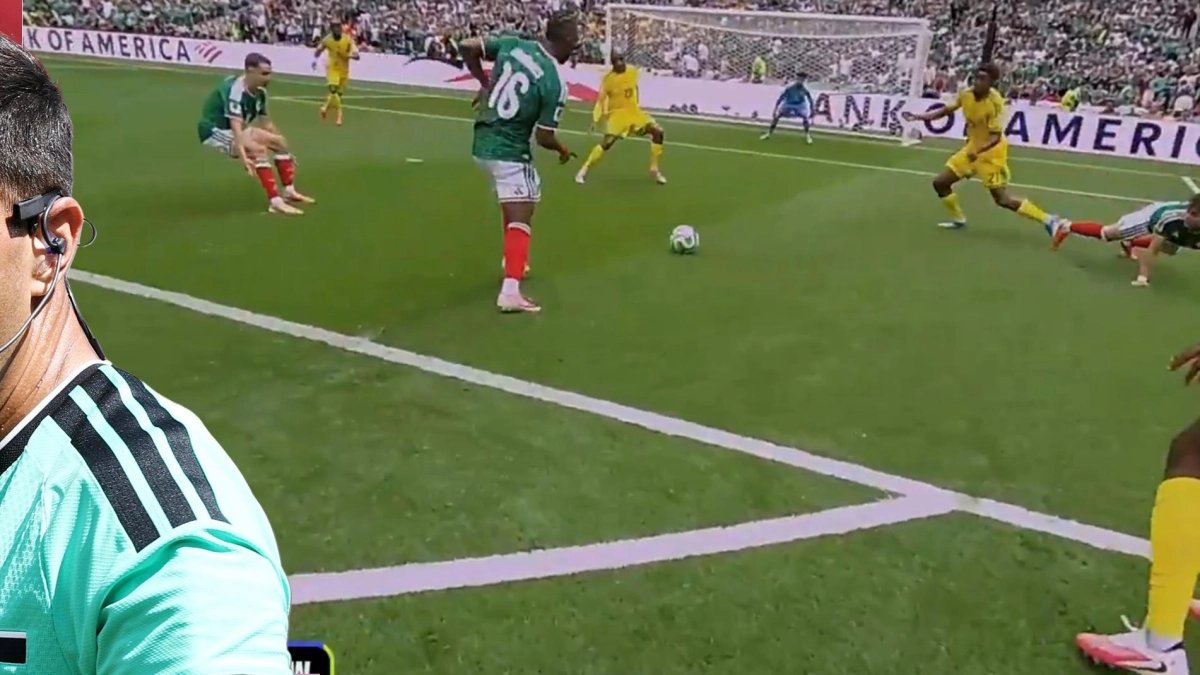
Already in the first match, between Mexico and South Africa, the Brazilian referee Wilton Sampaio He was the pioneer in wearing a headband in which, next to his temple, he carried a camera in which he recorded all the plays of the game.
Wilton Sampaio Photo:AFP
READ ALSO

“That element was already tested in the Club World Cup. In the feedback we received, people commented that it was a good idea, but since the referee was running, that made anyone dizzy. The camera was on the chest. So, we stabilized that,” explained Fernando Jiménez, representative of Lenovo, official partner of Fifa in technological matters.
“The repetition of the goals is very interesting. Tremendous. Or, for example, the red card of the South African Mwene: the slap he hits on the Mexican is clear. As a spectator, you say: ‘Oh, of course, look, the referee was seeing the play right and it caught his attention and that’s why he went, reviewed and finally, well, he sent him off.’ So, these aids contribute to making the game much fairer and through technology it gives the tools for the judge to make an informed decision,” he added.
The ‘semi-automatic VAR 2.0’: all the World Cup players were scanned
Another element that has undergone an important evolution in this World Cup is the VAR, which, for the first time in the history of the tournament, is semi-automatic. However, it has a very different visual treatment.
The 1,248 players participating in the tournament were scanned from head to toe to have their physiognomy in detail and this is transferred to the screens of the official broadcast, where the image of the participating player is already shown in the analysis of the actions of advanced positions.
Semi-automatic VAR in the 2026 World Cup Photo:Taken from DSports
“What was seen in the VAR were some mannequins. Some dummies without textures, without hair and without anything. So, we scanned the 1,248 players. In the replay you can already see, well, how long their foot is, and if the arm is longer than the other, what the build is like and the hairstyle and all that. That type of visualization gives you, as a spectator, more confidence, because if you see Lucho Díaz, for example, you are going to look much more convinced,” said Jiménez.
Data analysis platform for all teams
Fifa and Lenovo jointly developed a platform that was delivered to the 48 participating teams. It’s called Football AI Pro and, according to the brand’s statement, “it processes millions of data points and more than 2,000 metrics per match to identify game patterns, analyze rivals and support tactical decisions by coaches, assistants and players before and after the match.”
Data analysis in the 2026 World Cup Photo:Lenovo
“This is a software created with Lenovo artificial intelligence that takes all the matches that the 48 teams have played during the qualifying round and during all the friendlies. And this application has been available since the teams arrived at the training camps. The good thing is that the 48 technical teams have access to the same information. So, access to these tools is democratized. Previously, Germany, Brazil, France could have it, but Curaçao, Haiti, Uzbekistan or Congo were not going to have it,” he pointed out. Jimenez.
The software is fed in real time with what is happening in the 104 matches of the World Cup, with a particularity: at the moment in which the teams are in competition, from the initial whistle to the end of the match, it is disabled for the two teams that are on the field, so as not to give them any type of advantages.
“In terms of technology, each stadium has its data center. The ball, for example, communicates with it 500 times per second, sending information on the kinetic point where it is being touched, the speed, the angle, the spin, the rotation. In other words, the amount of information there is is absolute,” Jiménez said.
Support for fans
Fifa’s technological partner also created an infrastructure based on “digital twins”: they are 3D virtual replicas of the stadiums and their operations, in which different scenarios related to security and crowd management can be simulated, such as evacuation flows and crowd distribution. This is also updated in real time, which can identify problems such as failures in facilities or saturations in certain areas.
Football is moving deeper and deeper into the 21st century. Artificial intelligence is here to stay.
SPORTS