Synopsis: A senior anti-drug official warns that masterminds based abroad are increasingly directing sophisticated transnational criminal rings, underscoring the need for stronger international cooperation to combat narcotics crime.
A senior anti-drug official has highlighted the growing challenges faced by law enforcement agencies in combating drug trafficking, stressing that most criminal networks are directed by foreign masterminds operating from outside Cambodia and that effective suppression requires strong international cooperation.
The remarks followed a major drug raid in Thailand the previous week.
In a video statement released by the Ministry of Interior June 13, Major General In Song, Deputy Director of the Anti-Drug Department, said drug trafficking is a global crime driven by highly organised criminal syndicates that operate across borders.
“Most drug masterminds are foreign nationals and are based overseas,” Maj Gen Song said. “They establish trafficking networks in target countries where drugs are produced, distributed, traded and consumed.”

He said criminal organisations often employ sophisticated methods to conceal the identities of their leaders, including compartmentalising information among network members so that individuals involved in operations do not know each other or the identities of those directing their activities.
According to the official, such tactics create significant obstacles for law enforcement agencies attempting to trace and dismantle entire criminal networks.
“Even when authorities successfully arrest members of a network, it remains difficult to identify and locate the masterminds behind the operations,” he said.
Maj Gen Song noted that drug traffickers are increasingly exploiting modern technology and anonymous financial systems to evade detection. Many transactions are conducted through accounts lacking proper identification or using falsified identities, complicating investigations.
He also pointed to the geographical and security challenges encountered during anti-drug operations, saying traffickers often choose remote or difficult terrain to carry out production, storage and distribution activities.
“In addition, criminal groups are frequently armed with a range of weapons, including handguns, rifles, grenades, improvised weapons, knives and swords, posing serious risks to law enforcement personnel,” he said.

Citing a recent case, Maj Gen Song said authorities conducting a drug crackdown operation in Takeo province in April 2025 came under attack from suspects, resulting in two law enforcement officers being shot and injured. Both officers are currently receiving medical treatment.
He added that several years ago, three law enforcement officers lost their lives during anti-drug operations after being fired upon by drug suspects.
The official added that because drug trafficking is a transnational crime, no single country can effectively combat it alone.
He called for stronger cooperation among domestic and international law enforcement agencies, particularly in sharing intelligence, operational experience and technical expertise.
“International cooperation is extremely important for preventing and suppressing drug crimes,” he said. “The exchange of information, experience and technical knowledge among relevant authorities is essential to achieving successful outcomes in the fight against drug trafficking.”
Maj Gen Song said enhanced collaboration between countries would help authorities disrupt criminal networks more effectively and improve efforts to protect communities from the threat posed by illicit drugs.
Southeast Asia, in recent years, has been hit hard by drug crimes, which all governments treat as a major security concern.
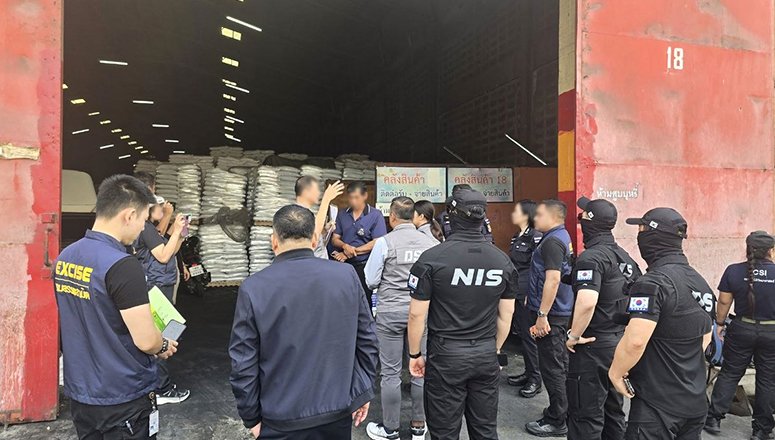
According to South Korea’s Yonhap News TV, a significant case emerged on June 9 in Thailand, where the South Korean National Intelligence Service, in cooperation with Thailand’s Narcotics Control Department, conducted a joint operation against drug production facilities. Authorities raided 10 warehouses storing raw drug materials in Bangkok, Samut Prakan, Rayong and Nonthaburi, seizing approximately 50 tonnes of chemical substances intended for narcotics production.
The confiscated materials were sufficient to supply an estimated 700 million people simultaneously, underscoring the immense scale of the operation, with a market value of roughly 8.4 trillion won ($5.27 billion). While the NIS has previously concentrated on apprehending and extraditing overseas drug suppliers such as Pa Gong Rio, this marks the first instance in which a domestic government agency has directly targeted an overseas drug supply base.