U.S. President Donald Trump says he is extending the ceasefire with Iran to give its leadership time to “come up with a unified proposal.”
In a late afternoon message on social media Tuesday, Trump said he had been asked by Pakistan’s prime minister “to hold our Attack on the Country of Iran.”
“I have therefore directed our Military to continue the Blockade and, in all other respects, remain ready and able, and will therefore extend the Ceasefire until such time as their proposal is submitted, and discussions are concluded, one way or the other,” he wrote.
A two-week truce between the two countries was set to expire in the next 24 hours, and both countries warned that, without a deal, they were prepared to resume fighting.
Iran’s top negotiator Mohammad Bagher Ghalibaf called Trump’s extension a “ploy to buy time.” In a social media post in response to the move, he said that the continuation of the U.S. blockade on Iranian ports was “no different from bombardment and must be met with a military response.”

With the 14-day ceasefire in the U.S. war against Iran set to expire on Wednesday, Foreign Affairs Minister Anita Anand said Canada’s federal government is ‘very much hoping that there is a de-escalation, that the ceasefire will remain in place and become permanent.’
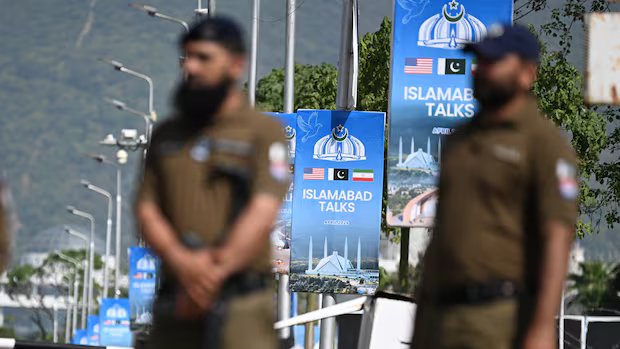
U.S. Vice-President JD Vance, expected to lead American negotiators if talks continue in Pakistan, remained in Washington on Tuesday, a White House official said. And Pakistan, which has been urging both sides to return to Islamabad, said it was still awaiting confirmation on Iran’s participation.
Iranian Foreign Minister Abbas Araghchi said Tuesday the U.S. blockade of Iranian ports was an “act of war” and thus a violation of the ceasefire.
“Iran knows how to neutralize restrictions, how to defend its interests and how to resist bullying,” he said in a post on X.
Blockading Iranian ports is an act of war and thus a violation of the ceasefire.
Striking a commercial vessel and taking its crew hostage is an even greater violation.
Iran knows how to neutralize restrictions, how to defend its interests, and how to resist bullying.
Both sides dug in
Both sides remain dug in rhetorically, and Trump had warned that “lots of bombs” would “start going off” if there was no agreement before the ceasefire deadline, and Iran’s chief negotiator said that Tehran has “new cards on the battlefield” that haven’t yet been revealed.

Asked earlier Tuesday if he would extend the ceasefire if there’s progress in the next round of Iran talks, Trump said, “Well, I don’t want to do that. We don’t have that much time.”
He said Iran “had a choice” and “they have to negotiate,” in an interview with CNBC.
Trump had told Bloomberg News he was ready to resume attacks.
“Well, I expect to be bombing because I think that’s a better attitude to go in with,” Trump said. “But, you know, we’re ready to go. I mean, the military is raring to go.”
Meanwhile, the U.S. said its forces boarded an oil tanker previously sanctioned for smuggling Iranian crude oil in Asia on Tuesday. The Pentagon said in a social media post that U.S. forces boarded the M/T Tifani “without incident.”
The U.S. military did not say where the vessel had been boarded, though ship-tracking data showed the Tifani in the Indian Ocean between Sri Lanka and Indonesia on Tuesday.
The statement added that “international waters are not a refuge for sanctioned vessels.”
The U.S. military on Sunday seized an Iranian cargo vessel, the first interception under blockade of Iranian ports. Iran’s joint military command called the armed boarding an act of piracy and a violation of the ceasefire.
EU officials to meet as jet fuel supplies decline
The U.S. has instituted a blockade of Iranian ports to pressure Tehran into ending its stranglehold on the Strait of Hormuz, a key shipping lane through which 20 per cent of the world’s natural gas and crude oil transits in peacetime.
Iran’s iron grip on the strait has sent oil prices soaring, and Brent crude, the international standard, was trading at close to $95 US per barrel on Tuesday, up more than 30 per cent from Feb. 28, the day that Israel and the U.S. attacked Iran to start the war.
Before the war began, the Strait of Hormuz had been fully open to international shipping, and Trump has demanded that vessels again be allowed to transit unimpeded through the waterway.
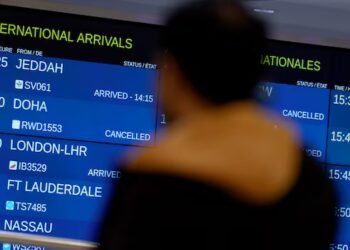
European Union transportation ministers were meeting in Brussels on Tuesday to discuss how to protect consumers after the head of the International Energy Agency warned that Europe has “maybe six weeks” of jet fuel supplies remaining.

U.S. negotiators, along with Vice-President JD Vance, are heading to Pakistan to engage in ceasefire negotiations with Iran. Bloomberg White House correspondent Jeff Mason spoke with President Donald Trump earlier today about his plans for the negotiations.
Iran’s chief negotiator accused the U.S. on Tuesday of wanting Iran to surrender and said that on the contrary, Iran has been preparing “to reveal new cards on the battlefield.”
“We do not accept negotiations under the shadow of threats,” Ghalibaf wrote in a post on X.
Israel-Lebanon talks also set to resume
Meanwhile, historic diplomatic talks between Israel and Lebanon were set to resume on Thursday in Washington, an Israeli, a Lebanese and a U.S. official said. All three spoke on condition of anonymity to discuss the behind-the-scenes negotiations.
The Israeli and Lebanese ambassadors met last week for the first direct diplomatic talks in decades. Israel says the talks are aimed at disarming Hezbollah and reaching a peace agreement with Lebanon.

A 10-day ceasefire began on Friday in Lebanon, where fighting between Israel and Iranian-backed Hezbollah militants broke out two days after the U.S. and Israel launched joint strikes on Iran to start the war. Fighting in Lebanon has killed more than 2,290 people.
Since the war started, at least 3,375 people have been killed in Iran, according to authorities. Additionally, 23 people have died in Israel and more than a dozen in Gulf Arab states. Fifteen Israeli soldiers in Lebanon and 13 U.S. service members throughout the region have been killed.