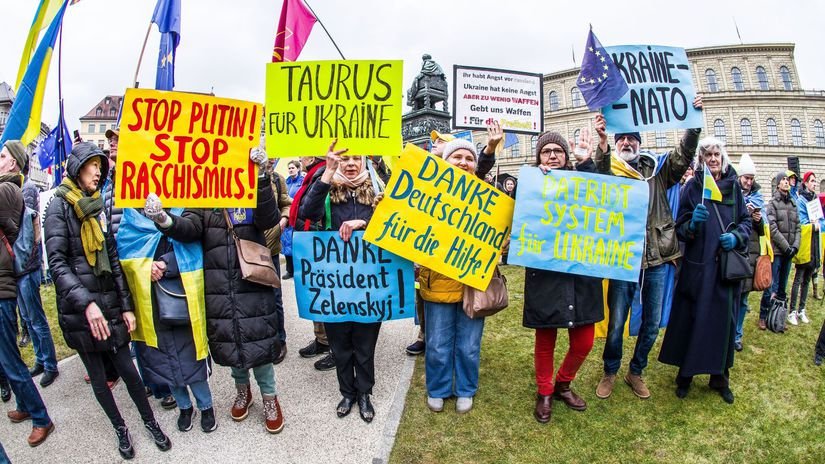
Able-bodied men from Ukraine should no longer receive temporary protection status in the European Union. Thanks to it, they do not have to go through the asylum process like other refugees, but they immediately gain the right to legal residence or access to the labor market. The German Minister of the Interior, Alexander Dobrindt, proposed that this privilege be taken away from them. More Ukrainian men than women are already coming to Germany, while Kiev is suffering from a lack of soldiers.
As reported by the German daily Welt, Dobrindt made this request last week at an informal meeting of the interior ministers of the EU member states in Luxembourg.
“I am firmly convinced that we can reach an agreement that will go in this direction, even if we have not yet discussed the details,” he told reporters after the meeting.
For the time being, it is valid in EU countries that refugees from Ukraine do not have to apply for asylum, like, for example, migrants from Africa. They have the right to the so-called temporary protection (temporary refuge), which they extended until March 4, 2027.
They are therefore not subject to the restrictions that asylum seekers face. They can move freely, they are entitled to health care, education and social assistance, but especially legal residence, and they can look for employment.
There are more young men
The problem is that, after the start of the large-scale Russian invasion in February 2022, mainly Ukrainian women with children fled across the border, now men have the upper hand. This is confirmed by data recently published by the Federal Office for Migration and Refugees (BAMF) in Nuremberg.
At the end of May of this year, almost 1.35 million Ukrainians who fled there before the war were registered in Germany. More than 355,000 of them were men aged 18 to 63 and about half a million women of the same age.

As recently as March 2025, they registered “only” 1.25 million Ukrainian refugees, of which approximately 297,000 were men of the mentioned age. The number of Ukrainians able to fight increased significantly during the year.
According to BAMF data, almost 100,000 people from Ukraine came to Germany in the last 16 months, of which almost 60 percent were men capable of fighting.
The analysis of the Federal Employment Agency, which focused on the age group of 15 to 64 years, reached a similar result. The share of men in it is about 41 percent – as recently as May 2022, they were only 26 percent.
 Read more Find a job or fight, Scholz told the Ukrainian refugees
The reason why more men than women are now arriving is the relaxation of the ban on traveling abroad, which Kyiv approved last August.
Until then, it was difficult for Ukrainian men between the ages of 18 and 60 to go abroad, because the state was concerned that they would avoid military service (conscription applies to men from the age of 25). After a recent change in the rules, even 18- to 22-year-old Ukrainians can leave the country.
A burden on the social system?
The German government of Friedrich Merz decided to limit the influx of these refugees. “Fighting young men from Ukraine do not belong in the German social system,” Welt quoted Alexander Throm, spokesman for the Christian Democratic Union (CDU) parliamentary faction in the Bundestag.
 Read more We will not feed deserters. The Germans want to cut social benefits for Ukrainian men
He pointed out that some EU countries, such as Poland, have already tightened up the receipt of social benefits for Ukrainians. In January, Dobrindt told the Deutsche Welle station that Kyiv must ensure that young Ukrainians cannot travel to the EU.
At the end of last year, Berlin also came up with a reform – Ukrainians who entered Germany after April 2025 will now be treated like other asylum seekers. In practice, this means that they will also receive lower social support. However, it still has to be approved by the Bundestag.
Some politicians are convinced that Ukrainian refugees are a burden on the social system, because many of them – especially women – do not have permanent jobs. Statistics from the Federal Labor Agency show that only 321,000 Ukrainians had permanent employment (with paid contributions) in January.
Experts also explain this by the fact that the German bureaucracy makes it difficult for them to apply on the labor market, and young mothers do not have options where they can leave their children.

“Whoever studies and works here today can help rebuild Ukraine tomorrow. That’s why it is also in our European interest to give these people a chance,” Robin Wagener from the opposition Green Party emphasized to Welt.
The government’s effort to limit protection for Ukrainian men is also rejected by the opposition party Left. “Estimates speak of hundreds of thousands of soldiers killed on both sides. I have sympathy for anyone who avoids the bloodshed by running away,” MP Clara Bünger told the Welt am Sonntag newspaper.
Support within the EU
Berlin is also trying to enforce a change in attitude towards Ukrainian men at the European level. As reported by the DPA agency, two proposals were on the table at the mentioned meeting of the ministers of the interior.
One related to the extension of temporary protection for all Ukrainian refugees for another year, the other was accommodating Germany. According to him, Ukrainians between the ages of 23 and 60 would be exempt from this protection.
 Read more Social benefits instead of work. Ukrainians in Germany cannot find employment
This would mean that they would have to apply for asylum in EU member countries and their chances of getting a residence permit would be significantly reduced. However, the new rules would probably only apply to Ukrainians who would enter the territory of the Union after their introduction.
Dobrindt is convinced that most of his colleagues support the plan. The European Commission is now on the move, which should decide on the proposal by the end of June.
Eurocommissioner Magnus Brunner, responsible for migration, is open to the idea and assumes that an agreement will be reached. “We have to listen well, especially to the member states that are most affected by this,” he commented on the situation.
According to the EU, 4.33 million refugees from Ukraine are currently using temporary protection on its territory. Most of them, up to 29 percent, found refuge in Germany, about 22 percent in Poland and nine percent in the Czech Republic.
As for Slovakia, the Ministry of the Interior reported in February that since the beginning of the Russian aggression, almost 181,000 emigrants from Ukraine have applied for temporary refuge here, while over 34,000 have already lost their status.