Messi leaves; He leaves and, for years, he will be the mirror of every novelty: well, this could be the new Messi. But very soon he will stop being who he always was. Very soon—a few months, a year—the media will no longer talk about him every day, the millions of us will no longer talk about him every day: something important will have to happen to him—going to the beach with his children, having dinner with his wife—for us to name him. It will be a brutal change: his life was that we look at him and comment on him, that we envy him and venerate him for more than 20 years, when he was 16 or 17. It is going to be strange for him to live a little far from us; It will be strange for us to live almost without him. Weird, and we’ll get used to it. We will miss him when things go wrong. We will watch his goals on YouTube less and less. We will forget it.
But that is still missing; Meanwhile, in these weeks of the World Cup he will be more present than ever. Everything he does will be media bubblegum. For example, a button: Messi went with his Miami team, champion of the USAto see President Trump in the middle of attacking Iran. In Argentina some vehemently reproached him for this; Others shouted at them that he was Messi and could do whatever they wanted. Argentina is so capricious that, with its classic ability to crack, it has managed to get Kirchnerism to vindicate Maradona, Mileism to Messi. Barricades were set up: Maradona was the diabolical god while Messi was the representation of the almost Christian, good Argentine family order.
To believe it you have to forget that Lionel Messi is a sad product of today’s Argentina. He is, in any case, a boy who had to leave his country at the age of 12 to follow the treatment he needed to grow those centimeters he needed to grow in the world of football. Argentina could not or did not want to give it to him and he became like that, distant, a foreigner of all foreignness: he did not live in his place but he continued talking as if he lived, he built a kind of Rosario neighborhood in his head and in that neighborhood he has settled since then. He is the typical migrant of these times, the one who leaves and stays.

01:13
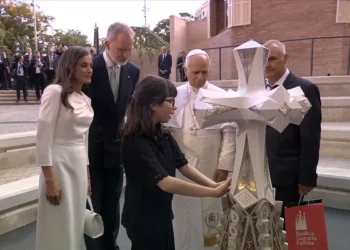
Leo Messi, Princess of Asturias Sports Award 2026
And it is also the most famous of these times. In a world that attacks migrants, he and his fellow winners are migrants—because they left. In rich countries, others are rich because they came. We are fools: the most xenophobic patriots shout the goals of gentlemen that their shouts try to deport—mass sport. Migrants are the core of this great cutting-edge business called football; The concentration of football wealth in three or four leagues is another form of global inequality. The vast majority of its stars do not play in their countries, but a Mbappé in Spain or a Rodri in England than the South American legion that is inevitably sold to European clubs because their own cannot pay for vaccines or Lamborghinis.
***
Messi was one of them and he stood out very soon. Sometime someone will be able to explain why, in a global activity, kids from two or three countries are better than almost everyone else. He started out as a small child and became very big: football is a sport where the good ones debut at 20 or 21 and the extraordinary ones at 17 or 18. At 17, Messi was already making rivers of pixels flow. They loved him more in Barcelona than in Rosario: in those days, when he played with his national team, the Argentines booed him for not singing the anthem, for not simulating the unnecessary.
And then, immediately, the ghost attacked: a man Diego Armando. Maradona, the D10S, had a great advantage in his career: he was the first and he believed he was the only one. Messi, on the other hand, was from the beginning the successor and the adversary and the disciple and the dethroner of Maradona: the comparisons never went silent.
They are both the same and so different. On the court the two are absolutely unique, better. Maradona was the drama: everything he did seemed impossible, he always walked on the edge of the abyss and then, when he didn’t fall, it was very clear that he was making art. Messi, on the other hand, is efficiency: he makes the impossible seem too easy, as if it had no merit, and then everyone says oh sure, my old lady could do this in high heels—until they understand that it really was impossible. But the most curious thing is that, off the field, Maradona was the drama: everything he did seemed tremendous, still on the brink of the abyss. And Messi, on the other hand, efficiency: the sensible father of the family, the safe investor, the boy who has never broken a plate or said a word louder than the other or thought anything relevant – or who, at least, wants us to believe it: there are those who say that his way of exercising his power is more subtle, more sibylline.
(So the other one looked dramatic; he seemed efficient. The word efficient is deplorable, it sounds like a sad routine, but it applies; the question is what to call efficiency when someone is efficient to do things that no one else could. In general it doesn’t have a name—unless it’s Messi.)
And there was a climactic moment: when both of them had to share the stage. In the 2010 World Cup in South Africa, Maradona led the Argentine team led by Messi. The paradox was guaranga: Maradona had to get Messi to get the only thing he needed to dethrone him, a World Cup. He didn’t do it: they both failed – or perhaps Maradona preferred that ending of Samson in the temple.

Messi continued on, to confirm that he was – and became more and more – an incomparable player. Short, with short, very robust legs, he was faster than anyone over short distances. And, even at that speed, he carried the ball as if it were part of his body, on impossible routes. He handled his right foot well but was clearly left-handed: with that extreme limb he made the ball do whatever he wanted. Messi did at high speed what the vast majority cannot stop and, above all, he had a privilege that only the greatest: that second more than others to do everything before. And he scored goals and more goals: no top-level player maintained his average of 0.79 goals per game over more than 20 years. Of course, he made it look easy: what anyone could do, if only no one did it. Il miglior fabbroTS Eliot said about Ezra Pound, a tremendous poet: the best craftsman, an authentic artist.
His former teammate and great rival, the Frenchman Mbappé, commented a few days ago that one morning, in training, he was competing in shots from the same point with Neymar and several others from PSG, and that he and the Brazilian were the best: that they scored six or seven goals out of nine shots. “And then Messi arrived and scored the same goal nine times, it seemed like he was giving a pass to the goal, one after the other, all the same. We couldn’t believe it, it’s something else,” said one of the best right now.
***
The injuries affected him and he lost more opportunities with his national team but he continued to win Spanish leagues and money and fame and those things that these guys earn. A few years ago, when I used to walk around Africa, I came to the conclusion – always provisional – that one in every 20 boys under 15 years old wore the Barça shirt with Messi’s 10 – in Vietnamese copies. Africa has about 300 million children under 15 years of age: if my count was correct there were, at any given time, 20 million children. From Jesus or Muhammad on down it is difficult to think of something similar.
Surely Messi doesn’t know it, but he knows the privileges that this assures him. He lives them, he enjoys them, and his defenders live and suffer them: millions of people who tell you that how dare you talk about him, you filthy worm, you gave me nothing and instead he gave me more happiness than anyone else – as if the idol played for that and not to change class, life, place in the world: as if the idol were not an intractable negotiator of himself but a generosity that spreads, someone who does it for others.
In any case, his peerless career was ending and ending, in some way, badly: he had won everything except what Maradona did, that Pelé did, which would make the difference: a World Cup. He had already left Barcelona in a sort of tantrum. It didn’t make sense that the separation between the breeder and the child was about money. It was enough for Messi to make a symbolic contract for one euro a year and proclaim that he was still in that club that was his home, loyalty and recognition, and that painfully rare gesture of loyalty would have brought him millions and millions from the brands that would have wanted to stick to the hero. But he didn’t want to or didn’t know how and went to Paris and Miami, two different moments in the history of the West.
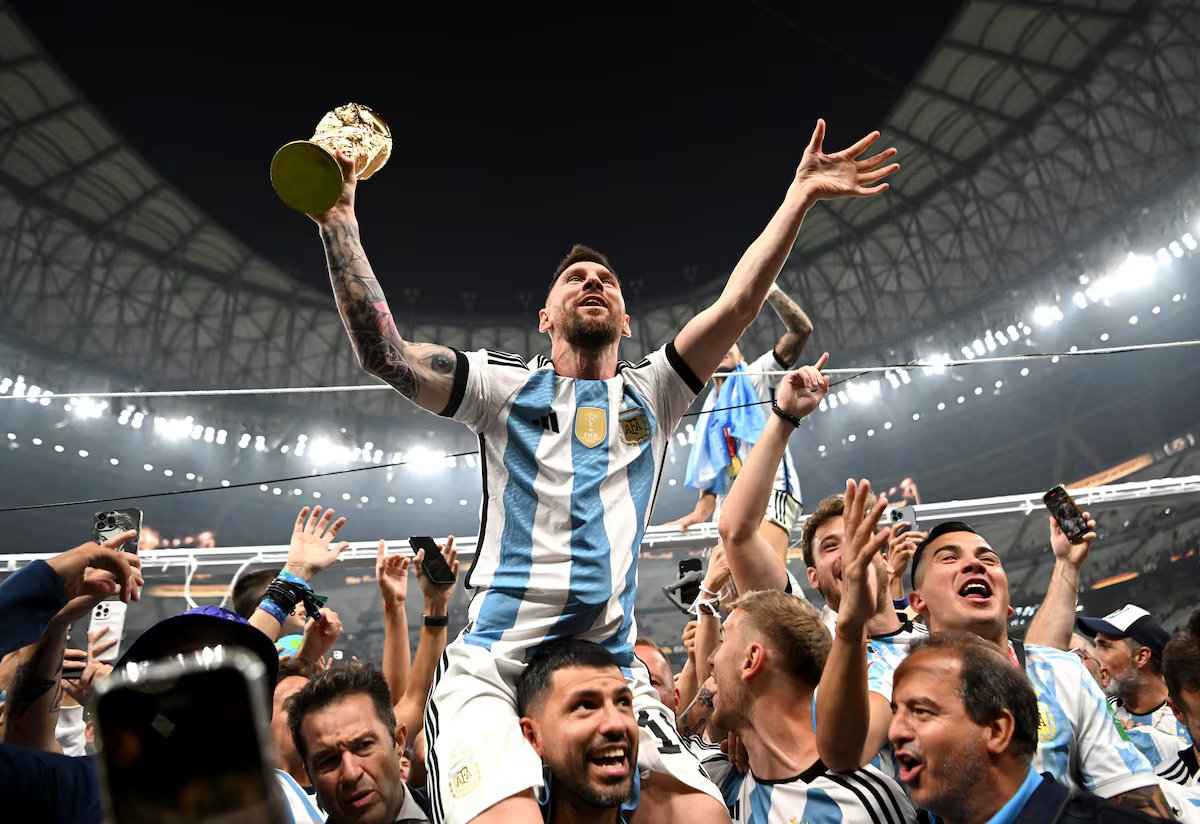
That he was kind to him: he gave him one more chance. For the World Cup in Qatar they put together a team tailored to him, conspired so that the big winner would not end up losing. It was his last chance and it was his peak. He won it, despite all his efforts, despite all his merits, because his team’s goalkeeper stretched his left leg well at the decisive moment and a substitute marker from his team kicked a penalty with his right foot right after, at the even most decisive moment. That’s how strange things in life are: if the young Montiel had hit that ball a hair higher, if he had not converted it, Messi’s life would have been, paradoxically, a great failure: yes, of course, he was good, very good, but he was never world champion.
It was then, he got it off his chest. It must be very strange on the night of a day when you have just crowned your life, of achieving what you had always wanted, of confirming that, no matter what happens, you will be for many a form of hero – and especially for you, which is ultimately what matters.
He got it, he’s calm now. Now he is going to try it again but, as my grandmother Sagrario said, it is already a pain in the ass. Certain phrases changed: Argentine players no longer announce that they are going to win the World Cup; We are going to defend it, they say.
And they will do it, they say, with Messi, by Messi, for Messi. Defense was never his thing, but anything is still possible. And then it will end. For a time his life is going to be a catastrophe. That which was a satisfaction on the margins, the famous rest of the warrior, will become its center: days and days with his wife, with his children, so far from the shouts and adorations. It must be strange to have to invent yourself at 40; It must be strange not to have to invent oneself, to know that one has already been; It must be strange to know that one has already been: that, whatever one does, nothing will measure up. It must be strange but I suspect that on Earth there are about 8.4 billion worse options.
Be Messi. What will it be like to be Messi?

World Cup 2026 Special
This report is part of the monographic issue of ‘El País Semanal’ of June 7 dedicated to the Soccer World Cup.