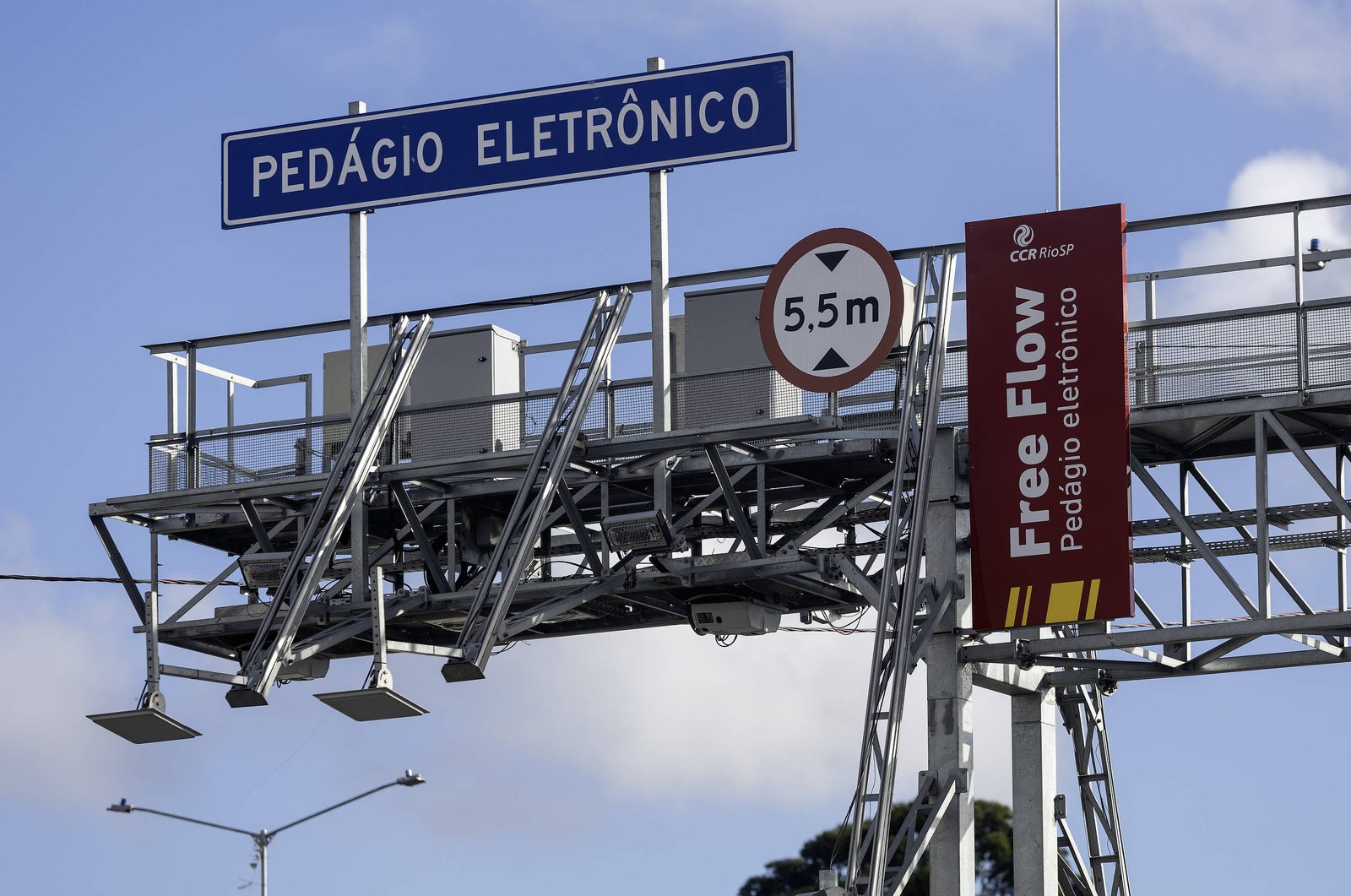
The delay in creating an integrated billing system for the toll highways, a technology known as “free flow”, led the federal government to suspend fines which had not yet been paid by drivers who crossed these portals installed on highways across the country.
Now, the Lula (PT) administration is trying to define how the money will be returned to the thousands of citizens who paid their fines for late payment of these tolls.
THE Sheet had access to information compiled by ANTT (National Land Transport Agency) regarding the collection of fines for delays in paying these tolls from August 2023 to February 2026.
Under the current rule, a driver who passes through a state or federal highway with a free flow toll has up to 30 days to make payment, as defined by each concessionaire. If payment is not made, he is fined.
The total value in the period, according to official data from the agency, amounts to R$93 million. This figure includes both money raised directly by ANTT and by state traffic departments, considering only federal concessions.
In total, the agency points out that 476,000 fines were paid by drivers across the country who crossed the granted federal highways.
The problem, however, is that there is still no clarity on how this money will be returned. The matter has already been taken to the National Treasury Secretariat by ANTT. There are doubts about possible budget limits, rule restrictions or procedures that have to be adopted to operationalize the return. The Ministry of Transport has already signaled that it will pay for the return.
As if the federal complexity were not enough, there are doubts about how the issue will be handled with the states and regional concessions.
In recent days, the subject has taken up a large part of the Transport summit’s agenda, which intends to soon reveal what, after all, will be the fines refund process and the new schedule for the integration of concessionaires’ billing systems.
In addition to returning the money to those who have already paid for the fines and suspending those that are still open, the government needs to make it possible to cancel the points applied to each driver’s CNH (National Driving License). Some of these people may even have lost their license, for example, with the addition of points they already had. This is yet another question that is still open.
Asked about the matter, the Ministry of Transport said that it is still reconciling ANTT data with internal information from the department, which includes checking fines collected by Detrans in the states.
“The Ministry of Transport will assume the amounts that will be reimbursed” said the ministry. Regarding the return process, the note states that “there will be wide dissemination of information to open an administrative procedure with the regulatory agency, which will proceed with the reimbursement.”
ANTT, when questioned about the data it itself measured, simply stated that it “follows, within the scope of the Ministry of Transport, discussions related to the improvement of the free flow electronic toll system, with the aim of guaranteeing safety and user experience”.
Ministry data shows that more than 3.5 million fines have been applied for late payment of electronic tolls to date, including federal and state fines. Rio Grande do Sul, São Paulo and Minas Gerais are among the states that imposed the most fines.
With failures in the integration of each dealership’s charging systems, basic issues have not been resolved to this day, such as offering drivers a single access channel to check which tolls they ultimately need to pay.
In practice, many drivers are unable to identify which dealerships they have visited, how much they owe or how to make payment on time. This led to the automatic imposition of thousands of fines.
ANTT data shows that only a third of the fines were actually paid.
The Ministry of Transport’s plan foresees that the Brazilian CNH application, which currently gathers information about the driver, the vehicle and traffic violations, will also have a channel just for tolls, where the user will be able to access all the charges they have received and make their payment.
Until last month, the government had decided that the suspension of penalties would be valid until December 30, 2026, but this period is under review and could be shortened.
The plan provides that the late toll will continue to be charged to the driver who is in debt, but whoever pays the amount within the established period, regardless of when they were fined, will be free of the R$195.23 fine and the five points on their driver’s license.
If the toll is not paid within the period that will be reset, the fine would be charged again, in addition to the return of the application of the five points on the driver’s license.
In June last year, Senatran (National Traffic Secretariat) published a technical regulation with a period of six months to complete the approval of the concessionaires’ systems on its internal basis. In December, the deadline ended, without any system having been approved, due to the lack of integration between them.
The road sector fears that the federal government’s decision to suspend fines and points on the driver’s license for drivers who did not pay free flow fees could set a bad precedent and discredit a model that has already been the target of political pressures across the country.
Although the proposal was designed with the participation of concessionaires —who publicly defend the validity of the measure—, behind the scenes the assessment is that the sector ended up entering a dilemma.
As the suspension of the fine only applies to those who pay the electronic toll in arrears, road operators see this measure as a way to recover the fees owed and a solution to the scenario of wear and tear among some users. At the same time, they also assess that the decision could create a precedent of impunity capable of compromising the sustainability of the system in the future.