Rare is the day when the residents of Washington do not wake up with a new shock courtesy of the tenant of the White House. And it is not, although also, because of the war in Iran, because of his use of the press to intoxicate public opinion or because of his insulting messages in Truth, but for the reforms that the president of the United States Unidos is undertaking unilateral action in the capital, in the manner of a mayor with unlimited budget and power, of a Roman emperor or a king, like Charles III, with a fixation on one city, Madrid.
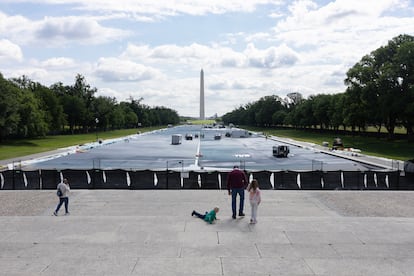
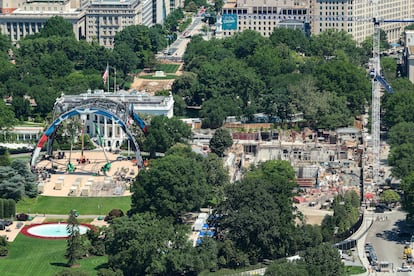
The surprise on Monday was an ephemeral structure visible from the roof of one of the hotels around the White House: a 30-meter arch on its south face, where a mixed martial arts combat is scheduled to be held on June 14, Donald Trump’s 80th birthday. Last week was the return of water to sources that had been dry for years. And before that, the closing of the pond in front of the Lincoln Memorial to paint it of a pool blue; the gold trim everywhere in the White House; the demolition of its east wing to build a gigantic ballroom; or the project to erect an imperial triumphal arch to commemorate the 250th anniversary of the Independence of the United States.
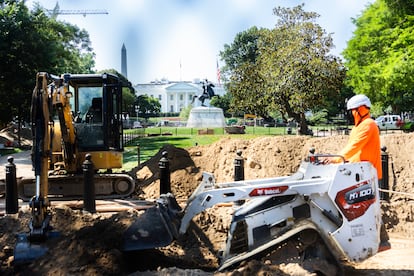
As a result of the passion for the pickaxe of a politician with the heart of a builder, ditches and cranes, closed parks and fenced squares are piling up on the streets of Washington, while the courts They are filled with demands to try to stop or, at least, slow down some of these works. It is all part of a plan to “beautify the nation’s capital,” but above all it responds to an anomaly: the administrative regime of limited autonomy of the District of Columbia (DC).
Its management depended on the House of Representatives until 1973, when the Home Rule Act, a law that is the result of years of struggle for a bit of self-determination. Since then, the city has had councilors and a mayorMuriel Bowser, who will retire in January after 12 years in the position and a final stretch with Trump in front of her, against whom she has been able to do very little. Washington’s budget depends on the Capitol, its neighbors retain some control over the police and have two senators and a “shadow” congressman. Like those of Puerto Rico, they are in the Capitol to advocate for the interests of DC, but, above all, to ensure that the district is recognized as State number 51. That is to say: they have a voice, but they lack a vote.
Almost unlimited power
That regime largely explains the abuses of Trump, who has almost unlimited power over federally owned land, the part in which he is fundamentally getting his hands on DC. In the rest of that square bitten by the Potomac River, is where the neighbors live; about 700,000 within a metropolitan area with six million inhabitants that includes parts of Virginia and Maryland. Trump was greeted with hostility during his first presidency; They opted in 2024 for their rival, Kamala Harris, with more than 90% of the votes and now they suffer the consequences.
“The attitude of the presidents towards the capital has been respectful, despite the tensions. Trump has taken those tensions to an obscene level,” warns Paul Strauss, senator from DC since 1997, in a videoconference conversation, a position for which the Government does not remunerate. “No one had disrespected the White House building in that way. He wants to turn the Lincoln Pond, which was designed with a dark bottom precisely to reflect the monument, into a resort pool, and dreams of an arch with an authoritarian style as if the Germans had won World War II,” adds the politician.
Strauss – who is running for re-election in November, because, he says, “it would not be good to give up now that there is so much at stake” – recalls that the damage to the city goes, however, “beyond the physical.” “It is also economical, and it started (last year) with the massive layoffs of officials,” he says.
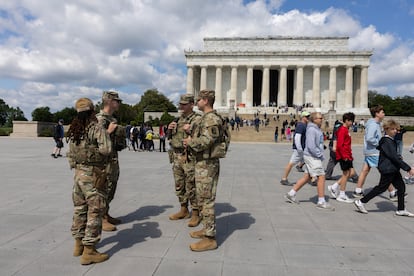
Then came an executive order to make Washington “safe, beautiful and prosperous.” The first part resulted in a deployment of hundreds of national guard agents in August, for which crime problems were alleged that the statistics did not take into account.
They are still there nine months later. It is common to see them on corners, in groups of four, with nothing much to do, except allow themselves to be photographed by tourists and put on a brave face when an angry neighbor yells at them to leave. They are also in charge of protecting the actions of Trump’s immigration police (ICE is its fearsome acronym in English), while the migrant population lives in fear of deportation in a militarized city.
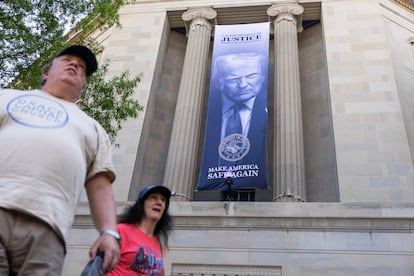
With a determination that presidential historian Russell Riley confirms is “unprecedented,” Trump is leaving his mark on the city also by putting his name on everything — from the Kennedy Center (in a decision that a judge overturned on Friday) to the Institute for Peace. Without waiting for the verdict of posterity, the Treasury Department He wants to put his face on a new $250 bill, and the president has adorned emblematic buildings of the Administration with his supernatural-sized portrait and imagery more typical of Pyongyang or Damascus than Washington.
Nowhere does the vision of his image invite metaphor about his autocratic tendencies more than the facade of the Department of Justice, which Trump has turned into an instrument of revenge against those he perceives as his enemies. The last on the list was, this week, the columnist E. Jean Carroll, who won a lawsuit civil for defamation after accusing him of a sexual assault in the 1980s in New York.
The president of the United States has also used that department to create a fund of 1,776 million dollars with which to compensate those who he considers were “politically persecuted” by his predecessor, Joe Biden. And that could include the participants in the assault on the Capitol, whom he already pardoned on his first day back in the Oval Office.
The announcement of the fund came after Trump withdrew a 10 billion lawsuit against the Treasury for revealing information about his income in a leak to the press. It was a surreal judicial adventure: the president demanded damages from the United States, so the lawyers on both sides were at his command.
On Friday, two different judges weighed in on a matter that has generated criticism even among Republicans. First, the creation of the fund was temporarily suspended. A few hours later, a Florida magistrate reopened the case of Trump’s complaint to the Treasury, considering that the agreement through which he withdrew his lawsuit, which includes tax benefits for him and his family, raises suspicions of “manipulation of the judicial system.”
Because of these manipulations and because of the information that speaks of inflated and hand-granted contracts and of personal enrichment and irregular financing in his works in Washington, the cover of the Sunday opinion supplement of The New York Times carried a doctored image in which an operator sweeps up a symbolic handful of red, white and blue shavings, colors of the flag, under block letters that say “Department of Corruption (founded on May 18, 2026).”
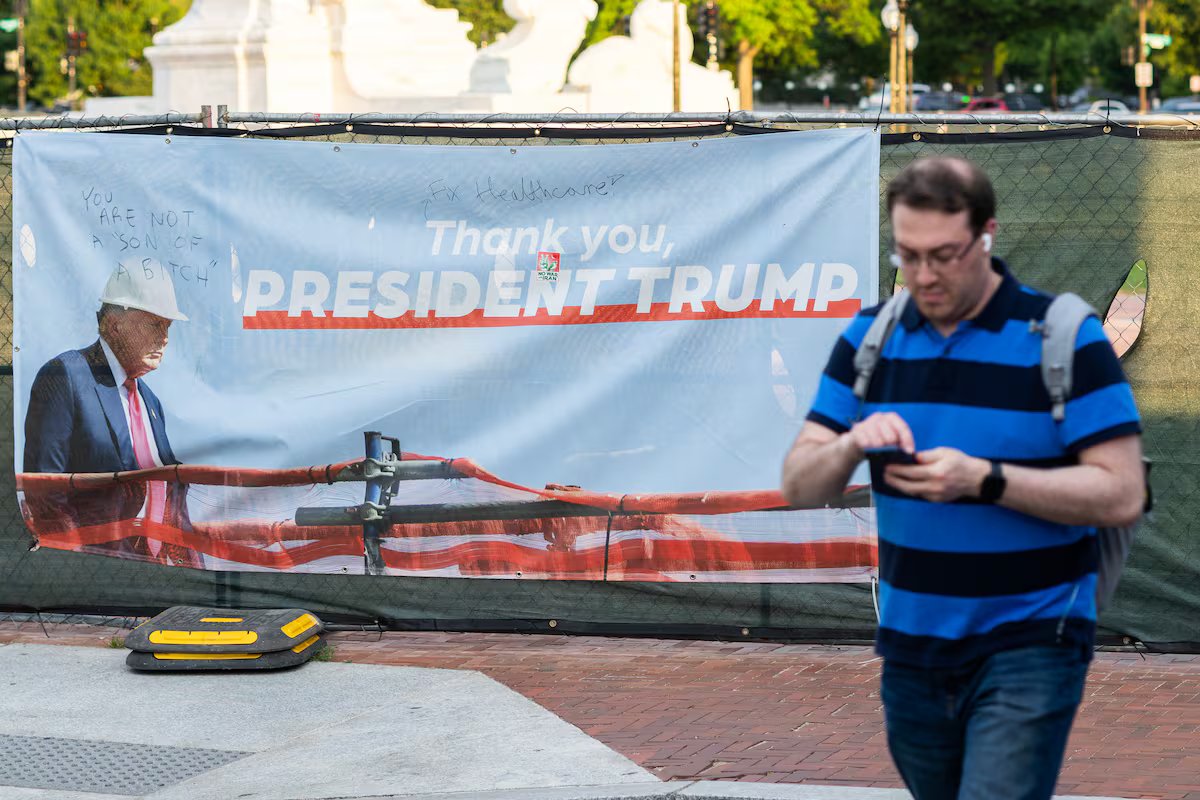
A reduced version of the president’s face has also appeared on billboards that cover works in public spaces. They bear the signature of National Parks, the agency that manages these federally owned lands, and in them you can see the tenant of the White House wearing a construction helmet and a phrase that says “Thank you, PRESIDENT TRUMP.” It seems like a supreme act of egomania: it is not unusual for politicians to demand recognition, but thanking themselves is something else.
There are residents of Washington who also appreciate some of these reforms. For example, the one that has returned water to the Meridian Hill park pond, that Juan Ramón Jiménez used to frequent when he lived in the city, or to the fountains in the roundabout of the Christopher Columbus statue in front of the train station. They had been out of action for almost two decades, until this week the Secretary of Transportation presented the restoration of the complex, vandalized several times in left-wing protests. Duffy also promised a $465 million investment to renovate the Amtrak terminal, where trains leave for New York.
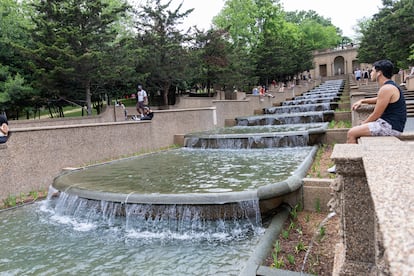
“I am the most critical of Trump, but I appreciate that he is making these improvements in the city, forgotten by politicians for too long. The capital of the United States did not deserve that neglect,” explained Lilliana Novack, a young resident of Washington, last week while walking through Meridian Hill Park. Senator Strauss recalls that the operation of these sources was never a matter of local authorities, but of the federal government and, therefore, of Trump while he was president for the first time (2017-2021).
Rush to reach the anniversary
Other tweaks, accelerated to arrive in time for the 250th anniversary party, have met with opposition from heritage conservation activists, veterans who have sued Trump for the construction of his triumphal arch, which they denounce as a “vanity project” that does not respect the memory of the fallen, and from some judges. The most persistent is the one who ordered stop the construction of the ballroom that the president wants to build where the east wing of the White House was, which he demolished without asking permission. Despite this court order, the president proudly showed the press last week that these works are underway.
Mary Graw, a law professor at Catholic University in Washington, distinguishes in a telephone interview two types of legal questions raised by Trump’s actions. The first questions the limits of federal power over Washington. The second, about whether the president is authorized to invade the sphere of competence of other parts of the Government, a question to which this president has been answering for 16 months with a Yeah resounding. “There is a saying in this country: shoot first, ask questions later. That’s what Trump is doing in many cases,” warns Graw. “It works especially well when it comes to physical structures. Once they are destroyed, there is little that can be done.”
In addition to these delaying maneuvers in the courts, there have also been attempts at resistance in the streets, from organizations such as Free DC or the Save America Movement, which covers the city with posters that mock members of the Government.
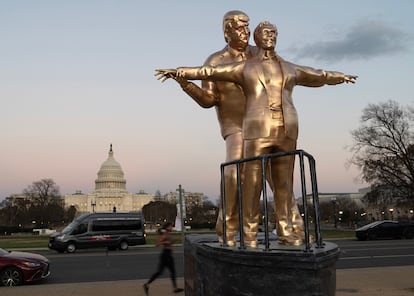
The most imaginative of these groups is called Secret Handshakeand is an anonymous artistic group that places ephemeral satirical statues on the Mall. One of them represented Trump and his former friend, the millionaire pedophile Jeffrey Epstein, in a pose in homage to the famous love scene on the bow of Titanic. Another, titled A throne fit for a king, It was a gold toilet in a marble-lined bathroom.
Marble is one of the favorite materials of its current tenant when he undertakes renovations in the White House.