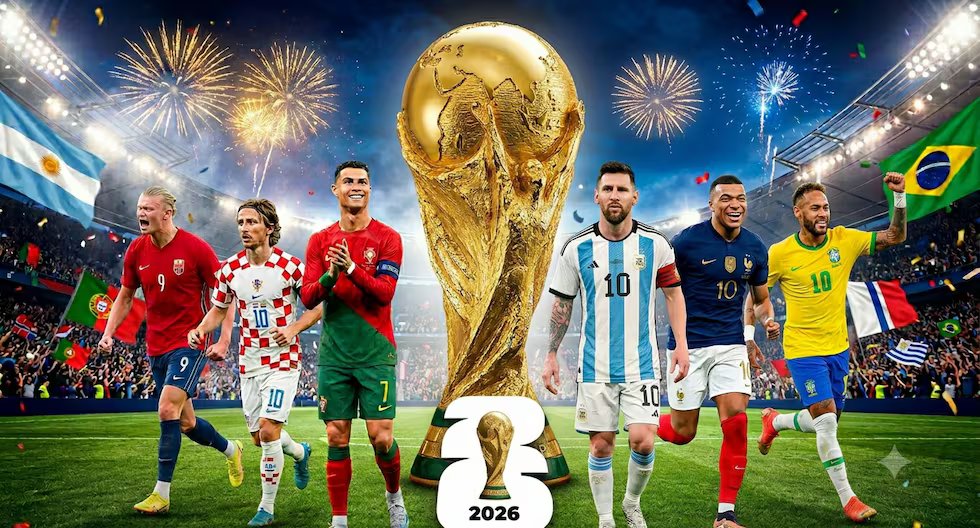
FIFA projects an audience of more than 5 billion people and will distribute more than US$655 million in prizes among participating teams. However, the real business is played off the court.
The most intense competition will not necessarily be for the trophy, but for capturing the attention of consumers in an environment where television shares the spotlight with TikTok, Instagram, YouTube and streaming platforms.

Lego
“The World Cup is one of the last mass attention phenomena left on the planet today. Social networks fragmented audiences, but it remains one of the few moments where billions of people consume the same content at the same time“said Eduardo Flores, director of the Sport Marketing agency Toque Fino and vice president of the Peruvian Sports Marketing Association (APEMD).
FIFA estimates that during a World Cup up to 5 billion people can be reached and billions of digital interactions generated. In Qatar 2022 alone, the organization’s official platforms recorded a growth of close to 500% in interactions, while the cumulative reach of the tournament reached 262 billion views on social networks.
For Nathaly Montoya, director of the Sports Business and Administration degree at the UPC, the combination between the new format and the North American headquarters marks a turning point for the industry.
“This is, with data in hand, the most commercial edition in history. The tournament is expanded to 48 teams, 104 matches and 16 host cities. “More matches mean more advertising inventory, more activations and more exposure windows for brands.”he explained.

Lego
The specialist added that The United States, Mexico and Canada bring together three of the most developed advertising markets in the worldwhich has driven interest from global sponsors even before the start of the championship.
The sponsorship model is also changing. If a decade ago many companies participated mainly for brand exposure, today the pressure to demonstrate return is much greater.
“Before, brand awareness was prioritized. Now advertisers demand specific metrics for conversion, sales and generation of new customers. Sponsorship stopped being an image expense and became a business investment,” said Flores.
Montoya agreed and added that “brands no longer invest for simple visibility, but for measurable return. The World Cup provides an emotional context of identity and passion that multiplies that value.”
In countries like Argentina, where the Argentine Football Association (AFA) maintains agreements with companies such as Coca-Cola, YPF, McDonald’s and Sancor Seguros, commercial income linked to the national team would exceed US$80 million annually, according to market estimates cited by Valora Analitik.
The rise of social media is also redefining where budgets are spent. “Television continues to be essential to generate reach, but social media is where the conversation happens,” Flores said.
According to the specialist, there is an obvious change since Russia 2018: former footballers have lost prominence to influencers and content creators capable of documenting the World Cup experience in real time.
“Brands want creators who can tell what it was like since they left the airport, which players they met or how they experienced the event.. “It is a great opportunity for influencers,” he stated.
Montoya added that the winning strategy no longer pits television against digital platforms, but rather integrates both worlds. “The World Cup is one of the few events that reactivates television due to its ability to bring together massive live audiences. The most effective formula combines television for reach and digital platforms for conversation,” he said.

The rise of social media is also redefining where budgets are spent.
Footballers are also a fundamental part of this economy. Brands are looking for a combination of sports performance, digital reach and the ability to generate conversation. “Performance builds credibility, while digital reach amplifies the message,” Flores explained.
According to the specialist, between The figures with the greatest commercial appeal towards 2026 include Kylian Mbappé, Jude Bellingham, Lamine Yamal, Vinícius Júnior and Erling Haaland, all with a strong connection with young audiences.
Montoya added that companies continue to value established figures such as Lionel Messi and Neymar, even when their sporting performance is no longer at the peak of their careers.
“Brands no longer buy just performance. They buy digital reach and emotional connection. That’s why “Neymar continues to be one of the most powerful personal brands in football.”he pointed out.
Footballers are also a fundamental part of this economy. Brands are looking for a combination of sports performance, digital reach and the ability to generate conversation. (Photo: Lenovo)
Although Peru will not be present at the tournament, specialists agree that the event will continue to boost local advertising investment. The sectors with the greatest opportunities would be beverages, telecommunications, sports betting, retail, technology and mass consumption.
“Peruvian brands do not need to compete on budget, but on relevance. We have an enormous advantage over global giants: we know the Peruvian consumer better,” Flores said.
For Ximena Vega Amat y León, CEO of Claridad, Creativity will continue to be the main local asset. “Peruvian brands win through context and emotional connection. Creativity continues to be the great equalizer against big budgets,” he said.
The executive considered that, Although the absence of Peru limits commercial enthusiasm regarding Russia 2018, the World Cup will continue to generate opportunities for those companies capable of connecting withon collective emotion.
Although there are weeks until the start of the tournament, Several brands have already begun to compete for their own championship in the advertising field.either. One of the campaigns that has generated the most conversation is Legor, which brought together four of the greatest figures in world football: Lionel Messi, Cristiano Ronaldo, Kylian Mbappé and Vinícius Jr.
According to the Spanish newspaper AS, the commercial, which was launched 70 days before the start of the tournament, quickly became one of the most talked about content of the year. The campaign is part of a collection of figures inspired by iconic football moments and seeks to connect with different generations of fans: Messi and Cristiano represent the legacy, while Mbappé and Vinícius symbolize the present and future of the sport.
For Nathaly Montoya, from the UPC, the success of this campaign lies in the fact that it goes beyond football. “The best executed campaign and the one that sets the trend is that of Lego. What makes it stand out is that it did not sell football, but rather belonging. The final twist shifts the prominence from the stars to the consumer. It concentrated four generations of fans in less than a minute and prolonged the conversation organically on social networks,” he said.
Other brands have also begun to move their chips. Coca-Cola launched “Bubbling Up”, the first of three commercials planned for the World Cup, while its subsidiary in Korea chose V, a member of BTS, as the protagonist of the “Feel It All” campaign, a bet that seeks to connect football with the universe of entertainment and pop culture.
McDonald’s, Budweiser, Lay’s, Stella Artois, Rexona and Bimbo have also activated campaigns with figures such as David Beckham, Erling Haaland, Jürgen Klopp and Rafael Márquez, demonstrating that the battle for consumers’ attention began long before the opening whistle.
Vega Amat y León, from Claridad, considers that the integration of celebrities responds to a natural evolution of the event. “Football is still the heart of the party, but it is a party that is accompanied by music, influencers, food and celebrities.”s. It’s not that football doesn’t reach; “It is so big that it needs to be surrounded by other elements to complete the experience,” he said.
An emblematic case ishe recent Quilmes spot in Argentina, “CoRazones para believing”, which brings together figures such as Manu Ginóbili, Charly García, Ángel Di María and Leandro Paredes to build a story about Argentine identity. The campaign focuses on emotion and national pride more than on the product, a trend that specialists consider increasingly relevant in sports advertising.
If brands compete for attention, the most popular players remain some of the most valuable advertising assets on the planet. And Neymar has just proven it.
After being called up again by Brazil for the 2026 World Cup, the forward generated nearly US$6 million in commercial deals in less than an hour. as reported by Brazilian journalist Jorge Nicola. Brands such as Puma and Red Bull activated campaigns almost immediately after the official call was announced.
The impact was not limited to the commercial level. Neymar also added more than 1.1 million new followers on Instagram in just a few hours, establishing himself as one of the most influential athletes in the world.
For Eduardo Flores, director of Sport Marketing Toque Fino and vice president of the Peruvian Sports Marketing Association (APEMD), this phenomenon reflects how the logic of sports sponsorship has changed. “Brands buy a combination of both: sports performance and digital reach. Performance builds credibility, while digital reach amplifies the message“, held.
Montoya highlighted that the Neymar case shows that the value of a sports figure no longer depends exclusively on what happens on the field. “Brands no longer buy just performance. They buy digital reach and emotional connection. That is why Neymar remains one of the most powerful personal brands in football, even when he is no longer in the best moment of his sporting career,” he explained.
Vega Amat y León also highlights the symbolic weight that certain stars retain. “This is probably the last World Cup for Messi and Neymar. I can’t imagine a World Cup without them. “The impact that Neymar’s call-up had demonstrates the weight he continues to have as a global figure,” he said.
The transformation of the World Cup into a comprehensive entertainment platform also explains why more and more musicians, influencers and celebrities appear in campaigns. “Football continues to be the emotional heart of the campaign; the culture that surrounds it is what multiplies its reach,” summarizes Montoya.
While Flores goes further. “This World Cup will be much more than a soccer tournament. It will be a global platform for business, technology, entertainment and brand building,” he explained.
He also added that in an economy where attention is one of the scarcest resources, the 2026 World Cup appears as the perfect scenario for companies to compete for something more valuable than a drink: the preference of billions of consumers.