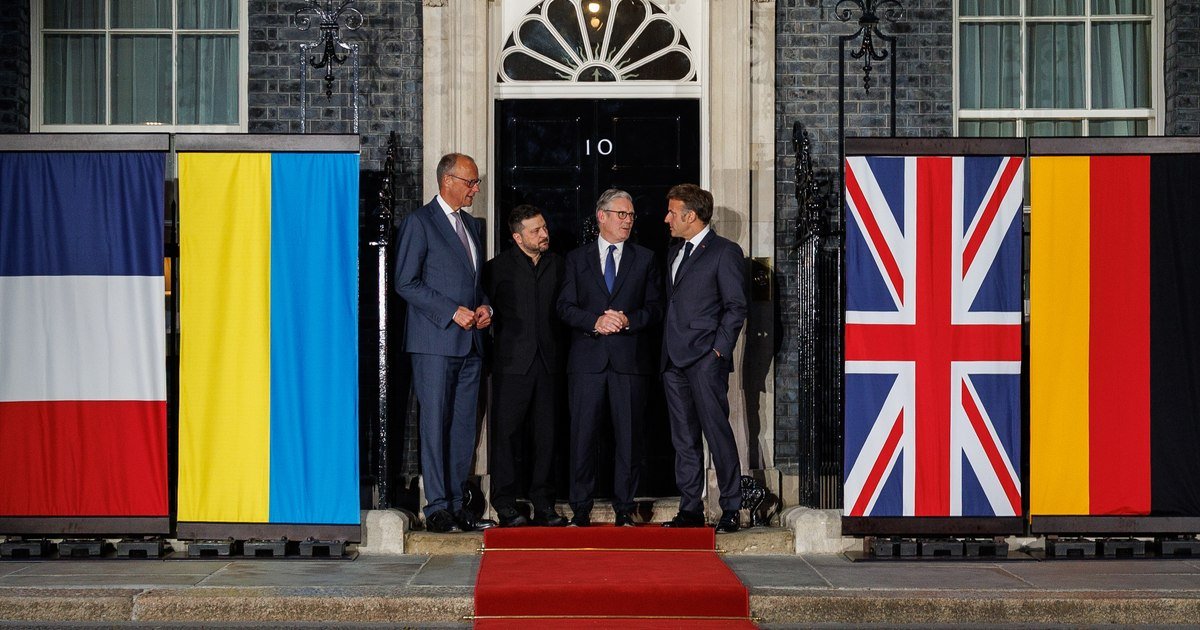
The leaders of Great Britain, France and Germany, together with Ukraine, issued on June 7 a joint statement in which they set five conditions that must be met between Kiev and Moscow in order to reach a solution to the war started by Russia in Ukraine.
Merz, Zelenski, Starmer and Macron PHOTO X / @Keir_Starmer
The statement, which closely aligns with an open letter previously sent by President Volodymyr Zelensky to Russian President Vladimir Putin, was published after Zelenskiy’s visit to London, where he held talks with British Prime Minister Keir Starmer and E3 consultations with the leaders of the United Kingdom, France and Germany.
The joint document “welcome” Ukraine’s recent progress on the battlefield as well “revolutionary use of drone technology”referring in part to Ukraine’s ability to conduct medium-range strikes against Russian logistics behind the front lines, according to Kyiv Independent.
The leaders also discussed how it could be “coordinated as effectively as possible additional support for Ukraine, according to its priority needs”ahead of several international meetings, including the G7 leaders’ summit.
The conditions imposed by Zelensky
The statement lists five conditions “which should be fulfilled for a just and lasting peace”among which is the request that Vladimir Putin accept “an immediate and complete armistice”as well as the start of negotiations “on the current line of contact” — forms that directly reflect Zelensky’s letter.
“Third, Ukraine must be provided with strong and legally binding security guarantees once the ceasefire comes into force”says the joint statement, which also calls for the deployment of a multinational force to monitor and enforce the ceasefire.
The fourth condition calls for reparations for damage caused by Russia during the war, with leaders pledging that Russian assets remain frozen until Moscow ends the conflict and pays reparations.
“Fifth, Europe’s security interests must be protected in any agreement. The elements of any negotiation related to the EU and NATO would require the agreement of the European Union and its member states and NATO allies respectively.”
Image 1/2:
PHOTO X / @ZelenskyyUa
Deadlock in peace negotiations
Despite months of US-brokered peace talks, Vladimir Putin has repeatedly refused to accept a ceasefire in Ukraine. The Russian leader rejected Zelensky’s open letter one day after its publication.
Before the talks, Zelensky stated that “Europe should be included in the negotiations and should be strong”. The president is also scheduled to meet King Charles III of the United Kingdom on June 8.
The open letter stated that Russia and Ukraine should begin direct negotiations, but noted that “other specific participants may be included in this bilateral format already initiated between us”.
While American involvement in the peace process has stagnated amid the war with Iran, Zelenski has sought to revitalize diplomatic negotiations by making direct appeals to Russia and creating more space for European involvement.
The Kremlin has recently signaled openness to a European role in diplomacy, but proposed the appointment of Gerhard Schröder as a possible mediator. Kiev and European officials rejected the idea in May, citing Schröder’s long ties to Vladimir Putin and Russia.