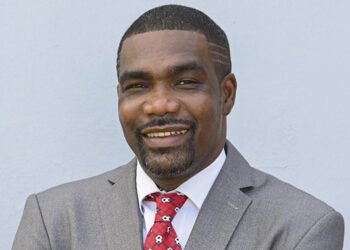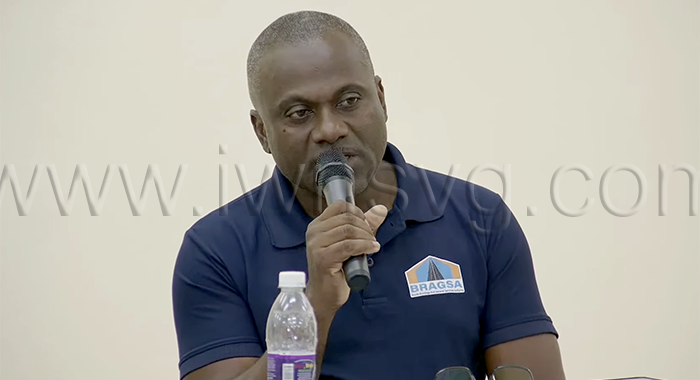
CEO of the state-owned Roads, Buildings and General Services Authority (BRAGSA), Kem Bartholomew, has framed the sand and aggregate harvesting project at the Roseau River in North Leeward as both an economic opportunity and a statutory responsibility, insisting that allowing the material to wash out to sea is not an option.
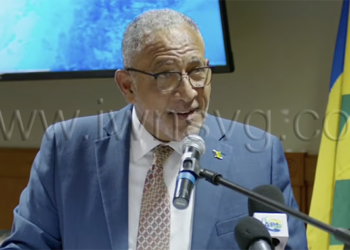
Bartholomew addressed the issue as he spoke at a town hall-style meeting at the Golden Grove Playing Field in North Leeward MP, Kishore Shallow’s “North Leeward Matters” series.
Shallow said at the beginning of the meeting that he had convened the forum although public consultations had been held in April, saying that Tuesday’s meeting was held “so we could ventilate this, get all the answers, and know how we’re going to benefit, so we can accelerate and progress with this project”.
Bartholomew rooted the current initiative in decades of state mining activity at Rabacca, on the windward side of St. Vincent, and argued that the volcanic deposits accumulated in North Leeward can be monetised for the benefit of the constituency and the wider economy.
‘We cannot extract it fast enough’

Bartholomew told residents that BRAGSA has been mining in Rabacca “even before I was born”, noting that his “great-grandparents were mining in the same location” and that the volume of material there remains enormous.
“There is so much material that we cannot extract it fast enough,” he said. “In fact, after La Soufriere volcanic eruption in April 2021, there’s even so much more material that is coming down that we are simply just pushing it on the sides of the riverbank.”
He said multiple entities – including foreign buyers – had shown interest in Rabacca material, but transport costs from Rabacca to the south of St. Vincent made it “cheaper to get it in Guyana” than to truck it down for domestic or export use.
Strategic shift to Roseau site
Bartholomew said a 2025 strategic analysis within BRAGSA concluded that the authority needed to “make investment for opportunity to gain income”, and that one clear avenue was to monetise Rabacca-type material where it was more cheaply available.
“… and it was identified that the same material is available on the Leeward side, and as the ministers have said, it’s easier to access via barge,” he said, adding, “We took this opportunity to embark on this to sell this product.”
South Leeward MP, Nigel “Nature” Stephenson, who is also minister of infrastructure and West Kingstown MP, Daniel Cummings, who has ministerial responsibility for the environment, as well as Shallow, attended and spoke at the event.
Bartholomew said that from the outset, BRAGSA’s internal policy was that the Grenadines, and especially Union Island, Canouan and Bequia, should benefit early, given their long-standing struggles to access affordable aggregate from the mainland.
“The same way the people on mainland have access to this material, we should get it to the Grenadines before anywhere else,” Bartholomew said, adding that truckers from the Grenadines faced prohibitive costs to reach Rabacca, which is located some 19 miles from Kingstown.
Bartholomew said the initial push for the Roseau operation came after a private company, Glossy Bay in Canouan, which had been sourcing aggregates from Guyana, expressed interest in material from St. Vincent.
BRAGSA moved to “make this a starting point for this operation,” Bartholomew said.
From reconnaissance to ESIA
The BRAGSA CEO outlined a step-by-step account of how the Roseau project was initiated, stressing that the state entity, not a private operator, is leading the work.
He said that in January, BRAGSA’s Physical Planning and Surveying Department, along with the Office of the Chief Engineer, invited interested parties from the mainland to meet and determine specifications.
The team hired a boat and travelled to North Leeward to carry out what he described as a “reconnaissance survey” of potential extraction sites.
Although their partners initially preferred the Richmond/Wallibou River, Bartholomew said he resisted that option.
“I said, ‘No way. I do not want to be a part of disturbing the historic operations at Richmond. The same material is available in the Roseau River in Larakai.’ So we said, ‘Let’s start with the Roseau River, because it does not immediately impact what is happening at Richmond.’”
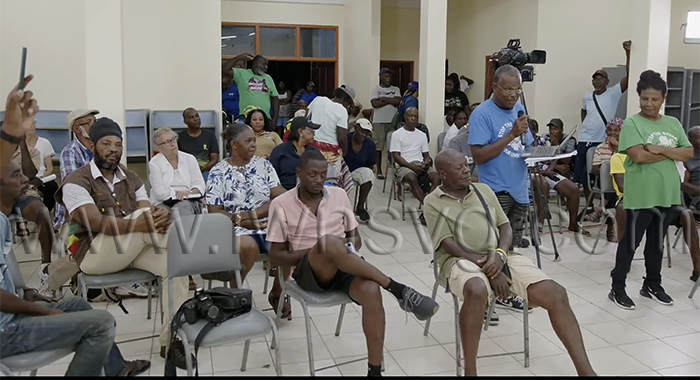
He told the meeting that “trucks go [to Richmond] daily to harvest material” and that “persons in North Leeward do not pay any price for material from Richmond”, noting that this long-standing practice was not to be disturbed by the Roseau operation.
Following the reconnaissance, BRAGSA visited Canouan with technical staff to inspect the site where the material would be landed and used, and then submitted a formal application to the Physical Planning authorities in February.
Bartholomew said the agency received “approval in principle”, subject to several conditions:
•Survey drawings and design of a ramp – “we said we don’t want to do anything, a temporary ramp on the beach,” he noted.
•Design of structures to store equipment and provide “comfort station for the workers”.
•Completion of an environmental and social impact assessment (ESIA).
To meet these conditions, he said BRAGSA conducted limited clearing at the Roseau site to allow surveying, instructing local contractors “not to cut any fruit trees” in order to keep “as small as possible a footprint that we can operate”.
“We were able to do all those preliminary data to meet the requirements of physical planning,” he said.
“And then we contract Dr. Reynold Murray to do the [ESIA]… He did several other assessments, and he provided those reports to us. We submitted all the necessary details to physical planning, and we got the approval to conduct [the] work.”
A $3.8 million starter contract; ‘do nothing is never an option’
Bartholomew disclosed that BRAGSA has signed a contract with Glossy Bay in Canouan for 110,000 tonnes of sifted material, valued at approximately EC$3.8 million.
“We got them deposit in the 500,000, approximately, that includes in cash [and] equipment to start the operation,” he said.
“They [have paid] over 500,000; they didn’t get any material yet. We are only selling it. They have it, so they came by barge.”
Bartholomew said BRAGSA was selling the material but was not responsible for its transportation.
He stressed that the barge being used is one BRAGSA has itself previously hired to bring crushed aggregates and plastering sand into Kingstown and other ports, underscoring that the state has long relied on imported stone because of a shortage of suitable domestic aggregate.
Against that backdrop, Bartholomew argued there is now an “abundance” of suitable material on the Leeward side, and that allowing it to continue to wash into the sea would be irresponsible.
“I have a principle that do nothing is never an option,” Bartholomew said and went on to explain that at a river mouth, deposition naturally builds up a plateau of porous material.
“If you do nothing, the material… accumulates,” he said, pointing to Rabacca as an example, where “the water is way underneath; you can’t see it because it’s covered with this porous material.”
Bartholomew reminded residents that BRAGSA, under Act 23 of 2008, is legally responsible for maintaining rivers, including removing excess material when necessary.