BEIJING/SEOUL – Chinese President Xi Jinping emerged from his first visit to North Korea in seven years with fresh assurances that Beijing remains Pyongyang’s key strategic priority, easing fears that deepening North Korea-Russia ties could eclipse China’s influence.
His two-day state visit on June 8 and 9 marked a “new era in bilateral relations”, North Korea’s state media Korean Central News Agency (KCNA) said.
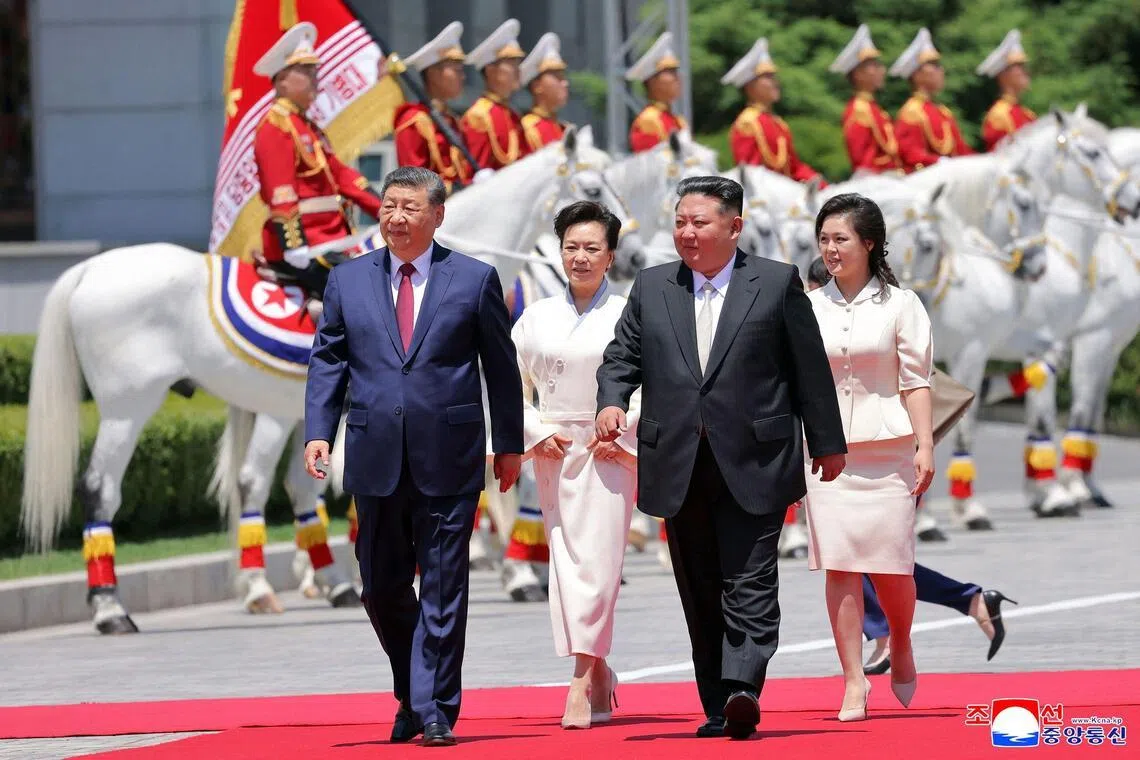
Pyongyang rolled out a full repertoire of state pageantry for Xi, with a 21-gun salute, military honours, a friendship parade and a visit to the Sino-Korean Friendship Tower, which honours Chinese soldiers who fought alongside North Korean troops during the Korean War.
Analysts say the visit was less a symbolic display of socialist camaraderie than an effort to reaffirm Beijing’s influence over North Korea amid Pyongyang’s deepening military and political ties with Moscow since the outbreak of the Ukraine war.
Xi and North Korean leader Kim Jong Un pledged during their summit meeting on June 8 to defend each other’s sovereignty and security while expanding cooperation in areas including politics, economy and culture.

Chinese President Xi Jinping (left) and North Korean leader Kim Jong Un at a welcome ceremony for Xi in Pyongyang on June 8.
PHOTO: AFP
Kim said strengthening ties with China was his country’s foremost strategic priority and that Pyongyang would “do its utmost” to make the strengthening of bilateral relations a model for state-to-state relations, according to KCNA.
Zhao Tong, a senior fellow with the Carnegie Endowment for International Peace’s Nuclear Policy Programme, told The Straits Times that Kim’s affirmation had a “reassuring effect” on Beijing.
He noted that Kim’s remarks at the 9th Congress of the Workers’ Party of Korea in February, in which he said Pyongyang was seeking to advance relations with other “anti-imperialist and independent countries”, were interpreted by some analysts as a sign that North Korea was seeking to diversify its diplomatic partnerships and reduce reliance on Beijing.
Kim’s latest statement helped to alleviate Beijing’s concerns, said Zhao.
Xi’s visit came less than a month after Beijing hosted both US President Donald Trump and Russian President Vladimir Putin separately in May, capping a period of high-level diplomacy on home soil aimed at projecting China as a major power amid global uncertainty.
Zhang Guangxin, an associate professor at Zhejiang Gongshang University’s East Asian Institute in Hangzhou, said a state visit of this level, and coming immediately after Trump’s and Putin’s visits, is itself a strategic declaration by Beijing that North Korea remains China’s most important neighbour.
Zhang said the visit, which coincides with the 65th anniversary of the China-North Korea Treaty of Friendship, Cooperation and Mutual Assistance, reaffirmed that the pact continues to underpin bilateral ties.
The treaty is China’s only formal military alliance with any country. Under the agreement, both nations are obliged to provide military and other assistance should either come under armed attack.
North Korea’s signing of a similar pact with Russia in June 2024 had fuelled concerns that Russia was beginning to rival China as North Korea’s most important strategic partner.
As Pyongyang drew closer to Moscow, there was a visible decline in its engagements with Beijing that year, which saw the 75th anniversary of bilateral relations pass with little fanfare.
Xi’s visit suggests those strains have eased.
Despite North Korea’s growing ties with Russia, China is still its most important economic partner, accounting for more than 90 per cent of the heavily sanctioned regime’s foreign trade.
Exports to China include tungsten ores and concentrates, as well as wigs and other hair accessories such as fake beards, eyebrows and eyelashes.
The upswing in bilateral trade follows the recent restoration of transport links that were suspended during the Covid-19 pandemic, including cross-border passenger rail services and the revival of air links in March.
Cho Han-bum, a distinguished research fellow at the Korea Institute for National Unification, assesses Xi’s visit as a restoration of traditional ties following the earlier period of chill.
“For North Korea, it is gearing itself up for a situation where its strategic importance to Russia would fall with the end of the Ukraine war, and Chinese support is needed to help prop up its recently deteriorating economy,” said Cho.
But any economic support from China would not come without a price.
The visit was essentially a “hard-power exchange of geopolitical footholds”, said Lee Seong-hyon, a senior fellow at the Washington-based George H.W. Bush Foundation for US-China Relations.
By explicitly calling for closer exchanges in “foreign affairs, law enforcement and the military”, Xi is seeking to embed China more deeply in North Korea’s security and foreign policy apparatus, giving Beijing greater visibility and influence over Pyongyang’s strategic calculations, Lee said.
A day before Xi’s visit, Kim’s powerful sister, Kim Yo Jong, had reiterated Pyongyang’s position that its status as a nuclear weapons state is “an absolutely irreversible red line and an undeniable reality”.
Lee described her remarks as a “structural boundary-setting exercise” aimed at taking denuclearisation off the agenda before the summit even began, clearing the way for talks to focus instead on economic support from China in return for North Korea’s continued geopolitical support for Beijing.
In late 2025, China omitted the phrase “denuclearisation of the Korean peninsula” from a major defence and arms control White Paper for the first time in nearly two decades, prompting debate that Beijing was adapting to the reality of a nuclear-armed North Korea.
The White House’s fact sheet on Trump’s meeting with Xi in Beijing in May said that both leaders had “confirmed the shared goal to denuclearise North Korea”. Yet, the Chinese readout of the same meeting said the leaders exchanged views on issues including the Korean peninsula, but made no mention of denuclearisation.
Carnegie’s Zhao said Beijing’s silence on denuclearisation is not surprising as it has, in the last two years, shifted to strengthening relations by highlighting the commonalities between both countries in terms of political systems and ideology.
With China’s current focus on managing competition with the US, the North Korean nuclear issue is low on Beijing’s foreign policy agenda, despite the Chinese Foreign Ministry maintaining that China’s official position on the issue has not changed, said Zhao.
“China now regards substantive progress towards North Korean denuclearisation in the foreseeable future as an unrealistic goal,” he said.
Washington’s Lee said that the omissions of “denuclearisation” and “peninsula” from the Chinese readout are a “calculated erasure of the post-Cold War diplomatic framework” and a tacit endorsement of Pyongyang’s nuclear state.
“From Beijing’s strategic calculus, a nuclear-armed North Korea serves as a massive geopolitical ‘lightning rod’. It forces the US, Japan, and South Korea to anchor their military resources and strategic focus defensively on the Asian littoral, effectively diluting the US alliance’s capacity to contain China in other theatres, such as the Taiwan Strait or the South China Sea,” said Lee.