PREPAREDNESS:
Previous exercises required troops to enter positions a week in advance, but this time they arrived only one day before the drill, an official said
-
Staff writer, with CNA, TAICHUNG
The army’s 10th Corps yesterday conducted artillery drills around the northern and southern banks of the Dajia River (大甲溪) estuary in Taichung, simulating a scenario in which Chinese amphibious forces attempt to invade central Taiwan in a combat scenario with limited preparation time.
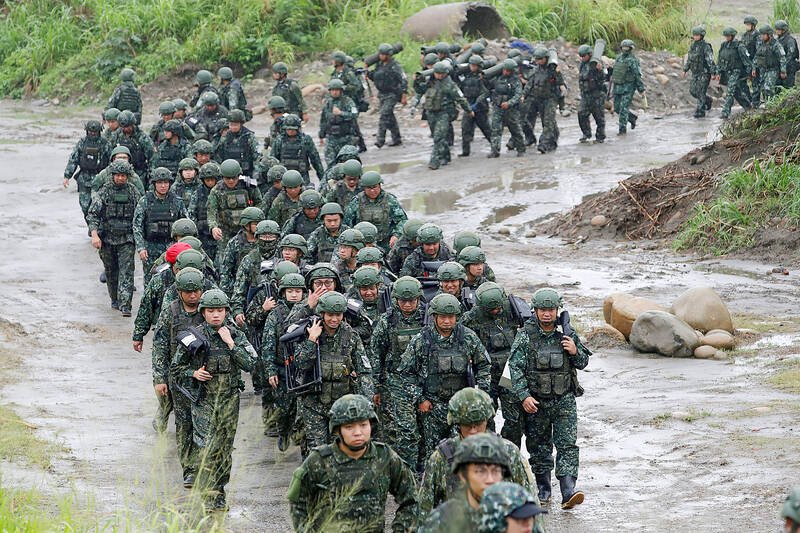
Despite heavy rain, troops carried out live-fire drills in an operational area with the Thunderbolt-2000 multiple launch rocket system for the first time in seven years, followed by exercises involving M109A2 self-propelled howitzers.
The drills incorporated the 58th Artillery Command, the 234th Brigade and the 586th Brigade, with 372 rounds across six weapons systems fired from eight positions across a 20km front, the 10th Corps said.

Photo: Chiang Ying-ying, AP
Locally developed Thunderbolt-2000 rocket artillery, M109A2 and M110A2 self-propelled howitzers, 155mm howitzers, 120mm mortars, and TOW-2A and TOW-2B missile vehicles took part in the drill.
The 10th Corps said the live-fire drills aimed to test joint firepower capabilities and the effectiveness of the kill chain, while simulating efforts to delay and weaken invading forces landing on Dajia Beach.
Colonel Weng Yi-ming (翁一銘), chief of staff of the 58th Artillery Command, told reporters the drills were no longer about set-piece maneuvers.
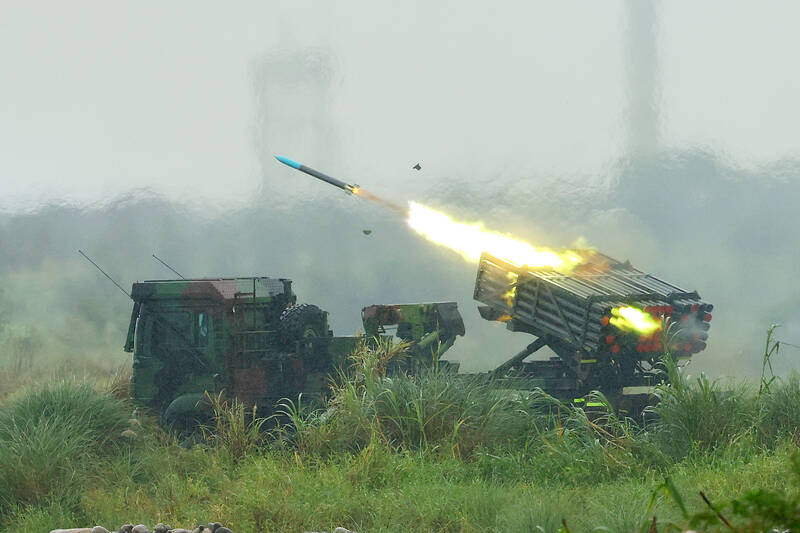
Photo: Ritchie B. Tongo, EPA
“What is different about this training compared with the past is that we are no longer conducting heavy artillery firing in a fixed, routine formation as before,” he said. “The timing for entering positions this time was based on realistic combat conditions. So, I believe this training posed a considerable level of difficulty for our troops.”
The drills began at 8:24am, when three Thunderbolt-2000 systems launched 180 MK15 training rockets. Each vehicle salvoed 60 rockets in about 30 seconds.
The first two launchers successfully fired their full loads, but the seventh rocket fired by the third launcher failed in flight shortly after launching.
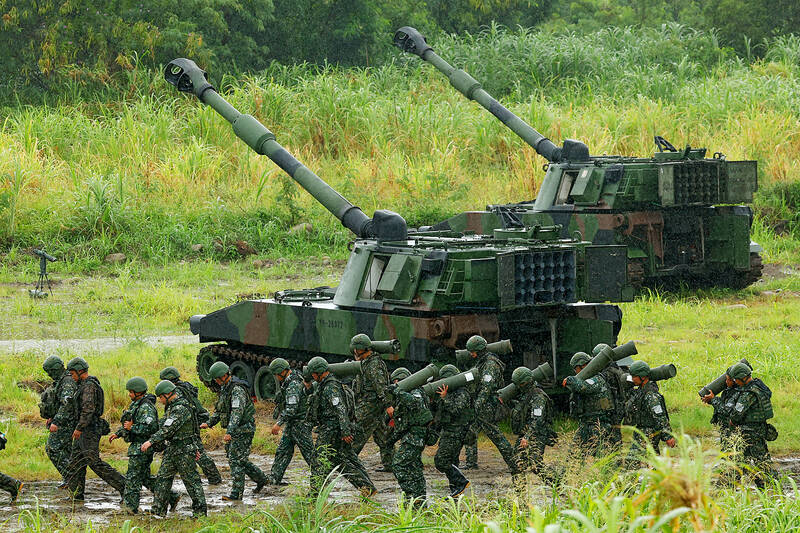
Photo: Ritchie B. Tongo, EPA
Weng said the rocket ignited properly and exited the launcher, but the second-stage ignition might have malfunctioned.
Personnel from the National Chungshan Institute of Science and Technology are analyzing the issue, Weng said, adding that the MK15 training rocket is not outfitted with an explosive warhead and landed more than 400m from the launch site in a safe area.
Major Liao Neng-cheng (廖能政), commander of the 58th Artillery Command’s rocket artillery unit, said the drill validated the unit’s regular training and demonstrated its determination to defend Taiwan.
Previous live-fire exercises required troops to enter positions a week in advance, but this time preparations were completed after arriving only one day before the drill, he added.
After the Thunderbolt-2000 systems withdrew, troops operating M109A2 self-propelled howitzers conducted live-fire exercises against targets about 9km offshore.
Captain Lin Chun-cheng (林俊呈), commander of an artillery company under the 586th Brigade, said rain made observation more difficult, but the unit had prepared contingency plans and used the Team Awareness Kit mobile system to maintain communications.
Additional reporting by Reuters