SHARED CHALLENGES:
Taiwan, Japan, the US and like-minded partners must step up collaborations to defend a free and open Indo-Pacific, an envoy to Japan said
-
By Lin Tsuei-yi
and Jake Chung / Staff reporter, with staff writer
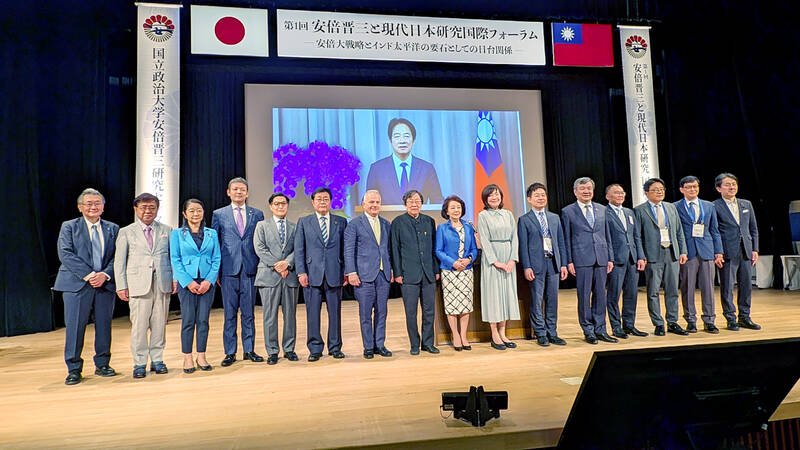
President William Lai (賴清德) yesterday thanked Japanese Prime Minister Sanae Takaichi for continuing late Japanese prime minister Shinzo Abe’s legacy by upgrading his “free and open Indo-Pacific” strategy, adding that Taiwan and Japan face identical security challenges along the First Island Chain.
Delivering a pre-recorded address at the first Shinzo Abe and Modern Japan International Research Forum in Tokyo, Lai said that Abe’s famous declaration that a Taiwan contingency is a Japanese contingency awakened the international community to the importance of peace and stability across the Taiwan Strait.
The forum is cohosted by National Chengchi University’s Shinzo Abe Research Center and the Japan Institute for National Fundamentals think tank.
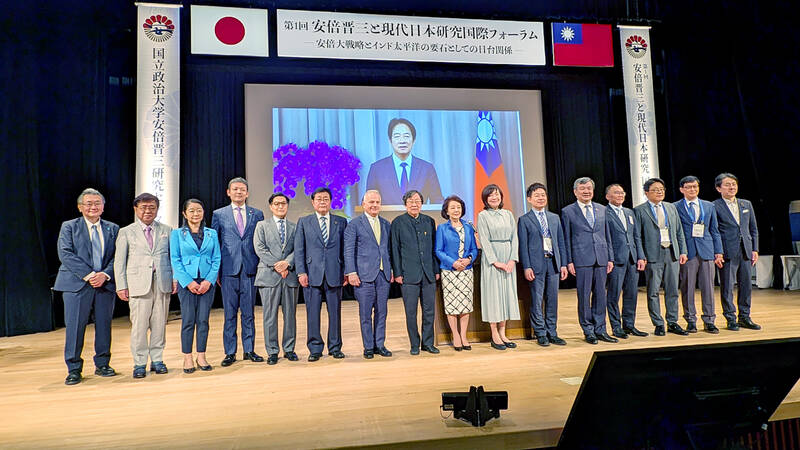
Photo: Lin Tsuei-yi, Taipei Times
Under the theme “Abe’s Grand Strategy and the Taiwan-Japan Relationship as a Cornerstone of the Indo-Pacific,” the forum invited experts from Taiwan, Japan and the US to discuss Abe’s strategy, as well as the security guarantees for modern Japan, its economic strategies and diplomatic ideas.
Akie Abe, Shinzo Abe’s widow, opened the forum by saying she hoped to take on the role of nurturer to continue her husband’s legacy.
She said she had visited the world after her husband’s assassination and came to understand that the late Japanese prime minister had been deeply relied upon by other nations, just as he had enjoyed great faith and trust in Japan.
Representative to Japan Lee Yi-yang (李逸洋) said that Taiwan’s defense is not just a matter of regional security.
As Taiwan is an important part of the global supply chain and its stock market’s value is the fourth-largest worldwide, its defense is closely connected to the security of democratic countries with competitive advantage in the artificial intelligence and high-tech industries, Lee said.
Taiwan, Japan, the US and other like-minded partners must step up collaborations to jointly defend a free and open Indo-Pacific region, he said.
Institute president Yoshiko Sakurai expressed her respect for Taiwan for establishing a Shinzo Abe Research Center and a Shinzo Abe Library.
Japan lacked similar commemorative facilities to serve as a testament to the wide-ranging impact of his contributions to Japanese reforms and international strategy, she added.
Shinzo Abe Research Center director Lee Shih-hui (李世暉) said that from the inception of the center, its management had hoped to hold an international forum in Japan.
The center is aware that the public in Japan has polarized opinions on the late prime minister, and it hopes to use third-party and objective research from Taiwan to show how his policies were important to regional peace and safety in the Strait, Lee Shih-hui said.
The center hopes to promote the Abe School of Politics and Economics, a project aimed at giving courses in Taiwan and Japan to explain to young people Shinzo Abe’s ideals, strategies and Taiwan-Japan relations, he said.
Additional reporting by Chen Yun