Finnish Prime Minister Petteri Orpo (NCP) invited 11 social media influencers for lunch at the PMs official residence in Helsinki on Tuesday, according to Helsingin Sanomat.
The influencers, all of them female, included Anni Ihamäki, Auri Kananen, Sara Parikka, Beata Leppilampi and others.
After the lunch, some of the influencers naturally shared details about their meeting with the PM. Among other things, they said that their discussions concerned social issues that usually don’t receive enough attention in regular political debates.
Some of the lunch guests described the occasion as ‘exciting’ and ‘impressive’, the paper noted.
HS spoke with Helsinki University researcher Essi Pöyry, who suggested that by attending the exceptional luncheon, the influencers were not necessarily endorsing Orpo’s National Coalition Party or making a statement about Orpo’s performance as PM.
The researcher added that the women who were invited had similar presences on social media. They all have relatively large audiences on their platforms. Parikka, for example, has more than 292,000 followers on Instagram.
However, according to the researcher, none of those invited had visibly criticised the government’s policies.
She said that the social media related event “immediately reminded me that the National Coalition Party has struggled with getting female candidates and losing female voters”.
According to Pöyry, their discussions at the lunch were not directly about politics, but rather concerned things like entrepreneurship or youth issues and other more general topics.
She said that because the influencers avoid critical discussion about the most pressing political issues, they are a good audience for Orpo.
Pöyry said she thinks Orpo wanted to broadcast a message that a middle-aged man wanted to talk about issues that concern women.
According to her, the PM succeeded with that goal to some extent.
THL calls for energy drink crackdown
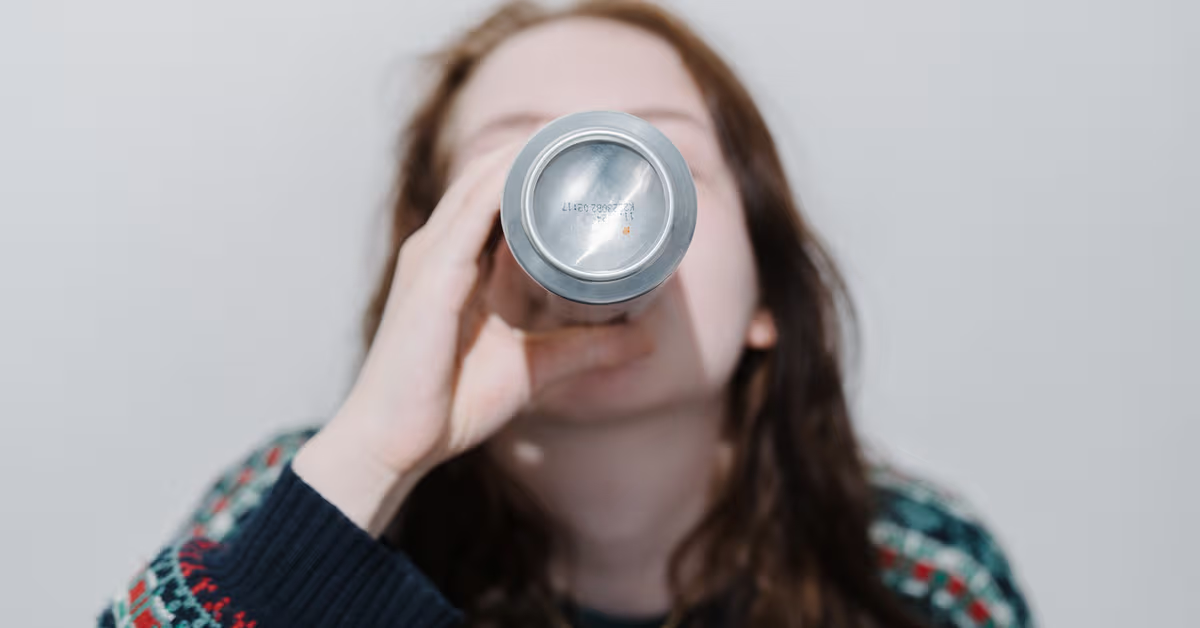
There is a national recommendation in Finland that stores should not sell caffeine-heavy energy drinks to youths under the age of 15.
But now, the Institute for Health and Welfare (THL) has called for a ban on selling the popular beverages to anyone younger than 18, Hufvudstadsbladet reports.
“The recommendation [in place] has not had the desired effect because consumption has only increased,” head researcher Susanna Raulio said, according to the paper.
The 15-and-up recommendation was issued more than a decade ago, but people are increasingly consuming the pep beverages — particularly girls and school-age kids.
According to the health agency, the energy drinks’ high caffeine content and acids make them harmful to health. Many of them contain sugar, too.
When children and young people consume energy drinks, they risk increased blood pressure, palpitations, heart rate changes, dental problems, mental symptoms as well as sleep disorders, according to THL.

Raulio points out that the impact on sleep can further lead to poorer learning.
“We consider [the proposed] ban as a way to protect our young people,” Raulio told the paper.
The paper noted that banning energy drinks for minors would be a rather harsh measure, but Raulio said other countries have made similar moves.
For example, Norway banned sales of the beverages to people under the age of 16, while 18 is the limit in Latvia, Lithuania, Poland and Hungary.
THL’s energy drink initiative is one of the agency’s proposals for the next government, according to HBL.
Pricier cottage life
Newspaper Ilta-Sanomat reported that municipalities have increased the fees they collect from cottage owners, citing a report from the Finnish Homeowners’ Association.
But the increases vary, depending on the location.
One of the most popular municipalities for summer cottages, Savonlinna, is now clearly the most expensive.
Cottage owners in the region are now paying an average of more than 1,400 euros per year on local property taxes, electricity and waste removal fees. The next most expensive municipalities include Mikkeli, Kangasala, Kuopio and Puumala.
At the same time, Oulu came out as the most affordable for cottage owners — they pay just under 650 euros per year in those fees.
The survey included the 25 largest cottage communities in Finland. It covered around 146,000 summer cottages, or nearly a third of all cottages in the country.
Ilta-Sanomat pointed out that property tax, electricity and waste fees have increased — and grown in more locations — than a year ago.
Since last year, local fees for cottages have increased on average by about three percent, or 30 euros.
Property taxes increased by three euros per year, the electricity costs by 25 euros, and waste fees grew by an average of two euros.
However, in comparison, during the shift from 2024 to 2025, costs increased by an average of just ten euros.
Edited a photo caption at 11:53 on 4 June 2026 to reflect that there is a recommendation that energy drinks should not be sold to people under the age of 15, but store policies about the guideline are known to vary.