Monday, June 8, 2026
    The GeoStrategic Consensus
    No Result
    View All Result
    • Login
    • HOME
    • AMERICAS
      • Argentina
      • Brazil
      • Canada
      • Chile
      • Colombia
      • Costa Rica
      • Cuba
      • Dominican Republic
      • Ecuador
      • El Salvador
      • Greenland
      • Guatemala
      • Honduras
      • Mexico
      • Nicaragua
      • Panama
      • Paraguay
      • Peru
      • United States
      • Uruguay
      • Venezuela
    • ASIA-PACIFIC
      • Australia
      • Brunei Darussalam
      • Cambodia
      • China
      • Federated States of Micronesia
      • Fiji
      • Indonesia
      • Japan
      • Kiribati
      • Laos
      • Malaysia
      • Marshall Islands
      • Mongolia
      • Myanmar
      • Nauru
      • New Zealand
      • North Korea
      • Palau
      • Papua New Guinea
      • Philippines
      • Samoa
      • Singapore
      • Solomon Islands
      • South Korea
      • Taiwan
      • Thailand
      • Timor-Leste
      • Tonga
      • Tuvalu
      • Vanuatu
      • Vietnam
    • CARICOM
      • CARICOM – Non-English
        • Haiti
        • Suriname
      • CARICOM Associates
        • Anguilla
        • Bermuda
        • British-Virgin-Islands
        • Cayman-Islands
        • Curacao
        • Turks-and-Caicos
      • CARICOM English
        • Antigua and Barbuda
        • Barbados
        • Belize
        • Dominica
        • Grenada
        • Guyana
        • Jamaica
        • Montserrat
        • Saint Kitts and Nevis
        • Saint Lucia
        • Saint Vincent and the Grenadines
        • The Bahamas
        • Trinidad and Tobago
    • EURASIA
      • Armenia
      • Azerbaijan
      • Balarus
      • Georgia
      • Kazakhstan
      • Kyrgyzstan
      • Moldova
      • Russia
      • Tajikistan
      • Turkmenistan
      • Ukraine
      • Uzbekistan
    • EUROPE
      • Albania
      • Andorra
      • Austria
      • Bosnia and Herzegovina
      • Bulgaria
      • Croatia
      • Cyprus
      • Czech Republic
      • Denmark
      • Estonia
      • Finland
      • France
      • Germany
      • Greece
      • Holy See
      • Hungary
      • Iceland
      • Ireland
      • Italy
      • Kosovo
      • Latvia
      • Liechtenstein
      • Lithuania
      • Luxembourg
      • Malta
      • Monaco
      • Montenegro
      • Netherlands
      • North Macedonia
      • Norway
      • Poland
      • Portugal
      • Romania
      • San Marino
      • Serbia
      • Slovakia
      • Slovenia
      • Spain
      • Sweden
      • Switzerland
      • United Kingdom
    • MIDDLE EAST AND NORTH AFRICA
      • Algeria
      • Bahrain
      • Egypt
      • Iran
      • Iraq
      • Israel
      • Jordan
      • Kuwait
      • Lebanon
      • Lybia
      • Morocco
      • Oman
      • Palestinian Territories
      • Qatar
      • Saudi Arabia
      • Syria
      • Tunisia
      • Turkey
      • United Arab Emirates
      • Western Sahara
      • Yemen
    • SOUTH ASIA
      • Afghanistan
      • Bangladesh
      • Bhutan
      • India
      • Maldives
      • Nepal
      • Pakistan
      • Sri Lanka
    • SUB-SAHARAN AFRICA
      • Angola
      • Benin
      • Botswana
      • Burkina Faso
      • Burundi
      • Cabo Verde
      • Cameroon
      • Central African Republic
      • Chad
      • Comoros
      • Cote d’Ivoire
      • Democratic Republic of the Congo
      • Djibouti
      • Equatorial Guinea
      • Eritrea
      • Eswatini
      • Ethiopia
      • Gabon
      • Gambia
      • Ghana
      • Guinea
      • Guinea Bissau
      • Kenya
      • Lesotho
      • Liberia
      • Madagascar
      • Malawi
      • Mali
      • Mauritania
      • Mauritius
      • Mozambique
      • Namibia
      • Niger
      • Nigeria
      • Republic of the Congo
      • Rwanda
      • Sao Tome and Principe
      • Senegal
      • Seychelles
      • Sierra Leone
      • Somalia
      • South Africa
      • South Sudan
      • Sudan
      • Tanzania
      • Togo
      • Uganda
      • Zambia
      • Zimbabwe
    • HOME
    • AMERICAS
      • Argentina
      • Brazil
      • Canada
      • Chile
      • Colombia
      • Costa Rica
      • Cuba
      • Dominican Republic
      • Ecuador
      • El Salvador
      • Greenland
      • Guatemala
      • Honduras
      • Mexico
      • Nicaragua
      • Panama
      • Paraguay
      • Peru
      • United States
      • Uruguay
      • Venezuela
    • ASIA-PACIFIC
      • Australia
      • Brunei Darussalam
      • Cambodia
      • China
      • Federated States of Micronesia
      • Fiji
      • Indonesia
      • Japan
      • Kiribati
      • Laos
      • Malaysia
      • Marshall Islands
      • Mongolia
      • Myanmar
      • Nauru
      • New Zealand
      • North Korea
      • Palau
      • Papua New Guinea
      • Philippines
      • Samoa
      • Singapore
      • Solomon Islands
      • South Korea
      • Taiwan
      • Thailand
      • Timor-Leste
      • Tonga
      • Tuvalu
      • Vanuatu
      • Vietnam
    • CARICOM
      • CARICOM – Non-English
        • Haiti
        • Suriname
      • CARICOM Associates
        • Anguilla
        • Bermuda
        • British-Virgin-Islands
        • Cayman-Islands
        • Curacao
        • Turks-and-Caicos
      • CARICOM English
        • Antigua and Barbuda
        • Barbados
        • Belize
        • Dominica
        • Grenada
        • Guyana
        • Jamaica
        • Montserrat
        • Saint Kitts and Nevis
        • Saint Lucia
        • Saint Vincent and the Grenadines
        • The Bahamas
        • Trinidad and Tobago
    • EURASIA
      • Armenia
      • Azerbaijan
      • Balarus
      • Georgia
      • Kazakhstan
      • Kyrgyzstan
      • Moldova
      • Russia
      • Tajikistan
      • Turkmenistan
      • Ukraine
      • Uzbekistan
    • EUROPE
      • Albania
      • Andorra
      • Austria
      • Bosnia and Herzegovina
      • Bulgaria
      • Croatia
      • Cyprus
      • Czech Republic
      • Denmark
      • Estonia
      • Finland
      • France
      • Germany
      • Greece
      • Holy See
      • Hungary
      • Iceland
      • Ireland
      • Italy
      • Kosovo
      • Latvia
      • Liechtenstein
      • Lithuania
      • Luxembourg
      • Malta
      • Monaco
      • Montenegro
      • Netherlands
      • North Macedonia
      • Norway
      • Poland
      • Portugal
      • Romania
      • San Marino
      • Serbia
      • Slovakia
      • Slovenia
      • Spain
      • Sweden
      • Switzerland
      • United Kingdom
    • MIDDLE EAST AND NORTH AFRICA
      • Algeria
      • Bahrain
      • Egypt
      • Iran
      • Iraq
      • Israel
      • Jordan
      • Kuwait
      • Lebanon
      • Lybia
      • Morocco
      • Oman
      • Palestinian Territories
      • Qatar
      • Saudi Arabia
      • Syria
      • Tunisia
      • Turkey
      • United Arab Emirates
      • Western Sahara
      • Yemen
    • SOUTH ASIA
      • Afghanistan
      • Bangladesh
      • Bhutan
      • India
      • Maldives
      • Nepal
      • Pakistan
      • Sri Lanka
    • SUB-SAHARAN AFRICA
      • Angola
      • Benin
      • Botswana
      • Burkina Faso
      • Burundi
      • Cabo Verde
      • Cameroon
      • Central African Republic
      • Chad
      • Comoros
      • Cote d’Ivoire
      • Democratic Republic of the Congo
      • Djibouti
      • Equatorial Guinea
      • Eritrea
      • Eswatini
      • Ethiopia
      • Gabon
      • Gambia
      • Ghana
      • Guinea
      • Guinea Bissau
      • Kenya
      • Lesotho
      • Liberia
      • Madagascar
      • Malawi
      • Mali
      • Mauritania
      • Mauritius
      • Mozambique
      • Namibia
      • Niger
      • Nigeria
      • Republic of the Congo
      • Rwanda
      • Sao Tome and Principe
      • Senegal
      • Seychelles
      • Sierra Leone
      • Somalia
      • South Africa
      • South Sudan
      • Sudan
      • Tanzania
      • Togo
      • Uganda
      • Zambia
      • Zimbabwe
    No Result
    View All Result
    Agentially
    No Result
    View All Result
    Home AMERICAS United States

    Artisanal or Exploitative? Unraveling the Story of Mexico’s World Cup Jerseys

    The Analyst by The Analyst
    June 8, 2026
    in United States
    Artisanal or Exploitative? Unraveling the Story of Mexico’s World Cup Jerseys


    It began as a feel-good story.

    Someone Somewhere, a Mexican apparel company, posted online wondering why Mexico’s World Cup jerseys couldn’t be embroidered by some of the nation’s Indigenous artisans. It was an idea that could bridge Mexico’s past and present, the company argued, while lifting some of its most vulnerable out of poverty. The next day, Adidas called.

    Last month, two years after that call, Adidas and Someone Somewhere unveiled versions of the Mexican national team jersey embroidered by hand by 150 Nahua women high in the mountains of central Mexico, in a tiny town called Naupan.

    Adidas flew two of the artisans to Germany to induct the jerseys into a company archive. Someone Somewhere brought others onto the field for one of Mexico’s last friendly matches before the tournament starts this week. And the jerseys, despite costing more than $200, sold fast.

    Then Mexican activists said the story had a much darker side.

    “Finally, we know all the murky details behind the Adidas collaboration with the artisans of Naupan,” Luz Valdez, a Mexican activist and influencer, said in a video last month to her combined 1.3 million followers on TikTok and Instagram.

    She accused the companies of exploiting the Nahua women while profiting off their image. The artisans were not even allowed to use their traditional sewing method, she said, instead learning Western techniques.

    One claim in particular took hold: The women were paid 36 pesos, or $2.06, an hour to embroider jerseys that cost as much as $285 each, she said, citing unnamed sources. That would be 9 percent below Mexico’s minimum wage. “I’m angry,” she said to the companies, “because you knew exactly what you were doing.”

    Her videos rocketed across Mexico, racking up millions of views. News outlets covered the story. Politicians responded to it. And thousands of people left angry comments, some saying the companies were even more evil than they had thought.

    But little had been said by the Nahua women. So we traveled into the mountains to speak with them ourselves.

    Into the Workshop

    We arrived on May 31 to a commotion in Naupan’s cultural center. Groups of Nahua women trudged up a hill in their traditional embroidered dresses, and a team of smartly dressed government types were getting out of an S.U.V.

    More than a mile above sea level, this town of 2,000 Nahua people was suddenly at the center of a national controversy, and Marina Núñez Bespalova, a top cultural official from Mexico’s leftist government, had booked a last-minute trip to respond.

    Speaking to dozens of Nahua women, Ms. Núñez Bespalova offered them free government training in textiles, as well as a workshop on how to eliminate intermediaries and sell directly to consumers.

    “Multinational companies enrich themselves off the value you give to these pieces,” she said. “You yourselves are a value, and from that value, you don’t earn what you’re owed.”

    When the event ended, many of the women shuffled off to get back to embroidering World Cup jerseys. We followed.

    Despite countless articles in the Mexican press, the Nahua woman who answered the door of the one-room workshop told us we were the first journalists to visit. The artisans, she said, were eager to share their side of the story.

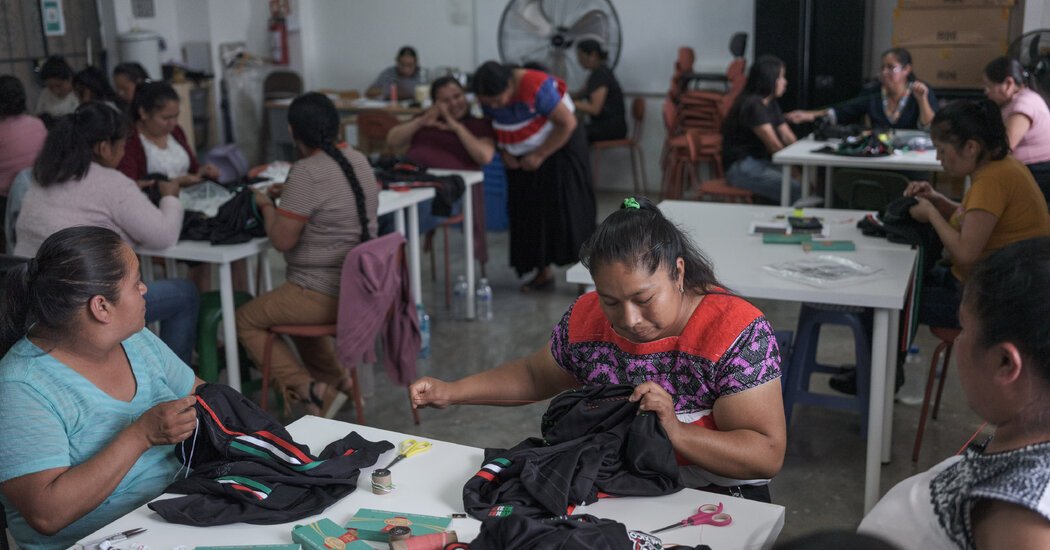
    Inside, more than 25 women sat at seven tables sewing the classic Adidas stripes in the Mexican flag’s colors into the jerseys. They chatted in Nahuatl, an Indigenous language spoken by about 1.5 million people in Mexico.

    I began asking questions, and they switched to Spanish. Then virtually all of them contradicted the national narrative.

    “Honestly, this job is much better than anything else,” said Monica Marin, 45.

    “We come the hours we want,” said Micaela Perez, 41. “I’m a widowed mother of two children. Thanks to this job, they see me.”

    “What we earn is fair,” said Anabel Guzmán, 35. “If you could’ve seen where I was the day I started here,” she added. “I’ve been able to get ahead with my kids.”

    The opinion in the room was unanimous: The compensation was just, the schedule was flexible, the location was convenient and, for now, the work was consistent.

    Their complaint was that the gig would soon end with the World Cup. For many, that meant going back to tilling fields of beans, chiles and peanuts, which meant longer hours, less pay and more grueling work.

    “If all those people making those comments took the time to come and talk to us, they’d realize we’re not being exploited,” said Betty Alonso, 28.

    The women said they now feared the negative attention would scare away potential employers.

    “I feel enormous anger toward all these influencers,” said Edith Carballo, 38, who joined the project after getting laid off at a pharmacy. “In their minds they’re helping us, supposedly. But they’re just helping themselves.”

    Into the Numbers

    Ms. Valdez, 28, has become one of Mexico’s most visible activists for her videos criticizing companies that she says exploit Mexican artisans and their culture.

    One of her viral videos last year accused Adidas of ripping off the huarache, a type of Mexican footwear with pre-Columbian origins. The company later apologized.

    Over the past several weeks, Ms. Valdez has been eviscerating Adidas and Someone Somewhere. In a series of videos, she said the women in Naupan received meager pay, had wages deducted for mistakes, were not given proper benefits and were forced to finish two jerseys every five hours. She also said the women lacked “ergonomic chairs,” “only had a one-hour lunch break” and “sometimes there wasn’t even toilet paper in the bathroom.”

    She said her information came from unnamed artisans and former employees of Someone Somewhere who sent her messages.

    Adidas said in a statement that it has worked with Someone Somewhere “to strengthen working conditions for participating artisans” in “adherence to our global standards.”

    The two-dozen women interviewed in Naupan all denied Ms. Valdez’s claims. (Though I did see one woman take a roll of toilet paper to the bathroom.)

    They said they were paid more than 36 pesos an hour, but requested we don’t publish their specific wages because they worried it could make them targets for theft or harassment in their poor community. They also said it took about seven hours to embroider one jersey, but they could work at their own pace and received bonuses for finishing faster.

    Antonio Nuño, chief executive of Someone Somewhere, also disputed the claims. He said that he shared the women’s fears about disclosing their specific wages. On the condition that we don’t publish detailed numbers, he showed me pay slips for nine women that showed they all received hourly rates higher than 36 pesos an hour. Most also received bonuses for efficiency, administrative tasks, training colleagues and working specific days.

    The company legally treats the artisans as suppliers, not employees, which exempts it from providing certain benefits. One of the women leaders in the community said they negotiated the contract for the Adidas project, but did not consult a lawyer.

    With the wages, bonuses and potential profit-sharing reflected in other documents he shared, the women would earn more than a living wage if they worked 40 hours a week, by standards calculated for similar rural areas in Mexico by the Anker Research Institute, which studies income benchmarks around the world.

    Ms. Valdez was not convinced. In an interview, she discounted the women’s accounts, saying artisans like them are always scared to criticize employers. “Workers feeling fine about exploitative conditions — that happens all over the country. But that doesn’t make it any less exploitative,” she said.

    The day after we left Naupan, several of the women posted a video on Instagram saying they loved their job.

    Ms. Valdez responded with a new video accusing them of reading from a script from Someone Somewhere. “As Simone de Beauvoir would say,” she said, quoting the French philosopher, “the oppressor would not be so strong if he did not have accomplices among the oppressed.”

    A Complicated Goal

    Mr. Nuño, 34, the head of Someone Somewhere, said that growing up in Mexico, he and two friends first traveled to Naupan when they were 15, as missionaries. The trio then spent three summers there in college, studying how the local artisans work.

    Now they run Someone Somewhere as a B Corp, a special certification for companies with environmental or social goals, which doesn’t carry tax benefits but is often used in marketing. In addition to making a profit, the company’s aim is to lift artisans out of poverty by bringing their work to market.

    That has not proved simple. In Naupan, the traditional clothing requires highly intricate, highly time-consuming embroidery. A design that takes 15 days is priced locally at 1,500 pesos, or $86, if they sell it at all, the Nahua women said. That is far lower than wages on the Adidas project.

    So Someone Somewhere made a deal. To reach a larger market, the company largely designs its own products it believes customers want — like T-shirts and sweatshirts — and then hires artisans to embroider them.

    Activists say that treats the artisans as laborers producing Western designs, while still marketing the goods as Indigenous products to win customers and corporate partnerships, including with IKEA, Lacoste and Delta Air Lines.

    Mr. Nuño said the approach was the best way to create stable work for the artisans.

    Three former employees of Someone Somewhere, who spoke on the condition of anonymity for fear of reprisal, said the company rarely substantially changes artisans’ lives, in part because the work is so inconsistent.

    We viewed an internal company document that showed in 2024, the company paid 35 artisans in Naupan an average of about $2 an hour. At the time, that was about 15 percent higher than Mexico’s effective hourly minimum wage. But the artisans’ average income fluctuated wildly from month to month, from $35 to $350, because of the inconsistent work, according to the document.

    Some artisans have also complained about the pay. One woman, who requested anonymity to preserve her job, said that she is paid $6 to $8 per T-shirt she embroiders. She said each shirt can take eight hours, resulting in a wage as low as 73 cents an hour.

    Mr. Nuño said that women are paid for two to three hours per T-shirt because tests showed that was how long most women took.

    Ms. Valdez said the lack of good work in Naupan does not justify low wages. The women’s pay should be based on their value to the project, she said. Adidas and Someone Somewhere have heavily featured the Nahua women in marketing materials, yet Mr. Nuño said they were not compensated for that.

    Ms. Núñez Bespalova, the Mexican official who visited Naupan, agreed the artisans should better understand their value.

    “But we also have to respect the decision-making of all artisanal communities. They’re not minors,” she added. “Sometimes we have to leave behind the paternalism we’re accustomed to, and trust that sometimes they make the best decision for their group.”

    Chantal Flores contributed reporting.


    Source link

    READ ALSO

    Israeli offensive in Lebanon gives Hezbollah new purpose

    Top Iranian official: Trump and Iran’s supreme leader will not meet

    Related Posts

    Israeli offensive in Lebanon gives Hezbollah new purpose
    United States

    Israeli offensive in Lebanon gives Hezbollah new purpose

    June 8, 2026
    Top Iranian official: Trump and Iran’s supreme leader will not meet
    United States

    Top Iranian official: Trump and Iran’s supreme leader will not meet

    June 8, 2026
    Democrats in Congress Grapple With Concerns Over Platner Allegations
    United States

    Democrats in Congress Grapple With Concerns Over Platner Allegations

    June 7, 2026
    The Hidden Figure With Close Ties to Bill Gates and Jeffrey Epstein
    United States

    The Hidden Figure With Close Ties to Bill Gates and Jeffrey Epstein

    June 7, 2026
    Exclusive: Iran supreme leader’s adviser says talks deadlocked over $24 billion and warns of wider war
    United States

    Exclusive: Iran supreme leader’s adviser says talks deadlocked over $24 billion and warns of wider war

    June 7, 2026
    The New York Primary That Is All About Israel
    United States

    The New York Primary That Is All About Israel

    June 7, 2026
    Next Post
    The Marshall Islands and its Fintech and Digital Ecosystem

    The Marshall Islands and its Fintech and Digital Ecosystem

    POPULAR NEWS

    Azerbaijani foreign minister congratulates Kyrgyzstan on UN Security Council membership

    Azerbaijani foreign minister congratulates Kyrgyzstan on UN Security Council membership

    June 7, 2026
    Keeping waste disposal responsible | The Star

    Keeping waste disposal responsible | The Star

    June 7, 2026
    Telex: Parliament will also elect the members of four investigative committees on Monday

    Telex: Parliament will also elect the members of four investigative committees on Monday

    June 7, 2026
    Rubio defends neglect of Afghan military allies

    Rubio defends neglect of Afghan military allies

    June 8, 2026
    Youth renewal as Sylverster Lim succeeds Soo Tien Ren in Dapsy Stampin leadership

    Youth renewal as Sylverster Lim succeeds Soo Tien Ren in Dapsy Stampin leadership

    June 8, 2026

    EDITOR'S PICK

    S. Korea, Japan hold joint maritime search drills for 1st time in 9 yrs

    S. Korea, Japan hold joint maritime search drills for 1st time in 9 yrs

    June 7, 2026
    LETTER: Reply to Antigua and Barbuda Considers Wage Deductions for Child Support Defaulters

    LETTER: Reply to Antigua and Barbuda Considers Wage Deductions for Child Support Defaulters

    June 7, 2026
    A wine bottle, a bet and a car mechanic: How a new birthing device was invented

    A wine bottle, a bet and a car mechanic: How a new birthing device was invented

    June 7, 2026
    World

    World

    June 7, 2026

    Recent Posts

    • Rubio defends neglect of Afghan military allies
    • Youth renewal as Sylverster Lim succeeds Soo Tien Ren in Dapsy Stampin leadership
    • Police arrest man for insulting Malays, Batam council slaps customary sanctions – Archipelago
    • President Thongloun explores China’s innovation hub during state visit

      © 2026 Agentially - Navigating shifting sovereignties and global risk .

      Welcome Back!

      Login to your account below

      Forgotten Password?

      Retrieve your password

      Please enter your username or email address to reset your password.

      Log In
      No Result
      View All Result

        © 2026 Agentially - Navigating shifting sovereignties and global risk .

        This website uses cookies. By continuing to use this website you are giving consent to cookies being used. Visit our Privacy and Cookie Policy.