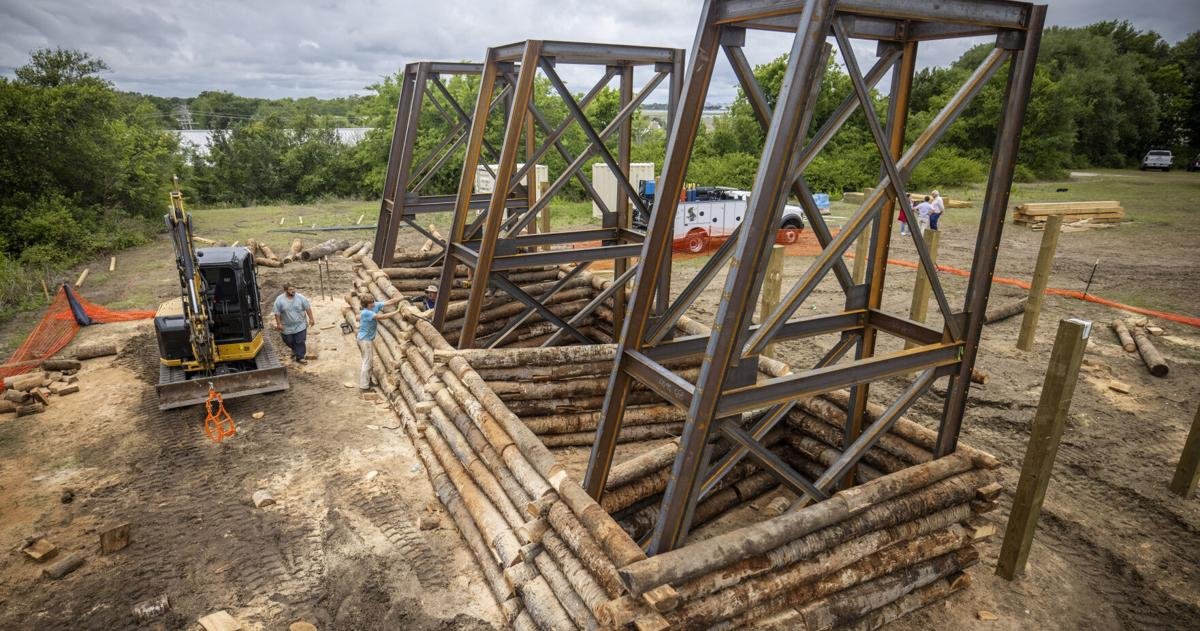
SULLIVAN’S ISLAND — Three steel frames overlooked J. Marshall Stith Park on the humid, drizzly afternoon of June 1.
The hum of chainsaws and drills filled the air atop the mound, where a small crew from Truluck Marine fastened palmetto logs to each other. Sawdust danced about, mixing with thick rain drops that occasionally escaped dark, low-hanging storm clouds overhead.
At this point in the week, the contractors had made steady progress toward rebuilding a partial replica of the famed palmetto log fort that protected Col. William Moultrie’s troops from the cannon fire of the Royal Navy that were threatening from the waters off Sullivan’s Island’s Breach Inlet.
The island comes alive each year to remember the early, and often overlooked, Patriot victory in the American Revolution. This year, celebrations come with an added emphasis as the nation recognizes 250 years of independence.
To commemorate the sestercentennial anniversary of the Battle of Sullivan’s Island, remembered as Carolina Day each year, the SC250 Charleston Commission is erecting a 60-foot slice of the fort, featuring two gun bays and locally sourced palmetto logs.
The SC250 commission is paying for the cost of construction, maintenance and deconstruction of the fort. The town of Sullivan’s Island agreed to pay around $20,000 to create two new ADA-compliant parking spaces at the mound, add lighting, gravel walkways and install security cameras around the structure.
Crunch time before Carolina Day
Though crews now face a compressed timeline, the idea for the log fort replica in time for Carolina Day June 28 was floating about for over a year. There was much back-and-forth among town leaders, residents and SC250 to determine if the life-size recreation would be a good fit for the island.
Several possible locations were proposed.
There was Breach Inlet, where the original fort once stood. Battery Gadsden was considered briefly, too, though resident concerns about added traffic in what will surely be an extra-busy season for Sullivan’s Island ruled that location out.
In February, the fort found its home atop Battery Capron, or what’s known as “the mound” behind Stith Park.
Three months later, Truluck Marine broke ground.
Contractors must make quick work of preparing the tree logs and stacking them together in time. They’ve already overcome one hurdle: sourcing enough logs to stack them 20 feet high.
A few dozen came straight from Sullivan’s Island as leftover logs chopped down through Dominion Energy’s powerline maintenance in 2024. It was a start, but not nearly enough to complete the 20-foot tall display.
The rest were donated by Johns Island-based Sunnyside Farms. Owner Hank Walpole said the trees were sourced from cleared properties on Kiawah and Seabrook Islands and stockpiled for a to-be-determined purpose. He figured they’d come in handy for someone, someday, he told The Post and Courier.
Building fort is a ‘Herculean effort’
Sullivan’s Island resident Bill Marshall is the architect who designed the replica.
Marshall has a personal connection to the fight. His sixth-great uncle Henry Gray was a lieutenant who was wounded twice in battle, Marshall said, and he documented the unsuccessful British attack in paintings on display at the Gibbes Museum.
As crew members used high-powered chainsaws to even out the logs and drilled pieces of rebar into the wood for support, Marshall marveled at the “Herculean effort” it took to construct the fort in its entirety in 1776.
“Every time I come out here, I’m shocked,” Marshall said. “The original fort was 550 feet by 550 feet. … I’m blown away with the fact that they were able to do what they were able to do.”
It’s unknown who exactly proposed the idea for the log fort, though criticisms of the unusual fortress were recorded. Maj. Gen. Charles Lee dubbed the fort a “slaughter pen” and urged Moultrie to abandon the plans. Moultrie insisted they stay the course as battle day neared.
It ended up being winning strategy.
Despite being only partially completed by June 28, 1776, the spongy logs absorbed the blows from ship-fired cannonballs exceptionally well and allowed American troops to unleash on the Royal Navy.
This time around, the fort will be complete by Carolina Day — if all goes according to plan.
Rawlins Lowndes, the general manager of Truluck Marine, is overseeing the small crew tasked with bringing the design to life. Though Truluck typically builds docks, Lowndes said he was one of (if not the only) contractor willing to take on a job with such a tight turnaround.
“It’s a big effort, but it’s awesome,” Lowndes said.
“We won’t give up. We’ll be ready for the attack,” he joked.
Once completed, the replica will be free and open to the public. Visitors can access the exhibit via a paved path behind Town Hall on Middle Street.
Longtime Lowcountry dwellers may recall when the National Park Service undertook a similar effort to recreate the fort in honor of the 200th anniversary of American independence. That iteration was displayed at Fort Moultrie and was nearly an exact replica of the fort, gun bays and all, that visitors could climb in and explore.
The 2026 version won’t be interactive, but it will be ADA accessible and include interpretive signs detailing the history of the battle.
The fort will be on display for at least 18 months before being deconstructed. The mound then will be restored to its original condition once the fort is gone, Lowndes said.