Sunday, June 7, 2026
    The GeoStrategic Consensus
    No Result
    View All Result
    • Login
    • HOME
    • AMERICAS
      • Argentina
      • Brazil
      • Canada
      • Chile
      • Colombia
      • Costa Rica
      • Cuba
      • Dominican Republic
      • Ecuador
      • El Salvador
      • Greenland
      • Guatemala
      • Honduras
      • Mexico
      • Nicaragua
      • Panama
      • Paraguay
      • Peru
      • United States
      • Uruguay
      • Venezuela
    • ASIA-PACIFIC
      • Australia
      • Brunei Darussalam
      • Cambodia
      • China
      • Federated States of Micronesia
      • Fiji
      • Indonesia
      • Japan
      • Kiribati
      • Laos
      • Malaysia
      • Marshall Islands
      • Mongolia
      • Myanmar
      • Nauru
      • New Zealand
      • North Korea
      • Palau
      • Papua New Guinea
      • Philippines
      • Samoa
      • Singapore
      • Solomon Islands
      • South Korea
      • Taiwan
      • Thailand
      • Timor-Leste
      • Tonga
      • Tuvalu
      • Vanuatu
      • Vietnam
    • CARICOM
      • CARICOM – Non-English
        • Haiti
        • Suriname
      • CARICOM Associates
        • Anguilla
        • Bermuda
        • British-Virgin-Islands
        • Cayman-Islands
        • Curacao
        • Turks-and-Caicos
      • CARICOM English
        • Antigua and Barbuda
        • Barbados
        • Belize
        • Dominica
        • Grenada
        • Guyana
        • Jamaica
        • Montserrat
        • Saint Kitts and Nevis
        • Saint Lucia
        • Saint Vincent and the Grenadines
        • The Bahamas
        • Trinidad and Tobago
    • EURASIA
      • Armenia
      • Azerbaijan
      • Balarus
      • Georgia
      • Kazakhstan
      • Kyrgyzstan
      • Moldova
      • Russia
      • Tajikistan
      • Turkmenistan
      • Ukraine
      • Uzbekistan
    • EUROPE
      • Albania
      • Andorra
      • Austria
      • Bosnia and Herzegovina
      • Bulgaria
      • Croatia
      • Cyprus
      • Czech Republic
      • Denmark
      • Estonia
      • Finland
      • France
      • Germany
      • Greece
      • Holy See
      • Hungary
      • Iceland
      • Ireland
      • Italy
      • Kosovo
      • Latvia
      • Liechtenstein
      • Lithuania
      • Luxembourg
      • Malta
      • Monaco
      • Montenegro
      • Netherlands
      • North Macedonia
      • Norway
      • Poland
      • Portugal
      • Romania
      • San Marino
      • Serbia
      • Slovakia
      • Slovenia
      • Spain
      • Sweden
      • Switzerland
      • United Kingdom
    • MIDDLE EAST AND NORTH AFRICA
      • Algeria
      • Bahrain
      • Egypt
      • Iran
      • Iraq
      • Israel
      • Jordan
      • Kuwait
      • Lebanon
      • Lybia
      • Morocco
      • Oman
      • Palestinian Territories
      • Qatar
      • Saudi Arabia
      • Syria
      • Tunisia
      • Turkey
      • United Arab Emirates
      • Western Sahara
      • Yemen
    • SOUTH ASIA
      • Afghanistan
      • Bangladesh
      • Bhutan
      • India
      • Maldives
      • Nepal
      • Pakistan
      • Sri Lanka
    • SUB-SAHARAN AFRICA
      • Angola
      • Benin
      • Botswana
      • Burkina Faso
      • Burundi
      • Cabo Verde
      • Cameroon
      • Central African Republic
      • Chad
      • Comoros
      • Cote d’Ivoire
      • Democratic Republic of the Congo
      • Djibouti
      • Equatorial Guinea
      • Eritrea
      • Eswatini
      • Ethiopia
      • Gabon
      • Gambia
      • Ghana
      • Guinea
      • Guinea Bissau
      • Kenya
      • Lesotho
      • Liberia
      • Madagascar
      • Malawi
      • Mali
      • Mauritania
      • Mauritius
      • Mozambique
      • Namibia
      • Niger
      • Nigeria
      • Republic of the Congo
      • Rwanda
      • Sao Tome and Principe
      • Senegal
      • Seychelles
      • Sierra Leone
      • Somalia
      • South Africa
      • South Sudan
      • Sudan
      • Tanzania
      • Togo
      • Uganda
      • Zambia
      • Zimbabwe
    • HOME
    • AMERICAS
      • Argentina
      • Brazil
      • Canada
      • Chile
      • Colombia
      • Costa Rica
      • Cuba
      • Dominican Republic
      • Ecuador
      • El Salvador
      • Greenland
      • Guatemala
      • Honduras
      • Mexico
      • Nicaragua
      • Panama
      • Paraguay
      • Peru
      • United States
      • Uruguay
      • Venezuela
    • ASIA-PACIFIC
      • Australia
      • Brunei Darussalam
      • Cambodia
      • China
      • Federated States of Micronesia
      • Fiji
      • Indonesia
      • Japan
      • Kiribati
      • Laos
      • Malaysia
      • Marshall Islands
      • Mongolia
      • Myanmar
      • Nauru
      • New Zealand
      • North Korea
      • Palau
      • Papua New Guinea
      • Philippines
      • Samoa
      • Singapore
      • Solomon Islands
      • South Korea
      • Taiwan
      • Thailand
      • Timor-Leste
      • Tonga
      • Tuvalu
      • Vanuatu
      • Vietnam
    • CARICOM
      • CARICOM – Non-English
        • Haiti
        • Suriname
      • CARICOM Associates
        • Anguilla
        • Bermuda
        • British-Virgin-Islands
        • Cayman-Islands
        • Curacao
        • Turks-and-Caicos
      • CARICOM English
        • Antigua and Barbuda
        • Barbados
        • Belize
        • Dominica
        • Grenada
        • Guyana
        • Jamaica
        • Montserrat
        • Saint Kitts and Nevis
        • Saint Lucia
        • Saint Vincent and the Grenadines
        • The Bahamas
        • Trinidad and Tobago
    • EURASIA
      • Armenia
      • Azerbaijan
      • Balarus
      • Georgia
      • Kazakhstan
      • Kyrgyzstan
      • Moldova
      • Russia
      • Tajikistan
      • Turkmenistan
      • Ukraine
      • Uzbekistan
    • EUROPE
      • Albania
      • Andorra
      • Austria
      • Bosnia and Herzegovina
      • Bulgaria
      • Croatia
      • Cyprus
      • Czech Republic
      • Denmark
      • Estonia
      • Finland
      • France
      • Germany
      • Greece
      • Holy See
      • Hungary
      • Iceland
      • Ireland
      • Italy
      • Kosovo
      • Latvia
      • Liechtenstein
      • Lithuania
      • Luxembourg
      • Malta
      • Monaco
      • Montenegro
      • Netherlands
      • North Macedonia
      • Norway
      • Poland
      • Portugal
      • Romania
      • San Marino
      • Serbia
      • Slovakia
      • Slovenia
      • Spain
      • Sweden
      • Switzerland
      • United Kingdom
    • MIDDLE EAST AND NORTH AFRICA
      • Algeria
      • Bahrain
      • Egypt
      • Iran
      • Iraq
      • Israel
      • Jordan
      • Kuwait
      • Lebanon
      • Lybia
      • Morocco
      • Oman
      • Palestinian Territories
      • Qatar
      • Saudi Arabia
      • Syria
      • Tunisia
      • Turkey
      • United Arab Emirates
      • Western Sahara
      • Yemen
    • SOUTH ASIA
      • Afghanistan
      • Bangladesh
      • Bhutan
      • India
      • Maldives
      • Nepal
      • Pakistan
      • Sri Lanka
    • SUB-SAHARAN AFRICA
      • Angola
      • Benin
      • Botswana
      • Burkina Faso
      • Burundi
      • Cabo Verde
      • Cameroon
      • Central African Republic
      • Chad
      • Comoros
      • Cote d’Ivoire
      • Democratic Republic of the Congo
      • Djibouti
      • Equatorial Guinea
      • Eritrea
      • Eswatini
      • Ethiopia
      • Gabon
      • Gambia
      • Ghana
      • Guinea
      • Guinea Bissau
      • Kenya
      • Lesotho
      • Liberia
      • Madagascar
      • Malawi
      • Mali
      • Mauritania
      • Mauritius
      • Mozambique
      • Namibia
      • Niger
      • Nigeria
      • Republic of the Congo
      • Rwanda
      • Sao Tome and Principe
      • Senegal
      • Seychelles
      • Sierra Leone
      • Somalia
      • South Africa
      • South Sudan
      • Sudan
      • Tanzania
      • Togo
      • Uganda
      • Zambia
      • Zimbabwe
    No Result
    View All Result
    Agentially
    No Result
    View All Result
    Home ASIA-PACIFIC Australia

    China surveillance: How a prototype police dashboard tracks foreign journalists and residents

    The Analyst by The Analyst
    June 7, 2026
    in Australia
    China surveillance: How a prototype police dashboard tracks foreign journalists and residents


    You have reached your maximum number of saved items.

    READ ALSO

    From Euphoria to Turned On to Margo’s Got Money Troubles, sex work is all over TV. Which shows tell the real story?

    Life after prison: Three women share their personal journeys of rebuilding and reintegration

    Remove items from your saved list to add more.

    Beijing: It goes with the territory that foreign journalists in China routinely question how closely the government monitors their activities.

    Reporters swap stories of having travelled to regional or “sensitive” areas only to be met by police on arrival, sometimes even before checking into their hotel – something I experienced first hand when on assignment near the China-Russia border last year.

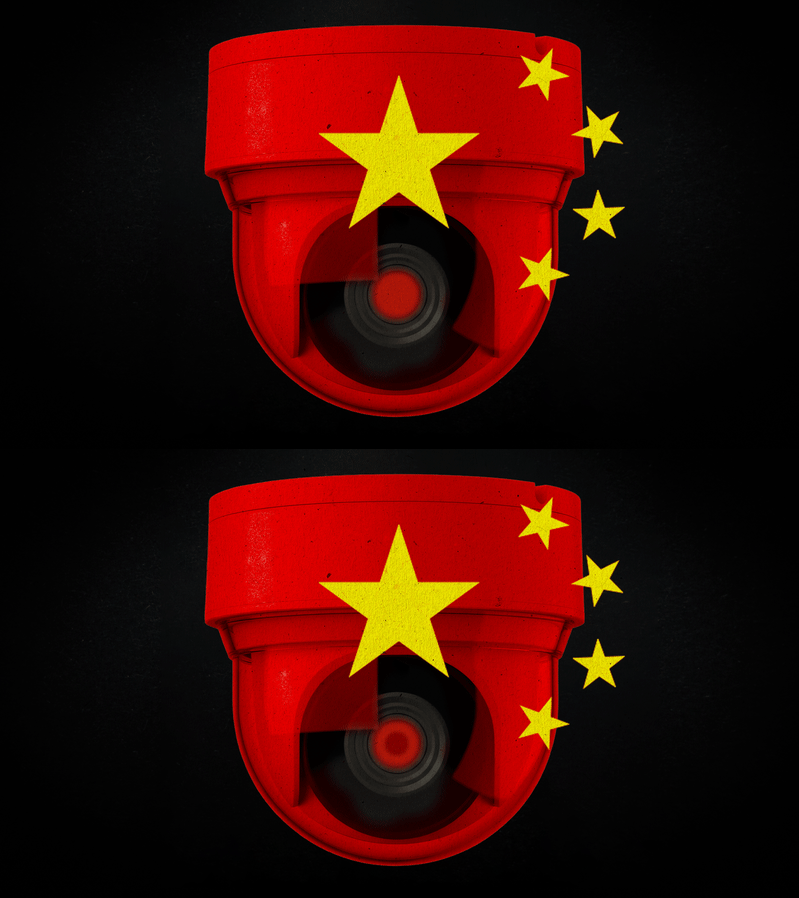
    The Chinese security state hoovers up vast amounts of data, including via some 700 million CCTV cameras installed across the country, checkpoints at train stations, prolific use of facial recognition software, and requirements that hotels register foreigners with police.

    Less clear is how sophisticated Chinese authorities are at pulling this data together to comprehensively track movements and surveil targets.

    But a German cybersecurity journalist’s recent discovery of a prototype policing dashboard has helped piece together a picture of how it could work – and may already be working in some form in parts of China.

    A screenshot of the demonstration model Chinese policing database uncovered by German journalist Marc Hofer. It shows the distribution of foreign residents across Zhangjiakou, in Hebei province, which neighbours Beijing.
    A screenshot of the demonstration model Chinese policing database uncovered by German journalist Marc Hofer. It shows the distribution of foreign residents across Zhangjiakou, in Hebei province, which neighbours Beijing.NetAskari

    “Overall, I think this is the first time we have really seen the access and seen how it could work as a coherent system, even if this is just a demo of a test system,” Marc Hofer says in an interview after publishing his findings on his NetAskari substack blog last month.

    Hofer unearthed the platform, which had been left unsecured on the open web, while poking around in the back end of sites affiliated with China’s Ministry of Public Security.

    The dashboard was still in test mode but appeared to have been developed as a foreigner-tracking tool for the Public Security Bureau in Zhangjiakou, a city in Hebei province that hosted parts of the 2022 Winter Olympics.

    It had a blue log-in page featuring the insignia of the Gong’an (Chinese police) and was titled “Dynamic Control Platform for Overseas Personnel”.

    The database had the details of about 350 foreign journalists who were based in Beijing in 2021, including four Australian reporters working for international news outlets.
    The database had the details of about 350 foreign journalists who were based in Beijing in 2021, including four Australian reporters working for international news outlets. NetAskari

    Hofer says he was able to connect to the dashboard and download some of the data. The dashboard gave an overview of the number of foreigners registered in the Zhangjiakou prefecture and their nationalities, and broadly pinned their locations at a district level on a map of the area.

    But, more significantly, it had been pre-filled with several datasets with what appeared to be profiles of hundreds of real people.

    This included profiles on the approximately 350 journalists based in Beijing in 2021, seemingly so they could be tracked if they crossed into Zhangjiakou for work or even visited as tourists.

    Each profile contained a headshot of the reporter, and listed their news agency, their passport details, mobile phone numbers and date of birth. Hofer’s own profile was among the files, though he has since left Beijing and is now based in Europe.

    Recorded in the database were four Australian reporters working for international news outlets in Beijing at the time, including the BBC and Bloomberg. At the time, there were no Australian-owned media companies operating in China following a fallout in bilateral relations and the arrest of Chinese-Australian TV anchor Cheng Lei.

    A profile of a foreigner captured in a Chinese policing “test” database, tracking their movements, including hotel information and hospital visits.
    A profile of a foreigner captured in a Chinese policing “test” database, tracking their movements, including hotel information and hospital visits.NetAskari

    A few journalists were listed as “trackable” in the system, giving authorities access to more granular data.

    One of them was the London Telegraph’s former China correspondent, Sophia Yan. Using Hofer’s information, she wrote a story for the paper revealing how the database contained CCTV records of her movements across China. She was recorded on 78 occasions at one particular intersection, as well as at supermarkets and subway stations.

    Another “trackable” American journalist was recorded at Zhangjiakou snow fields, his image captured via a ski pass system as he was wearing his snow gear.

    Overall, the system appeared to have more comprehensive profiles on foreign residents rather than on journalists in Zhangjiakou, including international students in the region, Hofer says.

    The most detailed profiles gave authorities access to information such as the number of hospital visits they had made, which hotels they were staying at, frequently visited places, and even petrol purchases – possibly reflecting authorities’ anxieties about self-immolating protesters in Tibet and other rural areas.

    It also recorded transport details, including the train a person arrived on and their seat number.

    “Foreign residents in the area get more or less tracked 24/7 by the looks of it,” Hofer says, while journalists and others would be only temporarily tracked when they arrived in the area and the system was alerted.

    The dashboard also had a “relationship modelling” function, which appeared like a web, with lines connecting profiles so that authorities could see how a target was linked to other people. One landing page had a “top 10” of foreigners who travelled together, with two Ukrainians recorded as having done so 314 times.

    “It seems to be set up for seeing who knows each other, who is affiliated with each other, and to have this information at their fingertips. By visually mapping them, you could see how often someone would meet up for coffee, or how often they would be seen walking with each other through town,” Hofer says.

    It further categorised certain people of interest as “key personnel”, those with “penalties”, and those deemed “fugitives”. There was no extra detail on the criteria for these categories. There were about 40 Australians registered across these categories, most of whom had Chinese names, though this masthead has been unable to independently verify whether their recorded details were correct.

    One graph kept statistics on the number of foreigners in Zhangjiakou from “Five-Eyes” countries, the intelligence-sharing network between Australia, Canada, New Zealand, the United Kingdom and the United States.

    Related Article

    Security cameras in front of a portrait of former Chinese leader Mao Zedong at Tiananmen Square.

    But the system was clearly incomplete, Hofer says, with data missing for some profiles and not as sophisticated as it could have been. For example, it did not have mobile phone tracking data.

    Nonetheless, the platform provides an insight into the lengths Chinese authorities are prepared to go to keep tabs on foreigners of interest and, in particular, on overseas media. In its latest annual report, the Foreign Correspondents’ Club of China stated that the surveillance of foreign press “has grown increasingly sophisticated and digitalised” and included the use of drones by authorities to monitor journalists in the field.

    “But the most common methods of interference remain traditional: correspondents are frequently followed, confronted or blocked by police, plainclothes officers, or unidentified individuals, making interviews difficult or unsafe for sources,” it said in its 2025 report, based on survey data from foreign reporters.

    Over the past decade, the Chinese government has expanded its massive urban video surveillance network called Skynet, which it asserts it uses for public safety. The system can track individuals in real time using facial recognition software.

    In 2015, authorities launched a related initiative called Sharp Eyes, which pushed surveillance into regional and rural areas with the goal of reaching 100 per cent coverage of public spaces.

    Fergus Ryan, an expert on Chinese tech systems at the Australian Strategic Policy Institute, says the common Western assumption is that China’s surveillance system is an all-seeing panopticon, but in reality, its collation of data is patchy across different jurisdictions.

    He says the north-western province of Xinjiang – where China is accused of (and denies) suppressing the Muslim Uyghur minority group – is believed to have the most sophisticated surveillance systems capable of fusing disparate data sources into a targeting tool.

    Surveillance cameras in Tiananmen Square in Beijing.
    Surveillance cameras in Tiananmen Square in Beijing.Bloomberg

    “What [the] Zhangjiakou [database] suggests is that the model isn’t confined to Xinjiang any more. The same cross-database analytics and movement tracking architecture is spreading to the rest of China, and foreigners are now in scope,” he says.

    When contacted for comment and provided with links to Hofer’s findings, China’s Foreign Ministry said, “we are not aware of the circumstances you have described”.

    Related Article

    Recently imported electric vehicles parked in a storage yard in Kilsyth in Melbourne’s east.

    Hofer says he monitored the Zhangjiakou database for months and initially thought it had been abandoned, but in April, he noticed tweaks were still being made in the backend.

    Hofer and Yan co-ordinated their coverage of the database. Within hours of Yan’s Telegraph story and Hofer’s Substack findings being published, the site had been closed off.

    “The whole server was pretty much scraped clean. It was still running, but the doors to all the rooms were locked,” Hofer says.

    This reporter is a member of the Foreign Correspondents’ Club of China.

    Get a note directly from our foreign correspondents on what’s making headlines around the world. Sign up for our weekly What in the World newsletter.




    Source link

    Related Posts

    From Euphoria to Turned On to Margo’s Got Money Troubles, sex work is all over TV. Which shows tell the real story?
    Australia

    From Euphoria to Turned On to Margo’s Got Money Troubles, sex work is all over TV. Which shows tell the real story?

    June 7, 2026
    Life after prison: Three women share their personal journeys of rebuilding and reintegration
    Australia

    Life after prison: Three women share their personal journeys of rebuilding and reintegration

    June 7, 2026
    Greenacre home invasion: Man suffers severe arm injuries
    Australia

    Greenacre home invasion: Man suffers severe arm injuries

    June 7, 2026
    Roland Garros 2026: Russian teenager Mirra Andreeva wins French Open to claim first grand slam
    Australia

    Roland Garros 2026: Russian teenager Mirra Andreeva wins French Open to claim first grand slam

    June 6, 2026
    Inner west home sells for $300k under reserve in ‘cautious’ market
    Australia

    Inner west home sells for $300k under reserve in ‘cautious’ market

    June 6, 2026
    Shots fired at events venue in south-western Sydney
    Australia

    Shots fired at events venue in south-western Sydney

    June 6, 2026
    Next Post
    Remove the right of admission and triple contributions to Fonasa: legal changes for private health insurance

    Remove the right of admission and triple contributions to Fonasa: legal changes for private health insurance

    POPULAR NEWS

    Energy Minister calls Jamaica electricity blackout ‘unacceptable’; orders probe | News

    Energy Minister calls Jamaica electricity blackout ‘unacceptable’; orders probe | News

    June 6, 2026
    (3)

    (3)

    June 7, 2026
    More details about the fights in the center of Vilnius have come to light

    More details about the fights in the center of Vilnius have come to light

    June 7, 2026

    Lithuania risks breaching EU fiscal rules as defence spending mounts

    June 7, 2026
    Continued uncertainty over Pernille Harder’s availability for World Cup qualifier against Sweden

    Continued uncertainty over Pernille Harder’s availability for World Cup qualifier against Sweden

    June 7, 2026

    EDITOR'S PICK

    High Commissioner of India to SVG hands over Edinboro Hard court

    High Commissioner of India to SVG hands over Edinboro Hard court

    June 6, 2026
    Matthew Perry’s assistant is the latest to be sentenced for his ketamine overdose death

    Matthew Perry’s assistant is the latest to be sentenced for his ketamine overdose death

    June 6, 2026
    New transformer arrives to boost power grid stability in southern Libya

    New transformer arrives to boost power grid stability in southern Libya

    June 6, 2026
    The Minister of Communications recommends the media

    The Minister of Communications recommends the media

    June 6, 2026

    Recent Posts

    • (3)
    • More details about the fights in the center of Vilnius have come to light
    • Lithuania risks breaching EU fiscal rules as defence spending mounts
    • Continued uncertainty over Pernille Harder’s availability for World Cup qualifier against Sweden

      © 2026 Agentially - Navigating shifting sovereignties and global risk .

      Welcome Back!

      Login to your account below

      Forgotten Password?

      Retrieve your password

      Please enter your username or email address to reset your password.

      Log In
      No Result
      View All Result

        © 2026 Agentially - Navigating shifting sovereignties and global risk .

        This website uses cookies. By continuing to use this website you are giving consent to cookies being used. Visit our Privacy and Cookie Policy.