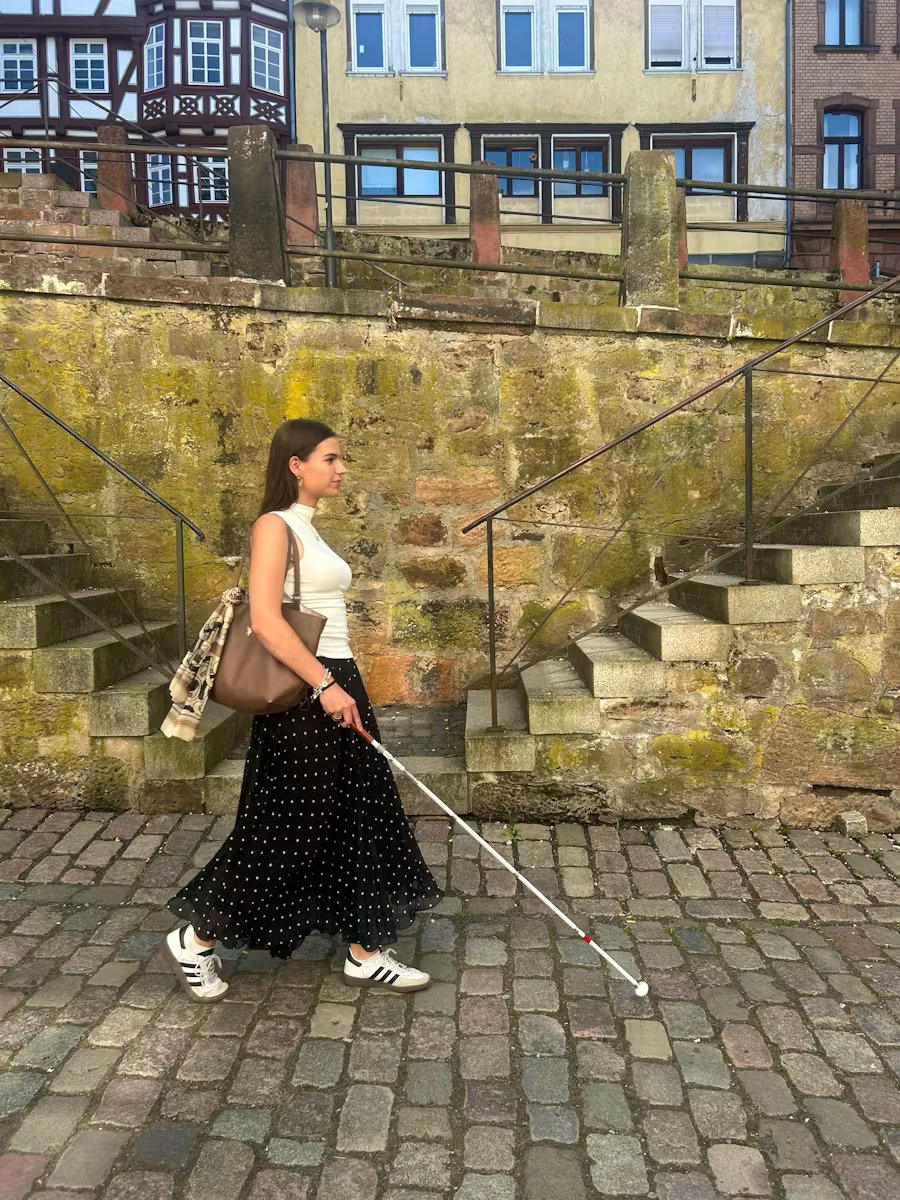
- Emma (20) has been gradually losing her eyesight since she was a child and today only about one percent can see.
- Many people don’t believe her blindness because she studies, uses social media and lives alone.
- The German orientates herself in everyday life using noises, smells and fixed processes.
- With videos on social media, she raises awareness about blindness and gives hope to other sufferers.
- Emma says blindness is hard, but her life is still full and valuable.
She didn’t suddenly lose her eyesight. It came gradually. First it was 13 percent Eyesight. Then less. Today Emma only sees about one percent – and yet people still tell her that she can’t do it at all blind be.
“I’ve even heard that I’m too pretty to be blind,” says the 20-year-old from Marburg. She laughs briefly, then becomes serious. “Many people simply have a very specific image of blind people in their heads. And if you don’t look exactly like that, they won’t believe you.”
What is cone-rod dystrophy?
“At 14 I knew: I would go blind”
Her illness started early. She was diagnosed with cone-rod dystrophy when she was seven years old. For years her vision worsened. She didn’t really understand what that meant until she was a teenager. “When I was 14, I was diagnosed that I would eventually go blind. I felt really bad mentally.”

She was in clinics, underwent therapy, and could no longer imagine her life. “I really thought at the time that my life was over. I couldn’t imagine living alone, studying or even having a normal life.” Today Emma is studying at university. She lives alone, does yoga and Pilates, goes to bars with friends, cooks, and posts videos on social media.
“Curbs, noises or smells help me”
“I don’t really see anything in the middle anymore,” she says. “It’s like a flying anthill made of points of light.” She only notices blurry outlines at the edges. She can still recognize some colors, but hardly any details. She has to hold photos extremely close to her face.
In everyday life she orients herself through noises, smells and fixed processes. Every object has a fixed place in her apartment. On familiar paths, curbs, certain noises or smells help her. “I basically walk a path in my head.”
“Many people think: She can’t be blind.”
Nevertheless, it is often not the practical restrictions that cost the most energy – but rather the reactions of other people. “It’s incredibly stressful to constantly have to prove yourself,” she says. The fact that she studies, travels alone or does social media regularly causes mistrust. “Many people think: If she can use her cell phone, she can’t be blind.”
The cell phone is one of their most important tools. She uses voice output, magnifications and AI programs that describe images to her. “But many people don’t even know that this is even possible.”
Things got particularly absurd once at the train station. Emma was walking through the hall with her cane when a strange man approached her. “He told me it was anti-social to use a blind cane if you weren’t blind.”
What would be most difficult for you if you constantly had to justify the way you live?
She hadn’t used her cane for long back then. «That was a huge overcoming for me. And then someone even uses a cane to deny your blindness.”
“It’s annoying that people know so little about blindness”
At some point, she started talking about her life on social media. Above all, to educate other people: “It annoyed me so much that my blindness was repeatedly denied, but at the same time I hardly knew anything about blindness at the time of my diagnosis. That’s why I wanted to make my experience with the disease visible.”
Today there is another reason: “I’m actually doing this for my younger self,” she says. Because when her vision became worse, she lacked role models. People who showed her that a fulfilling life is still possible. “Back then, I needed someone to show me: your life doesn’t stop.”
Today she receives exactly the same messages herself. From people who are currently going blind. From parents of blind children. From those affected who write to her that her videos give them hope.

“There are bad days”
One message particularly touched her: a mother wrote to her saying that her daughter was blind because of a tumor and was very afraid of the future. “She said my videos would show her that she can still be happy. That she can still go out partying, put on makeup, study or fall in love.”
Emma still doesn’t want to romanticize blindness. «It’s hard. There are bad days. And acceptance is not a point that you reach at some point and then everything is fine.” To this day, she has moments in which she feels sad about what she has lost. «It is a meaning that is missing. And of course I know that a lot of things would be easier if I could see.”
But she learned that her life still goes on. “I think the most important thing is that people understand: blindness is not everything that defines you,” she says. «I’m not just blind. I’m just Emma.”

Deborah Gonzalez (dgo) has been working at 20 Minuten since 2021. She is deputy head of the Society & Community department.