A man who is so deeply ashamed that he tries to keep a balloon under water for 35 years. Like this described Sylvana Simons attended on Tuesday evening Pauw & De Wit Donald Pols, who was dismissed from Tata Steel after one day because he had concealed his past with an extreme right-wing South African student organization. The affair was a missed opportunity, Simons said in an empathetic analysis: “If he had shared it with the world, he could have been a wonderful example of what your environment can do to you in your young years, how you can radicalize, how you can deradicalize.”
Pols’ dark past – which was revealed by NRC – was often interpreted as a youthful sin, including by Pols himself: “I may have been nineteen years old, but I actually had the brain of an adolescent. And I chose a path that I now look back on with disgust.” The conclusion was repeatedly heard on TV that Pols could have saved himself some of the misery if he had come forward with his story on his own initiative. What can past affairs teach us about dealing with bad choices?
Also read
The hidden past of Donald Pols: ‘I chose a path that I now look back on with disgust’
:format(webp)/s3/static.nrc.nl/wp-content/uploads/2026/06/01120454/030626OND_2033865437_hp-1.jpg)
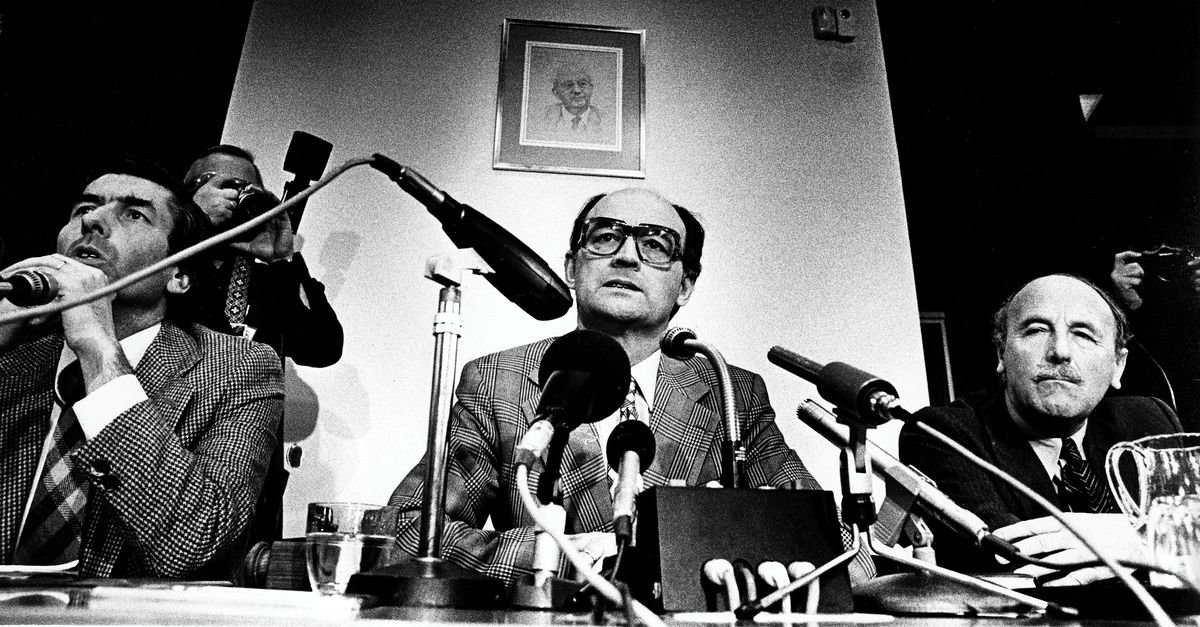
Donald Pols is not the first public figure to get into trouble due to a ‘youthful sin’, a term that implies a certain willingness to forgive. The name of was also mentioned on TV on Tuesday Willem Aantjes (1923-2015), who had to resign as faction leader of the CDA in 1978 after historian Loe de Jong reported in a live television broadcast that he had been a member of the Waffen SS in 1944. Later, new research nuanced De Jong’s findings – for example, it concerned membership of the less extreme Germanic SS – and the historian expressed regret about his “unqualified” press conference. Although Aantjes considered himself rehabilitated, his role in the CDA was over: he became chairman of the Camping Council.
Aantjes was not the only one who was confronted with a shameful history of the Second World War, but the consequences were not equally serious for everyone. A year after Aantjes was Joseph Luns (1911-2002, Minister of Foreign Affairs for many years and Secretary General of NATO from 1971) subject of a revelation by Loe de Jong. He turned out to have been a member of the NSB from 1933 to 1936. At first Luns claimed that he was confused with his brother Huib, and secondly he stated that he had been registered as a member by that brother without his knowledge. Huib Luns later confirmed this in a written statement, which his widow later said was false and was only intended to protect Joseph Luns’ position at NATO.
Silence and denial
Silence and denial are commonly used methods. For example, Prince Bernhard maintained until his death that he had never been a member of the NSDAP, despite steadily accumulating evidence. The poet’s biographer Lucebert (1924-1994) only revealed in 2018 that he had had Nazi sympathies at the age of eighteen, as evidenced by letters that also contained anti-Semitic passages. Later in his life, Lucebert would profile himself as an outspoken anti-fascist writer. But because he never said a word about that part of his war history and was therefore never asked about it, he did not have the opportunity to say that he looked back on those letters “with disgust” (Pols’ words).
:format(webp)/s3/static.nrc.nl/wp-content/uploads/2026/06/05125109/050626WEE_2034223434_luns.jpg)
Then NATO Secretary General Joseph Luns (left) shakes hands with Loe de Jong in 1979 as he leaves the NIOD office on Amsterdam’s Herengracht.
Photo ANP
War histories are not the only pasts that get people into trouble. State Secretary Philomena Bijlhout resigned as State Secretary for the LPF in 2002 after one day, when it emerged that she had lied about her membership in the civilian militias of the Bouterse regime in Suriname. VVD member Hans van Baalen (1960-2021) did not become an MP in 1998 after Free Netherlands published a classic juvenile sin story. The magazine wrote about Nazi sympathies in Van Baalen’s student days, including an admiring letter to Joop Glimmerveen of the extreme right-wing Volksunie. Van Baalen denied. When it later turned out that it could not be established with certainty that he had written the letter, he became a Member of Parliament and followed a long political career.
These almost always concern issues where there is a broad social consensus about what is morally reprehensible. This applies to the occupation period, South African apartheid, extreme right-wing sympathies, the Bouterse regime in Suriname and also to organized crime.
‘That tall woman’
This became apparent in 2003 Mabel Wisse Smitthe fiancée of Prince Johan Friso, had maintained friendly relations during her student years with the drug criminal Klaas Bruinsma, who was murdered in 1991. Journalist Peter R. de Vries even presented a TV interview with a former bodyguard of Bruinsma who claimed that Wisse Smit had been “that tall woman”, something that later researchers believed was based on mistaken identity. The expectant couple was accused of not having told Prime Minister Balkenende everything about the contacts between Wisse Smit and Bruinsma. The Prime Minister decided not to submit a consent law to the House of Representatives, as a result of which Friso could no longer claim the throne. “Nothing can be done against untruth,” said Balkenende.
Most juvenile sinners keep their past to themselves until they are caught
For example, in several cases (Pols, Bijlhout, Wisse Smit) the formal reason for dropping someone is not youth sin as such, but insufficient openness about it. That does not mean that openness always helps. GroenLinks MP Wijnand Duyvendak stepped down in 2008, just days before the publication of his book Climate activist in politics. In it he acknowledged involvement in a burglary at the Ministry of Economic Affairs in 1985. Duyvendak had been under fire for some time because of his past in action, about which he had never been secretive. He was sentenced to six weeks in prison for a burglary at a military complex in 1984, followed later by unproven accusations of involvement in the violent action group Rara.
In 2022, VVD member Soumaya Sahla was known that she had been imprisoned for three years as an ex-member of the terrorist Hofstad group. Yet she had to after complaints from PVV leader Geert Wilders step down as “terrorism and radicalization table chair” of her party. (Two years later, she was expelled as a party member after being accused of having “stealed” money from former party leader Frits Bolkestein.)
Communication logic
Donald Pols should have just told everything himself earlier. The aforementioned advice subsequently complies with the communication logic, which prescribes that you should always maintain as much control over the reporting as possible: it is better to get everything out at once. In the meantime, this is not always simple in practice: most juvenile sinners keep their past to themselves until they are caught.
In any case, one cannot determine how history ultimately judges. Over the decades, consensus grew about Aantjes that injustice had been done to him, while opinions (roughly along political lines) remained divided about Luns and Prince Bernhard. What was there to debate about Mabel Wisse Smit died down after the tragic skiing accident of Prince Johan Friso in 2012. Wijnand Duyvendak remained active with GroenLinks after his resignation: among other things, he was campaign manager in the successful 2017 parliamentary elections.
The effect of shame cannot be underestimated, wrote psychiatrist Louis Tas
There is always shame that gets in the way of openness. Donald Pols told NRC that even his wife and children knew ‘hardly’ anything about this episode from his past. The effect of shame cannot be underestimated, wrote psychiatrist Louis Tas in his article ‘Notes on Shame’ (1995): “Shame is not only an urgent, anxious, angry, incantatory attempt to hide oneself and to escape the witheringly critical gaze of the all-powerful Other. Shame also entails the often quite successful tendency to hide the shame itself.”
:format(webp)/s3/static.nrc.nl/wp-content/uploads/2026/06/05124909/050626WEE_2034223434_bijlhout.jpg)
Philomena Bijlhout in July 2002 after announcing her resignation as State Secretary in The Hague.
Photo ANP
Journalist wrote about the length of the road from shame to openness Sheila Sitalsing in Which I’m ashamed of. About silence and passing on blamewhich was awarded the E. Du Perron Prize in April. That book is about her dealings with her family’s Second World War past and her relatives’ silence about it. In the book, Sitalsing wonders why her mother kept silent for so long about the wrong past of Sitalsing’s grandparents. Her sister connects this silence with the fact that their mother never talked about it with their father. “And once he didn’t know, we too became part of the not knowing.” The step towards telling is not so small.
When Sitalsing herself goes to the Central Archives for Special Legal Affairs to investigate the concealed family history, she discovers that it is difficult to summarize it in a coherent story. ‘Perhaps I have become too conditioned – ruined – by all those years of Hollywood films and journalism, industries in which life courses like to be presented as moral narratives in which there is a reason for every behavior and a cause for every event (…) That is Hollywood and talk show kitsch.”
Seen in this light, it is perhaps not surprising that Donald Pols was unable to come forward with his secret childhood sin on his own.