The song “Odakle su, sele” celebrated folk music singer Snežana Đurišić and introduced it into the textbook for primary school students.
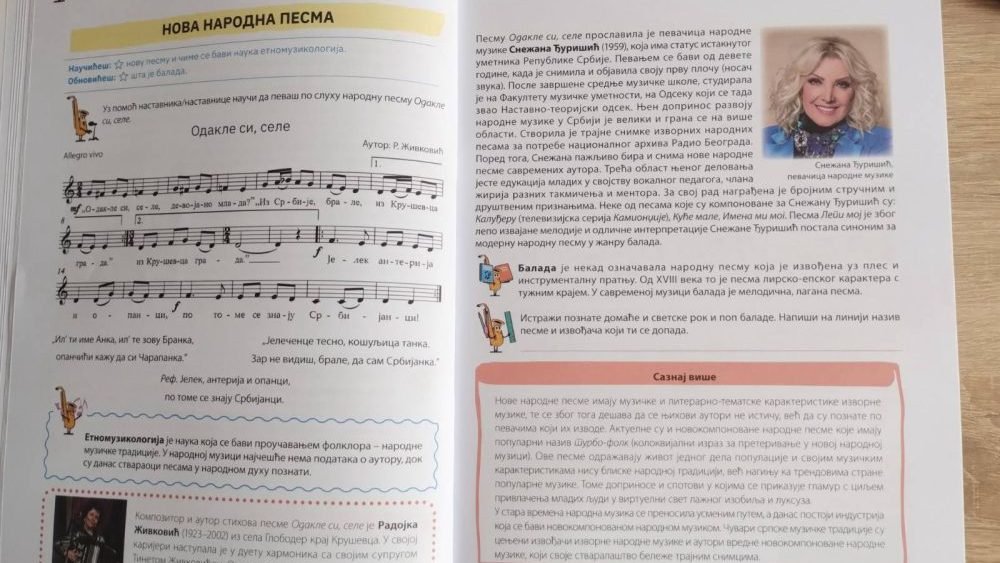
Namely, her name was found in the textbook Musical culture for the 8th grade of the publishing house Data status, in the lesson New folk song, as an example of the performer of the mentioned song, the author and composer of which is Radojka Živković.
If the authors of the textbook had stuck to three sentences from the biography of Radojka Živković and a few verses of the song “Odakle si sele”, which they recommended that the students sing by ear, everything would probably have gone unnoticed, but the fact that almost a third of the page was dedicated to Snežana Đurišić caused negative reactions from part of the public.
Although the part of her biography shown in the mentioned textbook is not disputed, the question is open according to which criteria the name of a performer can appear in school books and whether this is prescribed by the curriculum, which the publishers are obliged to follow, so that the textbook could be approved at all.
“The song Odakle si, sele was made famous by the folk music singer Snežana Đurišić (1959), who has the status of a prominent artist of the Republic of Serbia. She has been singing since the age of nine, when she recorded and published her first record (sound carrier). After graduating from high school, she studied at the Faculty of Music, in the Department that was then called the Teaching and Theory Department,” the aforementioned lesson says.
It is added that the contribution of this singer to the development of folk music in Serbia is great and that it branches into several areas.
“She created permanent recordings of original folk songs for the needs of the national archive of Radio Belgrade. In addition, Snežana carefully selects and records new folk songs by contemporary authors. The third area of her activity is the education of young people in the capacity of a vocal pedagogue, a member of the jury of various competitions and a mentor. She has been awarded numerous professional and social recognitions for her work. Some of the songs composed for Snežana Đurišić are: Kaluđera (television series Truckers), Little Houses, My Names.” The song Lepi moj, due to its beautifully sculpted melody and excellent interpretation by Snežana Đurišić, has become a synonym for a modern folk song in the ballad genre,” says the singer’s biography, which some believe is a redundant addition to the lesson itself.
On the same page under the heading “Find out more”, the authors explain that new folk songs have musical and literary-thematic characteristics of the original music, which is why their authors do not stand out, but are known for the singers who perform them.
“Newly composed folk songs that have the popular name turbo-folk (a colloquial expression for exaggeration in new folk music) are also current. These songs reflect the life of a part of the population and their musical characteristics are not close to the folk tradition, but lean towards the trends of foreign popular music. This is also contributed by the videos that show glamor with the aim of attracting young people to the virtual world of false abundance and luxury,” the textbook says.
It is also stated that in the old days, folk music was transmitted orally, and that today there is an industry that deals with newly composed folk music.
“Guardians of the Serbian musical tradition are valued performers of original folk music and authors of valuable newly composed folk music, who record their creativity with permanent recordings,” the textbook says.
The textbook Musical culture for the 8th grade, whose authors are Sonja Marinković and Slavica Stefanović, is in catalog of approved textbooks Ministry of Education, but it will be used in schools only from the next school year.
When asked by Danas why Snežana Đurišić is mentioned as an example, the publishing house Data Status sent us the answer of the author of the textbook:
“In accordance with the curriculum of the Music Culture course for the eighth grade, an example of the song ‘Odakle si, sele’ is given, interpreted by Snežana Đurišić. In order to shed light on the way of creating a new folk song, it is necessary to explain to the students the role of the performer, and the singer Đurišić, who contributed the most to the popularization of the mentioned song, was chosen. In addition, this singer has the necessary vocal qualities to be a positive role model for the students. The lesson also contains other explanations, and is any extraction from the context of abuse”, according to the authors.
They note that in the textbook of the publishing house Data Status, as well as in the textbooks for the same grade of other publishers, many authors and performers are mentioned in the genre of popular music, because that is what the curriculum requires.
They also point out that the textbook for the subject Musical culture for the eighth grade of the publishing house Data Status has been approved for use in elementary schools by the Institute for the Improvement of Education in 2025.
Data Status emphasizes the professional credibility of the authors of the textbook, stating that Dr. Sonja Marinković was a full professor at the Faculty of Music Arts, University of Belgrade, while Dr. Slavica Stefanović was an assistant professor at the same faculty. Both are now retired.
The mention of Snežana Đurišić in music is not disputed by the institution that deals with the approval of textbooks – the Institute for the Improvement of Education and Training (ZUOV).
“The song ‘Odakle si, sele’ is given in the textbook as an example of songs that are folk, but not traditional in the true sense of the word, because they have a well-known author, but due to its popularity and duration, it can be classified as a type of traditional song. When the text of the song is placed in the textbook, it is understood to write something about the author and the performer. Snežana Đurišić is a performer who left numerous permanent recordings of singing traditional songs for the needs of Radio Belgrade,” they say in ZUOV.
ZUOV emphasizes that musical culture is a compulsory subject that, in addition to performing music by singing and playing, introduces students to the music of various eras.
“From the fifth grade, students learn chronologically everything related to the history of music. In the eighth grade, the music of the 20th century, both in the world and in our country, is covered, and different genres of music are mentioned. When it comes to traditional music, it is present from the very beginning of school, by starting with simpler melodies and rhythms. Great care is taken to emphasize the preservation of the cultural heritage of our nation, as well as that of other nations,” explained ZUOV.
They state that the music culture textbooks for the 8th grade contain different genres, in accordance with the plan and program of teaching and learning for the 8th grade, from traditional music, through art and old town music to jazz and blues, rock, pop, hard rock, R&B, techno music, as well as folk, because they are all related to the music of the 20th century.
“Since musical culture is a subject that, in addition to developing other competencies, deals with the development of critical thinking, the students are offered a wide range of musical examples, and through reflection and communication, they arrive at what is quality and what is not,” answered ZUOV when asked by Danas how, when reviewing textbook manuscripts, it is assessed whether a name is controversial or not.
By the way, examples of compositions for listening and performing are given in the teaching and learning program.
The teacher has the opportunity to freely choose up to 30 percent of the compositions for listening and performance, taking into account the appropriateness of the teaching content, the age of the students, their abilities and interests, aesthetic requirements, outcomes and the locality where the school is located.
“The ratio between the offered compositions and examples from other literature should be at least 70 percent in favor of the ones offered. For the aforementioned reason, the teaching and learning program contains a larger selection of teaching material (for listening and performing) compared to the annual fund of lessons of the Music Culture course,” it is written in program for the eighth grade.
The authors of the textbooks illustrate the lessons on domestic contemporary music with numerous examples, including the music textbooks of Bajaga, Riblja chorba, Van Gogh, Jadranka Stojaković, Deca loših muziković, Partibrejkerski, Šaban Bajramović, Esma Redžepova, EKV, Piloti, Zdravko Čolić…
Follow us on our Facebook and Instagram page, but also on X account. Subscribe to PDF edition of Danas newspaper.