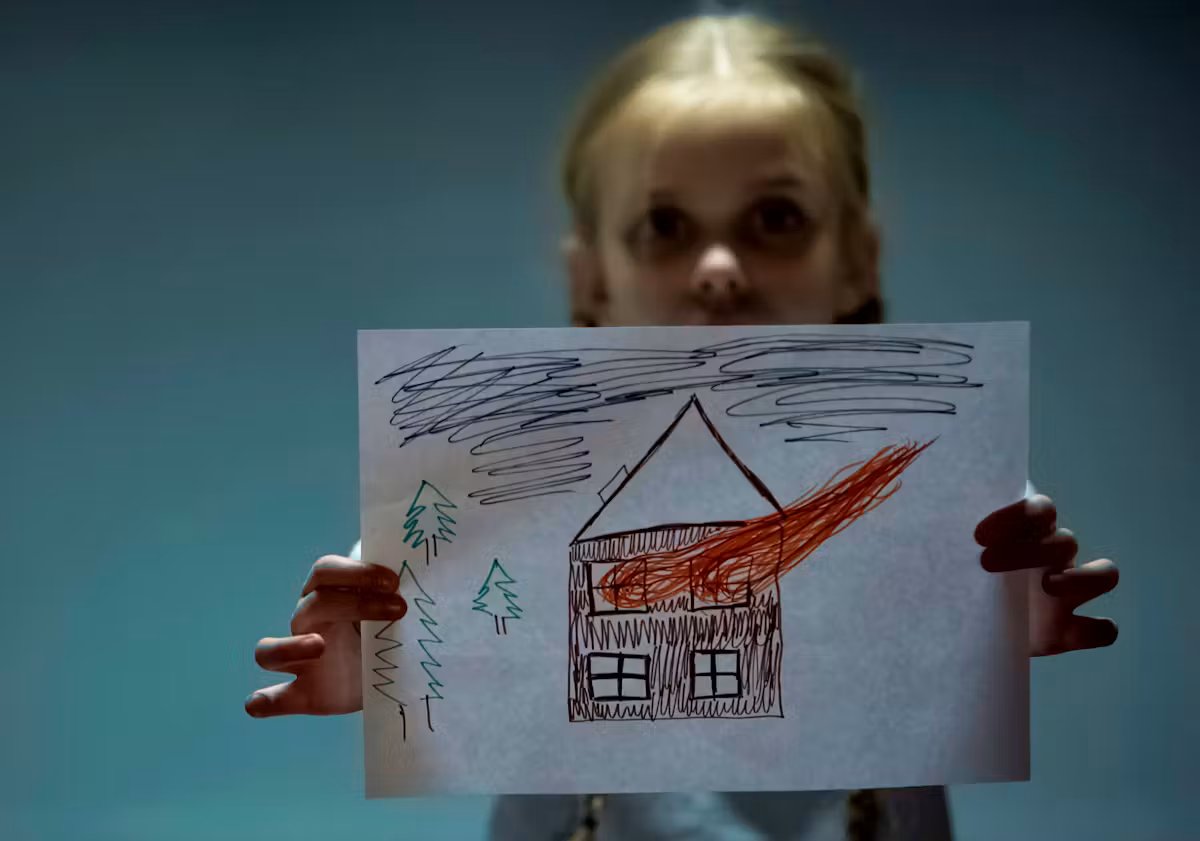
- According to experts, children should not be prematurely labeled as “psychopaths”.
- The debate was triggered by a Tiktok video in which a teacher reports on a first-grader with violent fantasies.
- As experts explain, not every violent fantasy in children is directly pathological.
- Experts recommend observing unusual behavior and seeking professional help if there are specific threats or callousness.
“Since I worked in a primary school, I’ve known that psychopaths are born that way,” says German Tiktoker Maliboo (26). On her first day as an integration assistant in a primary school, she met a little boy who made several statements that disturbed her.
«When I saw him for the first time, I thought: That’s a sweet little boy. Then he started talking,” Maliboo tells 20 Minutes.
Violent fantasies and critical questions
The first grader asked her at a pond: “Do you think many people have drowned here?” and shortly afterwards: “If someone were drowning, would you save the person or let them die?”
He also noticed him in physical education class: While other children were playing catch, he pushed them and laughed when they cried. When asked why, he replied: “I want to hunt them all down and kill them.” In general, the 26-year-old stated: “He is very interested in hurting or hunting others. That’s very scary.”
He often travels alone because other children are afraid of him. They also noticed his behavior. He killed beetles and said to an injured girl: “I want to see the blood.” Maliboo often asked himself: “How do you come up with such thoughts?” She says that intensive work is being done to help him and that the relevant specialists have already been informed.
Many users were shocked in the comments. Some called for teachers and parents to be informed immediately, others reported similar experiences. But how dangerous are such statements actually – and when do they become a warning signal?
Have you had similar experiences with children? Have you ever experienced children exhibiting antisocial behavior or violent fantasies? Tell us your story in the form!
Can children be psychopaths?
When asked by 20 Minutes, Volker Schmidt, chief physician and co-head of the Center for Child and Adolescent Forensics, said that seemingly psychopathic or antisocial personality traits can already appear in childhood. Characteristics such as lack of emotion, lack of guilt and low empathy could be precursors to later antisocial developments. “In severely stressed children, the apparent insensitivity can also be a protective reaction.”
However, not every unusual behavior is worrying (see blue box). “Lying out of fear of punishment, impulsive aggression or even violent fantasies can occur as part of normal development.” Behind aggressive fantasies could be anger, stress or the desire for strength.

“I want to kill her” – how dangerous is this statement?
Regarding the statements from the first grader, Dr. med. Volker Schmidt, his development, frequency and other abnormalities played a role. “Statements like ‘I want to hunt and kill them all’ should be taken seriously, but not evaluated in isolation.” Accordingly, children would often use such formulations impulsively, in play or in emotional excitement – without any intention to kill. “However, if such statements occur repeatedly, are associated with aggressive behavior or there is no discernible insight or remorse, they may indicate an increased need for clarification.”
When it comes to killing insects, psychologist Anuar Keller explains that we have already been socialized and legitimized, “that we kill insects in front of children.” For this reason, this statement could already be about natural and unreflective imitation, which is normal behavior in development.
When violent fantasies become a warning signal
According to Schmidt, you should pay attention to behavioral patterns that are noticeable over a long period of time in various areas of life. “These may include a remarkably low level of anxiety, a lack of guilty conscience, callousness, enjoyment of humiliating others, repeated cruelty to animals or arson.”
A professional clarification is recommended in the case of concrete threats or plans, increasing identification with violence, enjoyment of the suffering of others or social withdrawal. The most helpful approach is usually a joint approach between parents, school and specialists. “Higher levels of intervention include child protection measures or juvenile criminal justice measures from the age of 10.”
“Not every violent fantasy is pathological”
Anuar Keller, psychologist and department head of the school psychology service and the child protection department, emphasizes that “psychopathy” is not used as a diagnosis for children. Instead, it is about possible disorders of social behavior. “Children’s personalities develop over many years.”
“Not every violent fantasy is automatically pathological.” Children are still learning social rules and how to deal with emotions. The family environment, role models, stress and the ability to regulate emotions played an important role. It is often not individual strokes of fate that are decisive for development, but rather recurring stresses in everyday life. “The ability to adequately regulate emotions is essential for healthy development.”

Don’t be too quick to label children as “psychopaths”.
According to Keller, if children repeatedly attract attention through violent fantasies or unusual behavior, adults should neither trivialize nor hastily label them as “psychopathic”. It is important to observe and document the behavior, to protect the child from embarrassment, embarrassment or escalation and to talk to him about his fantasies. “Many children with unusual behavior continue to develop in a stable and unobtrusive manner with appropriate support.”
How do you deal with unusual or disturbing statements from children?

Selina Keller (sec) has been working at 20 Minuten since 2025 and is an editor in the Community & Society department.