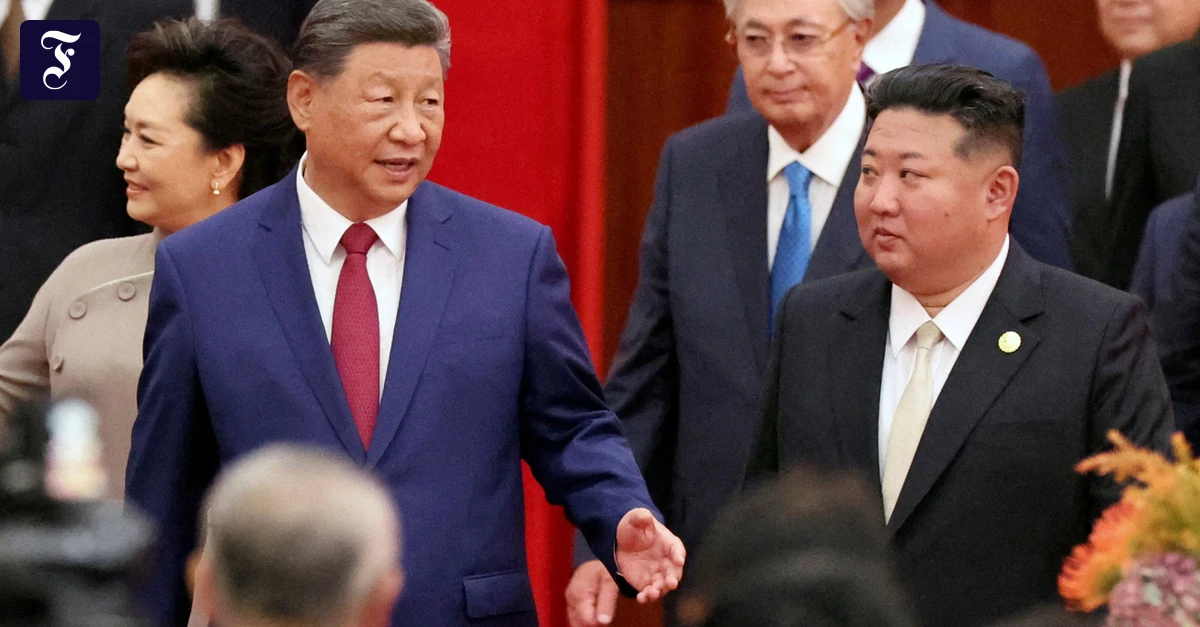
Chinese state and party leader Xi Jinping will be back next week for the first time in seven years North Korea travel. This follows “at the invitation” of ruler Kim Jong-un, the Chinese state news agency Xinhua and the North Korean regime media announced on Friday. It is also Xi’s first trip abroad this year, having just received US President Donald Trump and Russian ruler Vladimir Putin in Beijing.
When Xi visits North Korea next Monday and Tuesday, this trip will also be seen as a Chinese reminder to Washington and especially Moscow that China, not only as the largest trading partner, has significant influence over the regime in Pyongyang. The Chinese Foreign Ministry reminded on Friday that it is the 65th anniversary of the military assistance treaty between China and North Korea.
At the same time it also stands Kim internationally less vulnerable than ever before. North Korea is no longer the country Xi last visited in 2019: At that time, Pyongyang’s talks with the USA failed and international sanctions were not lifted. Since then, Kim Jong-un has largely broken off relations with the West and is concentrating more than ever on China and especially Russia.
And with success: Since 2022, North Korea has been supporting Moscow with troops and ammunition in its war of aggression against Ukraine. In return, Putin has stopped pressuring the North Koreans to scale back their nuclear weapons program for two years. Rather, Moscow is blocking new UN sanctions and undermining existing ones. The proximity to Russia gives Kim some legroom when it comes to Beijing.
“Assert influence”
“China will try to use its influence to prevent unforeseen moves by North Korea, which has moved closer to Russia,” the South Korean newspaper “Chosun Ilbo” quoted diplomatic circles in Beijing as saying. At the same time, people in Beijing also remember that US President Donald Trump met with Kim in his first term in office without any closer involvement of North Korea’s neighboring countries.
In keeping with Xi’s planned visit to Pyongyang, North Korea’s state media distributed images on Thursday showing Kim Jong-un visiting a uranium enrichment plant amidst numerous centrifuges. Kim was quoted as saying that North Korea’s “production capacity for weapons-grade nuclear material” has “doubled” in the past five years. This follows the five-year plan for military modernization, especially of the nuclear forces, announced in 2021.
International recognition of its nuclear weapons program is a long-held goal of the North Korean regime. Beijing has now also scaled back its long-standing official support for the so-called denuclearization of the Korean peninsula, at least rhetorically. When Chinese Premier Li Qiang was in Pyongyang last year for the 80th anniversary celebrations of North Korea’s ruling party, the official Chinese media no longer mentioned the goal of denuclearizing Korea.
Beijing wants to avoid the image of a trilateral axis
Xi had already shown Putin and Kim at his side at a military parade in Beijing last September and also met Kim bilaterally. This marked a visible rapprochement after years of supposedly frosty relations between Beijing and Pyongyang. The time was marked by North Korea’s isolation during the corona pandemic and the growing rapprochement between Russia and North Korea. In 2024, Moscow and Pyongyang entered into a military alliance. Last month, North Korean soldiers marched alongside Russian troops in Moscow for the first time.
While experts say Beijing doesn’t exactly like this cooperation, it doesn’t threaten its core interests either. China wants to avoid the image of a trilateral Beijing-Moscow-Pyongyang axis, but shares a worldview that is directed against the West.
China’s economic relations with North Korea are now said to be back to pre-Corona levels. Beijing is by far North Korea’s most important trading partner. Nevertheless, North Korea has reduced its dependence on China by rapprochement with Russia.
Kim has leverage against China thanks to his strengthening alliance with Putin. The fact that, according to various reports, North Korea receives not only energy but also modern defense technology from Russia will not please China, which is trying to maintain peace and stability on its northeastern flank.
In this context, the South Korean government hopes that Xi will influence Kim to soften the regime’s tough stance towards South Korea. Beijing is expected to “play a constructive role” in Korean affairs, the Foreign Ministry in Seoul announced in an initial reaction to Xi’s trip.