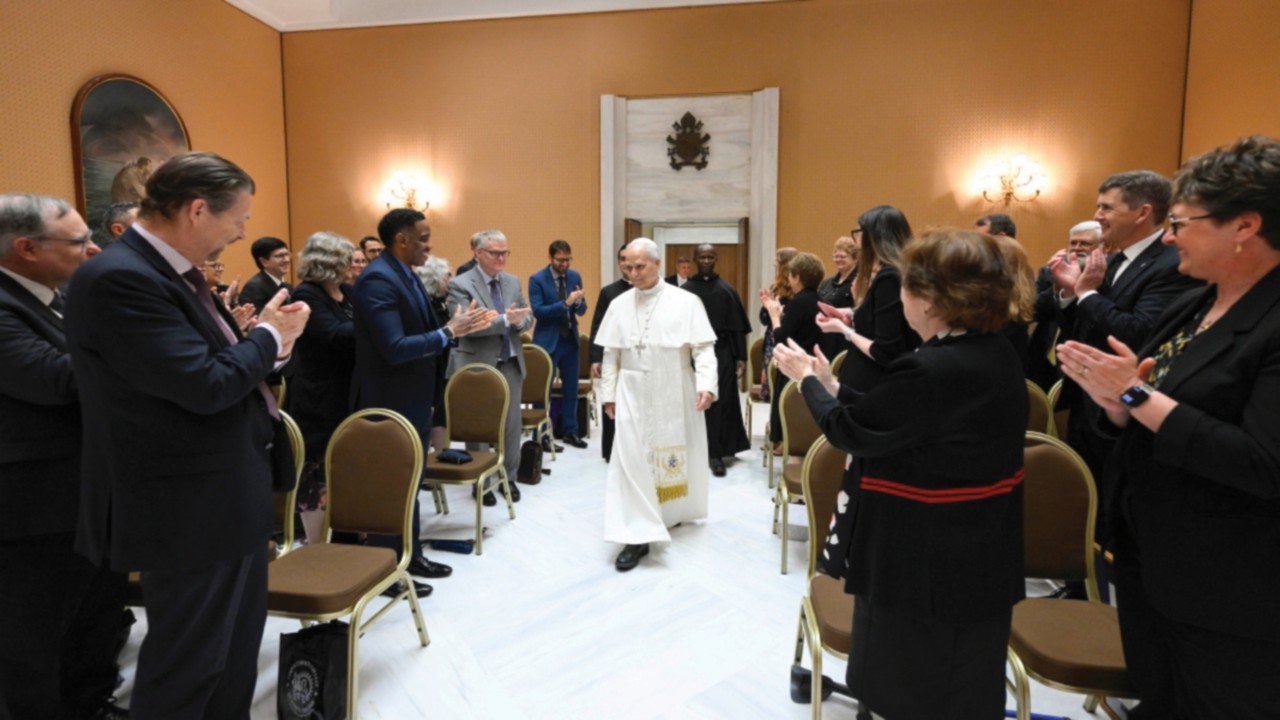
«Recent technological advances also pose numerous challenges to the world of education», therefore «the widespread use of artificial intelligence makes it increasingly difficult to evaluate students’ work, forcing educators to adapt their methods creatively to ensure the integral human education of those entrusted to their care, even when this involves a greater workload for teachers». Leo XIV underlined this while addressing the leaders of the Association of Catholic Colleges and Universities, gathered this morning, Wednesday 3 June, in the small hall of the Paul VI Hall. Founded in 1899, the association promotes Catholic higher education in the United States of America. Below is our translation of the speech given by the Pope in English.
In the name of the Father, of the Son
and of the Holy Spirit.
Peace be with you.
Good morning to all of you, and welcome to this dark and rainy morning in Rome. Today the light shines
from inside!
Dear brothers and sisters in Christ,
I am pleased to greet you on the occasion of the 2026 Seminar of the Association of Catholic Colleges and Universities, which takes place in Rome. As presidents and rectors of these institutions, I trust that the experience lived here, in the heart of the Church, will serve to strengthen your faith and renew your commitment to the universal mission of the Church. In particular, given your dedication to the educational task, I pray that your hearts will be increasingly fascinated by the beauty of truth and the greatness of humanity, created by God and redeemed by Christ.
In light of the Encyclical Letter I recently published, I would like to address a few words to you regarding the fundamental importance of Catholic education in today’s world. One of the challenges that the world of education is currently facing is the growing fragmentation of knowledge. While it is easy to find people who are experts in a particular field of study, many of these people “struggle to give direction to their lives, also due to the inability to connect information and knowledge, and not to lose the horizon of meaning” (Magnificent humanityn. 146). They often lack a global vision of reality capable of uniting not only the various fields of knowledge, but also the many aspects of life and the deepest desires of the human heart.
Catholic education has a particularly important role to play in this regard. When young men and women enroll in your colleges and universities with the intention of obtaining a specific degree, often driven by future job prospects, it falls to you the noble task of directing that desire for knowledge so that they can also “learn to seek and love the truth, to question the meaning of life and the dignity of every person” (Ibid., n. 143). This is no easy feat. As you all know, the search for truth not only requires learning and guidance, but also great effort (see Ibidn. 139). Unless Catholic education instills in students an authentic passion for truth – and not only for intellectual truth, but also for the Truth which is Christ himself (cf. John 14, 6) —, we can hardly expect people to be willing to make the necessary effort to recognize the truth and adapt their lives accordingly. In fact, Catholic institutions are called to be “a living environment in which the Christian vision permeates every discipline and every interaction” (Apostolic Letter Drawing new maps of hopen. 5.2). Your authenticity as true disciples of Christ will certainly help you in transmitting the living Gospel so that those entrusted to you can truly encounter the Lord and discover in the Catholic faith the unifying vision that only the Truth can give.
From a more practical or pedagogical point of view, recent technological advances also pose numerous challenges to the world of education. The widespread use of artificial intelligence makes it increasingly difficult to evaluate student work, forcing educators to creatively adapt their methods to ensure the holistic human education of those entrusted to their care, even though this often places an increased workload on teachers. In this sense, we must be willing to invest generously in the education of future generations. It is essential that young men and women learn to relate positively to new technologies, while developing their God-given gifts and abilities to reason, think critically, and commit knowledge to memory, thereby preparing them to responsibly shape the world to come (see Magnificent humanityn. 145).
Dear brothers and sisters, as you continue to carry out the evangelizing mission of the Church, it is my hope that students will always be able to find sound doctrine in your institutions (see 2 Tim 4, 3) entrusted to the Church, which will serve as a true and lasting foundation not only for their lives, but also for the future of the nation. Thanking you for your presence here and for your dedication to Catholic education, I heartily impart my Apostolic Blessing, which I willingly extend to the people, communities and institutions you represent. Thank you very much.