AUR seems to have abandoned classical ideological boundaries and to borrow, more and more pragmatically, themes and initiatives from the entire Romanian political spectrum. From the reforms regarding the number of parliamentarians, once supported by Traian Băsescu and USR to the messages associated with PSD, such as those related to state companies and their listing on the stock exchange. All these initiatives raise the question: what kind of party does AUR actually become?
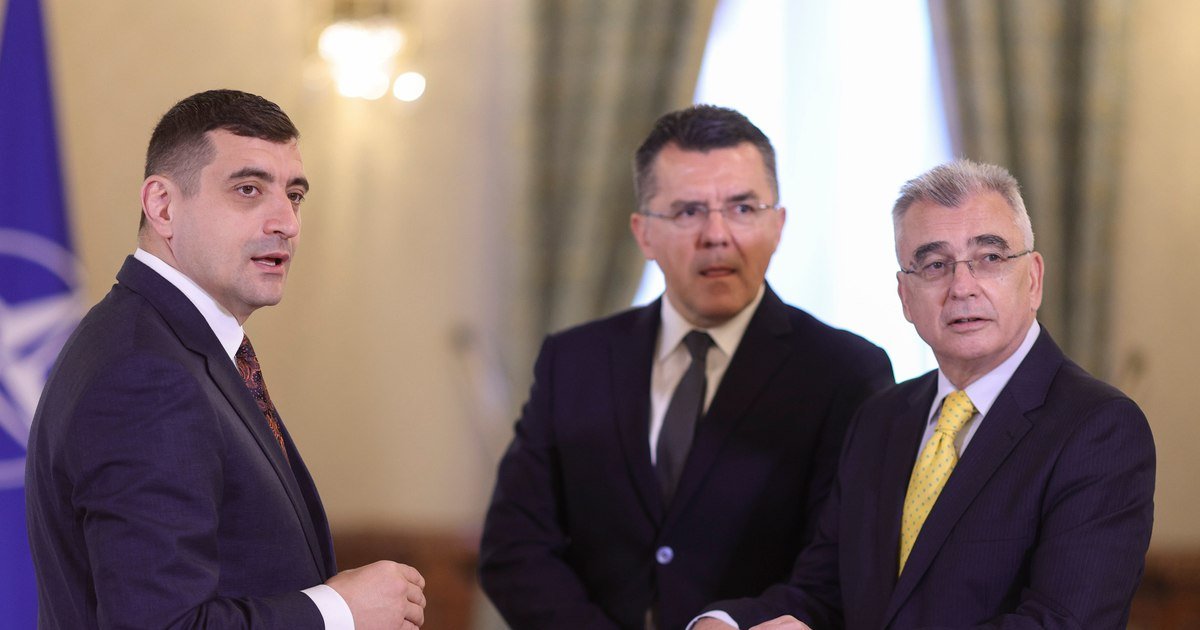
AUR leaders, George Simion, Dan Dungaciu, Petrisor Peiu Photo: Inquam Photos/Octav Ganea
Tuesday’s vote, in the Parliament, for the election of mayors in two rounds, was a surprise, in the context in which the USR voted alongside the AUR for the return to the previous electoral process.
Two weeks ago, the AUR came up with a plan to “reduce administrative expenses and reform public institutions”. It included, among other things, the annual reduction of expenses by 1% of GDP, in the next four years, 300 parliamentarians, a Government with no more than 10 ministries and 20 government agencies. Themes promoted by PNL and USR. On the other hand, and when the issue of listing state companies on the stock exchange was raised, AUR was in favor of the PSD and against the measure promoted by the Bolojan Government.
The analyst Radu Delicote believes that the party is conducting an electoral campaign prior to the early elections, a publicly declared goal to solve the government crisis.
“A pragmatic party, which understands very well the term realpolitik, in the sense in which it sits on the opinion polls, sees what the electorate wants, not necessarily to hold a doctrine, so rather to hear and see. And that’s what it collects electoral points. Yes, it took a lot of initiatives from everyone, some of which are very good initiatives. And in the context in which the defunct coalition is fighting back, AUR collects electoral points. For the USR, they maintained their legislative initiative, the brand. I don’t see a moral problem.”
AUR’s goal: early elections
The hidden intention of AUR is early elections, says the political analyst. The leaders of the AUR are adapting to the situation where they know that at this moment they are not a solution for the government, but, on the other hand, they are diluting the message that the pro-European parties’ fight was against sovereignty.
“Of course, because there is no majority at the moment in which you can afford to be radical on political decisions. And then you have to make compromises. The solution is a compromise Government, which will last 100 days, as Ilie Bolojan said when he took over the government, or early elections.”, says Delicote.
And Andrei Țăranu, political analyst and vice-dean at the Faculty of Political Sciences at SNSPA Bucharest, told “Adevărul” that the strategy behind the plans presented by AUR must be viewed in an electoral key. AUR’s proposals take up older themes from the public space and have a strong populist character, being used rather as instruments of political pressure in the midst of a governmental crisis.
“Now, I don’t think it’s possible to govern with them and they know this. And that’s because, until they make some gestures or give some rather European statements, that they are not against the European Union, they will always be looked at and put on the index. And these proposals, at least, a state with 300 deputies and senators, that here a question arises, is a very wrong consideration and, indeed, eminently populist. Reducing the scheme to 50 is a a proposal that the USR made in 2020, before the fall of the Cîțu government. So they are not coming up with new themes, but they are probably trying to take over or come up with themes that are already consumed in the public space.”said the teacher.
Censorship motion Photo: Inquam Photos
The scenario promoted by AUR seems to be coming true
Ever since the initiation of the censure motion, AUR has declared in the public space that the solution to the government crisis, for the political formation, is early elections. The capture of themes of national importance in recent weeks only confirms the intentions of the party leaders.
“We will have a Government, I am sure that the Parliament will vote for it. I don’t know how AUR will position itself in the next period, realistically. The very idea that the initiative of a party belongs to a party, and we don’t vote for it as a matter of principle, is a bad idea. It is a harmful idea. The Parliament remains the garden of democracy and debate, and if there is no debate, it means that the whole society has a real problem.”. says Radu Delicote.
He adds the fact that the threat under the auspices of which the PNL-PSD-USR-UDMR coalition was created no longer works after the withdrawal of the PSD from the Government and the voting by the AUR and PSD of the censure motion against the Bolojan government.
“You lose your moral ascendancy as a party, if you said that once, it’s possible that a large part of your electorate will no longer see you as sensible, and leave you. Out of all the confusion, in which the citizen no longer knows what’s going on, a party will emerge that is much more pragmatic than the others.”
Although the initiatives presented by the AUR in recent weeks go up to the referendum launched by Traian Băsescu to reduce the number of parliamentarians, the electorate’s memory regarding the initial idea of a legislative proposal is short for most voters.
“Some I remember, some I don’t. They don’t necessarily differentiate them in the avalanche of information we face. We are assaulted from many areas with information and this thing is no longer relevant, it was x’s, it was y’s. We are no longer in that narrative, it becomes relevant who will tell the story first, in his terms, in this case, AUR. Easy, easy, everyone communicates electorally, we are preparing for early elections.
We are becoming the Bulgarian model, and I am sorry to say this, but it seems that we are here.”the analyst concluded.
In conclusion, he referred to Bulgaria, which is famous for frequent changes of Government in recent years. In the last two years, 4 governments, interim and full cabinets have succeeded each other in Bulgaria, and 3 rounds of early parliamentary elections have been organized.