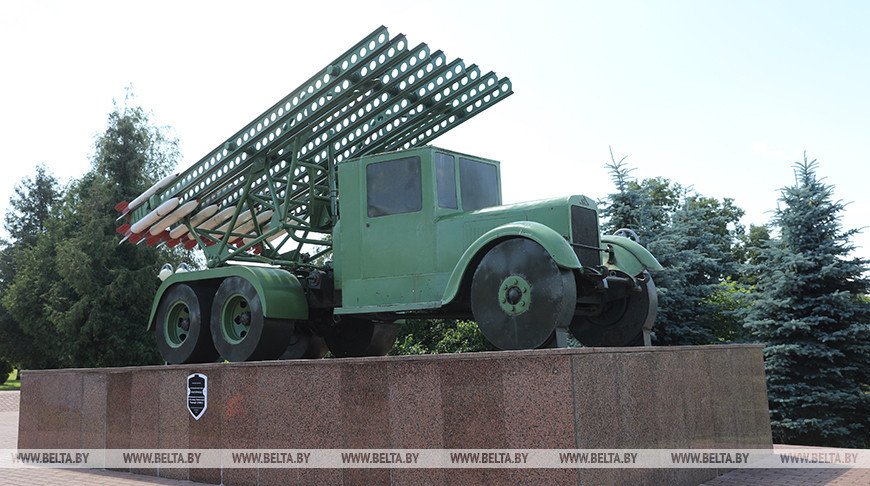
MINSK, 3 June (BelTA) – Widely known as Katyusha, the BM-13 was a truly innovative weapon for its time. It was used in all major operations of the Great Patriotic War of 1941-1945, terrifying the enemy with its deafening salvos, crushing power, and high mobility. What made Katyusha unique? What performance characteristics did this vehicle have? And why did Red Army soldiers nickname the BM-13 Katyusha? Mikhail Brel, Professor of the Armored Vehicles Weaponry Design and Operation Department of the Military Academy of Belarus, answered these and other questions in a recent episode of BelTA’s On Point. History project.
What was the BM-13 also known as Katyusha?
Despite the fact that today the BM-13 Katyusha is often referred to as a multiple launch rocket system, there was no such term during the Great Patriotic War. To describe this kind of military hardware, the term barrel-less system of field rocket artillery was used.
“Initially, in the pre-war period, rockets were developed for aviation. They were even tested in combat conditions, for example, during the Khalkhin Gol conflict. But based on the test results, it was concluded that it was more promising to use such rockets with ground launchers,” Mikhail Brel said.
The Katyusha design was in many ways unique for its time. Although the German army also had rockets and launchers for them, they were created on the basis of barrel artillery. The Nazi invaders used them, in particular, during the assault on the Brest Fortress. During the artillery preparation about 3,000 shells were fired at the fortress.
What performance characteristics did Katyusha have?
Rockets for land use and launchers for them were developed by the USSR Reactive Scientific Research Institute. The ZIS-6 truck served as the base. In 1941 these systems were tested, and on 21 June, a day before the start of the Great Patriotic War, they were adopted for service under the BM-13 designation.
“First of all, Katyusha’s uniqueness lay in the fact that it was precisely a barrel-less system of field rocket artillery. This was also its advantage,” Mikhail Brel noted. “There was another unique feature of this system. The blast wave inside the rocket propagated from two sides – in the head and in the bottom part. When the two blast waves met, a collapse occurred, which provided huge destructive power.”
Why did Red Army soldiers call the BM-13 Katyusha?
Mikhail Brel emphasized that there are different versions of the name’s origin. One of them is connected with a pre-war song with the same name, which is firmly associated with the celebration of Victory Day nowadays. The first time the BM-13 was fired was from an elevated position. Thus, the Red Army soldiers could see a resemblance to the song lyrics: “Katyusha went out on the riverbank, on the high and steep bank.”
On the whole, Red Army soldiers often gave certain “affectionate” names to weapons and military hardware. For example, the Shpagin submachine gun (PPSh-41) was called “papasha” (daddy) while the IL-2 ground-attack aircraft was called “Ilyusha”. A similar story could have happened with the BM-13, which high-explosive rockets were marked with the letter “K”.