‘She fought by using Sranantongo’
“It is my story within a story that has many stories.” Wordsmith Zulile – small sun in the sky – Blinker contributed to the exhibition in the Netherlands Echoes of In*dependence, in which she portrayed the story of Johanna Schouten-Elsenhout as that of a Creole woman with a layered life. ‘Wortu di e abra’, Blinker called this partial exhibition.
Text Euritha Tjan A Way
Image Les Adu
“When she wrote, it was as if she were inspired. She fought her battle through the use of language: Sranantongo. Resistance through language is a known fact. It is not a struggle like picking up weapons, but it is a form of resistance. Our struggle is strongly rooted in our cultural identity,” Blinker explains her choice for Schouten-Elsenhout. Writing in Sranantongo was absolutely revolutionary at the time. puwema umawho was affectionately known as ‘Aunt Jo’.
Independence?
‘Echoes of In*dependence: the Untold Acts of Liberation, Extraction & Solidarity’ brings together artists from countries such as Angola, Cape Verde, Mozambique, Suriname, Congo and Ghana. This was done in collaboration with The Black Archives in the Netherlands and the Surinamese Museum. In Echoes of In*dependence they asked the question what independence really means. Because for many former colonies the flag changed, but the structures did not. Foreign companies often still control the raw materials. Economic dependence has replaced the colonial rule of the past.
One of the prominent elements in the exhibition is the dyarusu sturu. “Men used to give these to their wives.“
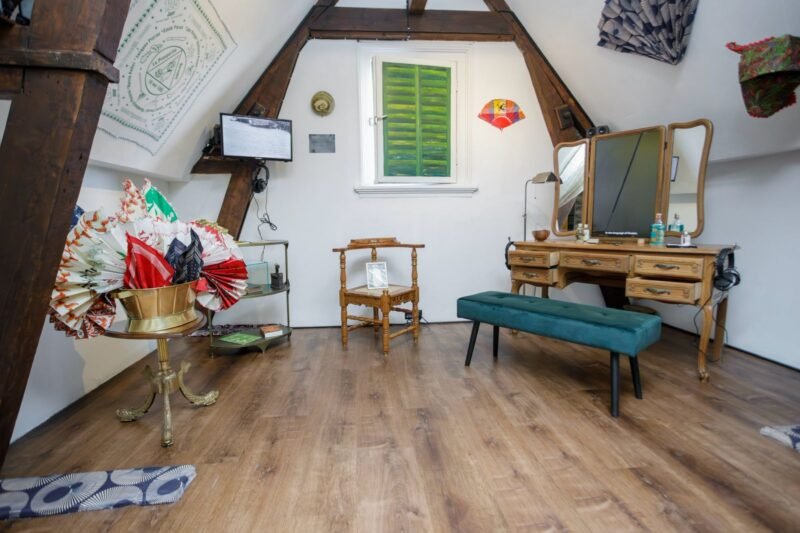
The exhibition about Schouten-Elsenhout was set up and decorated by Blinker and visual artist Ruth-Rachel Joeroeja. Blinker asked Joeroeja to express the power of collaboration and co-creation. One of the prominent elements in the exhibition is the dyarusu sturu. “Men used to give that to their wives. When she sat on that chair, it meant: ‘I want attention’. Those women, our Creole foremothers, also have a story. They want us to pay them attention and tell their story,” it sounds, peppered with artistic words as only Blinker can.
Dressing table
The dressing table with large mirror is also part of the exhibition. This is inspired by the poem Duman van Schouten-Elsenhout, which ends with ‘Luku ini yu eygi spikri’. “Taking responsibility and doing so without becoming vain: that is what it stands for. In this world we point too much at each other, but we take too little responsibility,” the word artist explains.
In her search for the background of Schouten-Elsenhout, she found the core of who Creole Surinamese women are. In the exhibition she also applied this to her own family tree as a woman. “Because we are talking about Anton de Kom and Schouten-Elsenhout, but who are the Anton de Koms in our family tree, in our families? They also deserve grani.” In doing so, Blinker has reduced the grand story of resistance from something intangible to something tangible and close by.
Different platforms
The path to curating the exhibition and achieving this result was not without challenges. “Sometimes you have to stand up for what you believe in. It was a learning process, also for me. Because I want to tell this story – my story, which contains many stories – on different platforms, and that works quite well.”
This joint exhibition also shows how liberation movements in Africa, the Caribbean and Suriname were connected. She honors women whose contributions have been invisible for too long, from Hannah Kudjoe in Ghana to Andrée Blouin in Congo and Schouten-Elsenhout in Suriname.
In addition, the exhibition connects the past with the present: from the murder of the Congolese freedom fighter Patrice Lumumba to the struggle of We Are Congolese today.
The exhibition opened on April 23 and can be seen in the Suriname Museum in East Amsterdam until the end of October. Blinker is looking forward to exhibiting this exhibition in Suriname as well. With this activity, The Black Archives is officially back in Amsterdam East, where it all started. This organization makes the heritage and history of the African diaspora visible and accessible through a unique collection, exhibitions, education and public programming.