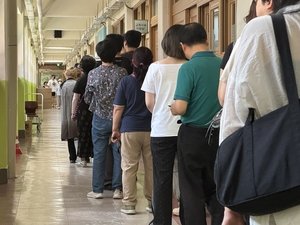
The political fates of two major figures on the left and right of Korean politics hung in the balance in Wednesday’s National Assembly by-elections, with the outcomes carrying implications for the conservative and progressive blocs alike.
Of the 14 by-elections, Busan’s Buk-A district and Pyeongtaek-B drew the most attention. Busan pits a former aide of President Lee Jae Myung against a former leader of the conservatives; Pyeongtaek brings a minor liberal opposition leader against established parties.
Exit polls were released shortly after voting ended at 6 p.m. and was conducted by the Korea Election Pool, a body comprising representatives of the Korean Broadcasters Association and broadcasters KBS, MBC and SBS.
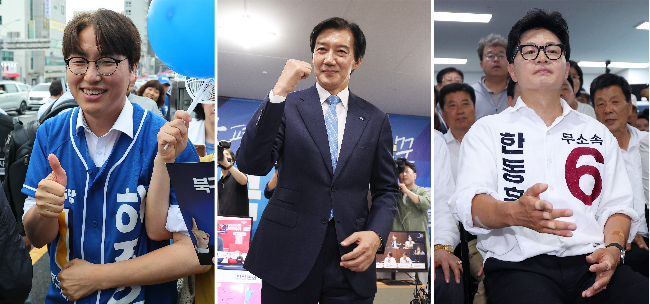
According to the exit polls, Democratic Party of Korea candidate Ha Jung-woo and independent candidate Han Dong-hoon were locked in a tight race in Busan’s Buk-A district.
They showed Ha with 42.6 percent support, narrowly ahead of Han at 41.6 percent. People Power Party candidate Park Min-sik garnered 15.8 percent.
The race drew nationwide attention as the two leading contenders were Ha, a former presidential secretary for artificial intelligence under President Lee Jae Myung, and Han, a former People Power Party leader running as an independent.
Han was expelled from the party earlier this year amid allegations that he and his family members posted internal messages critical of the party leadership and former President Yoon Suk Yeol.
At one time a strong Yoon ally, Han has since emerged as a prominent conservative voice calling for a clear break from the former president.
A victory for Han would provide a political boost to conservatives seeking a cleaner break from Yoon and mark his first entry into the National Assembly.
Han’s victory could also create friction with the current party leadership under Chair Jang Dong-hyeok, whose rise was backed largely by pro-Yoon supporters.
A victory for Ha, meanwhile, would help the ruling party defend one of its previously held seats while providing a boost for President Lee Jae Myung’s administration.
Another closely watched race was in Pyeongtaek-B, where Rebuilding Korea Party Chair Cho Kuk held a narrow lead.
According to the exit poll, Cho led a three-way race with 31.1 percent support, followed by People Power Party candidate Yoo Eui-dong at 30.6 percent and Democratic Party candidate Kim Yong-nam at 30.3 percent.
Cho, who founded the minor left-leaning Rebuilding Korea Party ahead of the 2024 general election, is a prominent figure among progressive voters after rising to national prominence as justice minister under former President Moon Jae-in in 2019.
Cho’s bid has drawn attention because a victory would mark his reentry into the National Assembly and give the Rebuilding Korea Party its first win in a constituency seat.
If elected, Cho could increase his influence within the liberal bloc that includes the Democratic Party he was once a member of.
Given his ties to Moon, a victory could revive discussion over the role of Moon loyalists within a liberal camp increasingly dominated by President Lee Jae Myung’s allies.
It could also revive discussions about closer cooperation between the Rebuilding Korea Party and the ruling Democratic Party.
The by-elections, held alongside nationwide local elections, were conducted in 14 constituencies to fill vacancies created by resignations and court rulings. Of the 14 seats up for grabs, 13 were previously held by Democratic Party lawmakers.
Exit poll results were available only for the Busan Buk-A and Pyeongtaek-B races. As of publication time, 16.72 percent of votes had been counted.
Regardless of the outcome, the elections are unlikely to bring a significant shift in the balance of power in the National Assembly.
Going into the election the Democratic Party currently held 152 seats in the 300-member National Assembly, compared with 106 for the main opposition People Power Party.
Meanwhile, other notable races included those involving former Korea Communications Commission Chair Lee Jin-sook and former acting KCC Chair Kim Tae-gyu. Both served in the Yoon administration and publicly defended the former president during impeachment proceedings.
Their races were widely seen as indicators of how voters view the People Power Party as it seeks to distance itself from Yoon while broadening its appeal to moderate voters.
flylikekite@heraldcorp.com