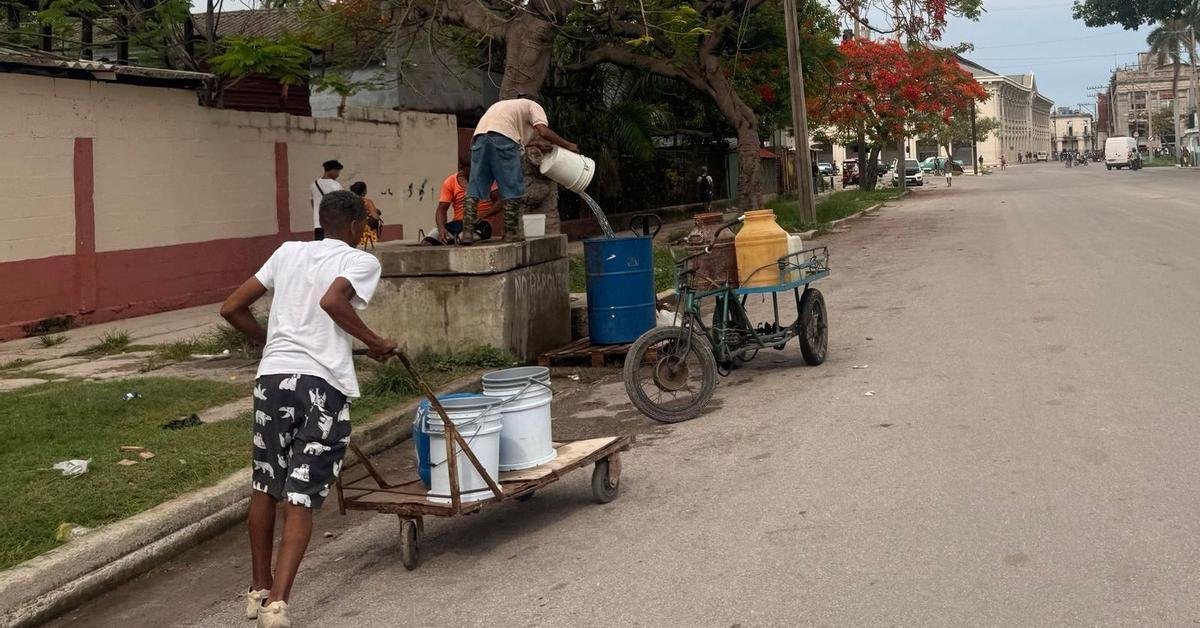
Havana/Havana, which once had the aqueduct among its urban prides, is now measured in a row of empty cubes. In Cuatro Caminos, in front of a peeling wall, each container waits its turn as further proof of the defeat of the hydraulic system. Standing on a concrete structure marked with a faded “No parking,” a man pours bucket after bucket of water into a tank. Knobs, drums and wheelbarrows gather around them. It is the logistics of survival in the Havana version.
“If your water comes on twice a week and it happens that you’re in a blackout at that moment, you’re screwed,” says a woman waiting her turn with two plastic doorknobs under her arm without drama.

/ 14ymedio
The transfer is continuous. Some arrive, others leave, some wait their turn and others look at the stream with the anxiety of someone who knows that there is not always a second chance. Among those who pass through the area are women, children, young people and older men. Everyone carries as they can. The most forward-thinking bring wheels; the others, arms and patience.
The water crisis in the capital is not new, but in neighborhoods such as Centro Habana, Cerro, Diez de Octubre or Regla it has become an exhausting routine, aggravated by blackouts. In many homes, water depends on an electric pump. If the service arrives when there is no power, the relief passes by. The neighbor hears that “the water came in,” but he can’t do anything. When the power comes back on, the pipe is already dry.
Hence, any point where water comes out becomes a small supply station. It doesn’t matter if it is an informal connection, a exploited breakdown, a community well or a pipe that someone knows how to open. People come because they need to drink, bathe, cook, wash or flush a toilet.
/ 14ymedio
Those who have a large tank can solve it for several days. Whoever has a cart can move more liters. Whoever has strength can make several trips. And those who have nothing hope that a neighbor will lend them a doorknob or sell them a little. In Havana there are already people who are dedicated to selling water in areas where the supply is critical, although on this occasion it is not clear if any of those present charge for the service.
What is certain is that water, like electricity, gas, bread or transportation, has ceased to be a certainty and has become an incessant search. Neighbors calculate schedules, blackouts, pressure in the pipes, distance to the supply point and load capacity. Daily life is organized around what is missing, and each container lined up on the sidewalk seems to say the same thing: in Havana, even water has to go out “to fight for it.”