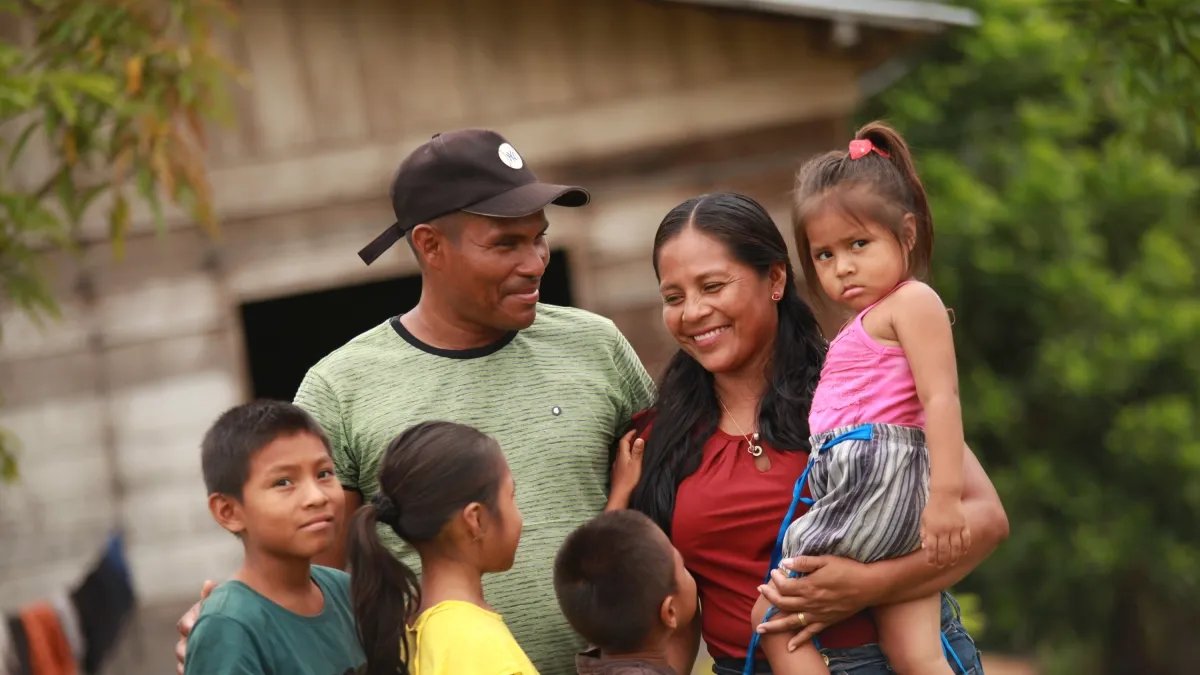
Cooking, washing, cleaning, taking care of the children, taking care of the family. Those tasks that sustain the daily life of millions of Colombian homes continue to fall on the shoulders of women. The results of the National Time Use Survey (ENUT)between September 2024 and August 2025, show one of the realities that the country faces regarding gender inequalities.
For the director of DANE, Beatriz Piedad Urdinola, “these figures represent more setbacks than progress.” And the numbers prove him right, because the 89.8 percent of women do unpaid work in Colombia and they spend more than twice as much time as men on these tasks. Specifically, They allocate 7 hours and 35 minutes a day to domestic and care activitieswhile they barely contribute 3 hours and 14 minutes. A gap of more than four hours that, repeated every day, adds up to entire weeks of invisible work.
Beatriz Piedad Urdinola, director of DANE. Photo:DANE
Furthermore, one of the most relevant indicators of the ENUT is the so-called total workload, which adds the time dedicated to both paid and unpaid employment. The men occupy on average 11 hours daily between both categories, where more than 80 percent of this time is spent on paid activities. For their part, the women they come to 13 hours and 47 minuteswhere half of that time is unpaid. Almost three hours of difference each day, which accumulate in silence.
That burden has increased over time.. The data show that the distribution of domestic tasks practically hasn’t changed in 10 years: Providing food (78.7 percent), cleaning the home (70 percent) and maintaining clothing (37.8 percent) continue to be the activities that consume the most time for women, and they continue to be the ones who assume them almost exclusively.
To understand what these figures mean in concrete terms, this DANE graph allows us to differentiate the tasks that a man and a woman, of the same age range, carry out on a daily basis and demonstrates how they continue to dedicate more time for housework and care and less time for personal activities.
Comparative graph of time use between women and men. Photo:DANE – ENUT
In this sense, in Colombia 7 in 10 men have a paid job, while only 4 in 10 women do. In household activities, the difference is more noticeable: 8 out of 10 women prepare food compared to only 2 out of 10 men, and 7 out of 10 women clean the house compared to 3 out of 10 men.
Even in the game with children under 5 years old, they participate twice as much as them (2 out of 10 compared to 1 out of 10). The only meeting point is digital entertainment, where 9 out of 10 peoplewithout distinction of sex, use media and social networks.
Radiography by territory
The regional contrasts are so marked that they reveal that the problem is not homogeneous throughout the national territory. For example, the department of Magdalena is the place in the entire country where women spend the most time on unpaid work with 12 hours and 41 minutes a day, while Quindío is the place where they spend the least time with 5 hours and 11 minutes. More than seven hours difference within the same country, which speaks of different cultures regarding care.
In terms of participation, Caqueta (95.5 percent) and Cordova (93.3 percent) are the departments where almost All women assume the responsibilities of the homewhile Atlantic registers the lowest participation with 83.6 percent, although the differences are not that great.
Regarding paid work, San Andrés is the department where the most women participate in the labor market with 48.4 percent and Tolima, where the least, with only 22.6 percent.. A difference of 26 percentage points that reflects how geography, the supply of formal employment and local culture determine whether or not a woman can have her own income.
In the eastern region It’s where women accumulate greater total workload with 15 hours and 9 minutes per day and the one that records the lowest average is San Andrés, with 12 hours and 48 minutes. This is no coincidence: where more women work for pay, the combined burden is relatively lower, because time at home is redistributed, even if only partially.
In the care economy there are activities in the home, such as cooking, washing, ironing or cleaning. Photo:Jaiver Nieto Álvarez. THE TIME
For its part, in the regions of the Amazon and the Orinoquía — incorporated for the first time into the ENUT — women recorded some of the highest averages of unpaid work in the country. Amazonian women dedicated 9 hours and 47 minutes a day to these tasks, well above the national average.
This pressure has caused the 14.1 percent of women in the country feel that “they do not have enough time”. In Bogotá, this perception of time poverty is exacerbated, reaching 16.4 percent of Bogota residents.
Even for women born outside Colombia Unpaid work time is much greater: 9 hours and 31 minutes dailycompared to 7 hours and 30 minutes for those born in the country. At the same time, their participation in the paid labor market is slightly higher than the national female average, which implies a more intense double day. A vulnerability that adds to the already known difficulties of the migrant population in Colombia.
70.4% of women use their time cleaning and maintaining the home. Photo:Bogotá Mayor’s Office
This panorama goes beyond the numbers. Care work, carried out mostly by women for free, is the support that allows the rest of society to function. According to DANE estimates, Unpaid work represents close to 20% of national GDPsurpassing traditional sectors such as commerce or manufacturing.
This new data is not just time use statistics, it is the urgent call for a national policy that redistributes care and recognizes that, without the work of women in the home, the country’s economy would simply stop.
MARÍA ALEJANDRA MESA MUNÉVAR
School of Multimedia Journalism EL TIEMPO – It’s Not Time to Be Silent.