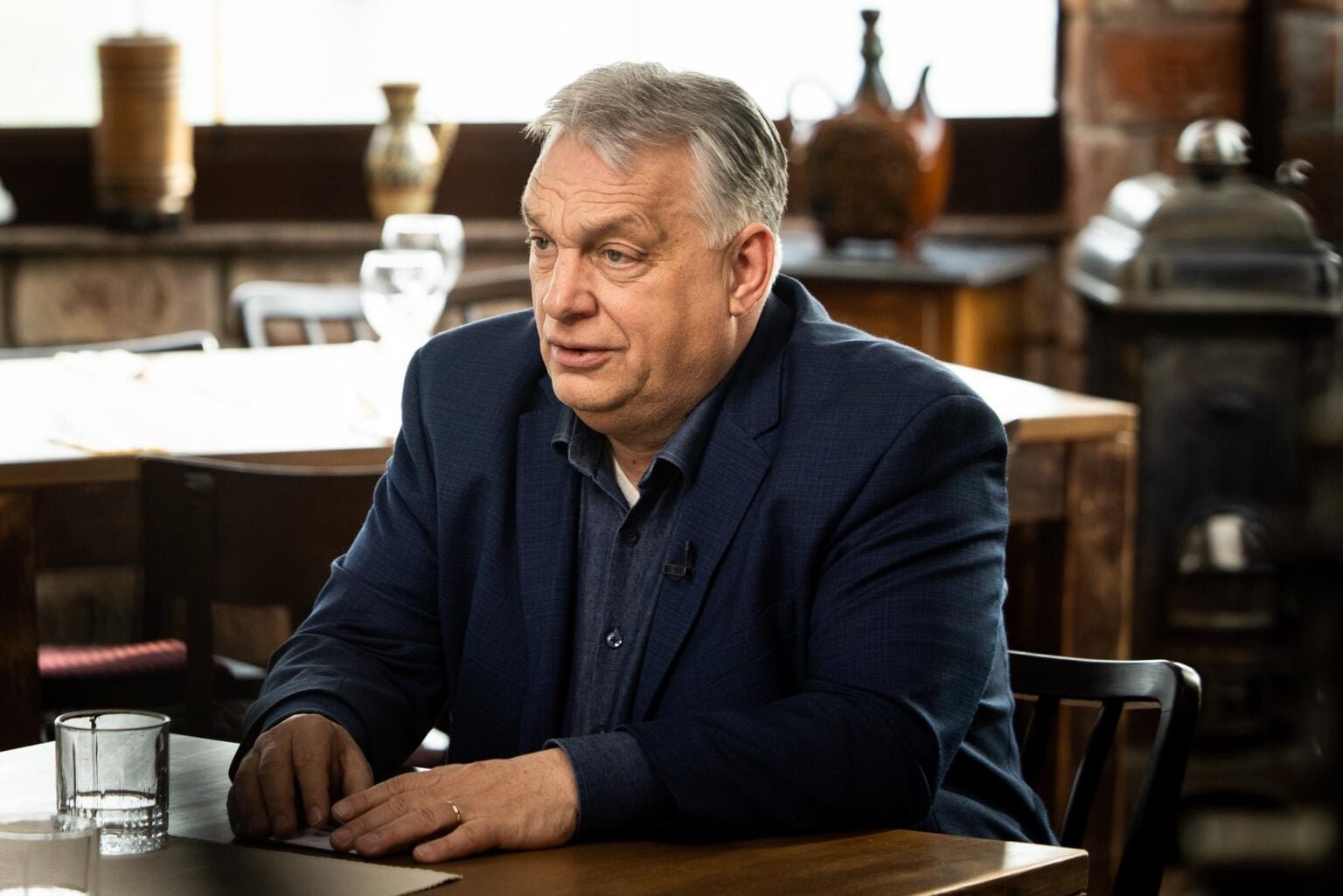

“The starting point for our work in the opposition is the fact that this has been the most successful era in Hungary over the past hundred years—the most successful sixteen years of Hungary’s modernization. A Christian, national constitution, full employment, an average income that has quadrupled, a country free of migrants, a government independent of Brussels and other external forces. It is easy to build an opposition policy on this foundation, easier than in 2002, after four years in office. Now the task is to defend the national achievements recognized by all,” Viktor Orbán explained in an interview with the newspaper Magyar Nemzet. The former prime minister also spoke about coming to terms with the election defeat, the new government’s first statements, and the path to the renewal of the right.
– Mr. President, you are no stranger to life in the opposition, you have had your fair share of it. But of course, not recently. Do those memories come flooding back?
– This place brings it all back. I left this office in 2010, and now I have come back. I know what life in the opposition is like. But that is not what defines me. What matters is that, whether in government or in the opposition, a person remains true to who they are. I am a boy from Felcsút, from Kolozsvári Street, whether I am prime minister or not. My mission has not changed either. I have always worked for a free, sovereign Hungary. The situation and circumstances are different, but the essence is the same: for me, politics is not a job, but a service.
– No two election defeats are the same. This one is visible not only from the Moon, but from any point in the solar system. You did not take up your parliamentary seat and announced that the national side must be reorganized in the form of a movement. What does the latter mean?
– As a political veteran, I can say: every election defeat is different. Now, after sixteen years in government, it is not just a cycle but an era that has come to an end. The starting point for our work in the opposition is that this was the most successful era of Hungary’s past hundred years, the most successful sixteen years of Hungarian modernization. A Christian, national constitution, full employment, a fourfold increase in average income, a migrant-free country, and independent governance in the face of Brussels and other external forces. It is easy to build an opposition platform on these issues—easier than it was in 2002, after four years in government. Now we must defend the national achievements that everyone recognizes. Fidesz and the entire national camp must build, from a well-organized and cohesive governing political community, first a strong opposition movement and later a viable pro-government position. This is happening simultaneously on multiple fronts: in parliament, within the party system, in the world of civil movements, in the world of emerging civic initiatives, and in small circles of freedom. We have seen and experienced this before, we know how it works.
Hungarians now have a liberal government and a national opposition. We must adapt to this in such a way that everyone can feel the strength of the national side, which numbers in the hundreds of thousands, even millions. The whole country must see that we are tigers, not rabbits.
– Do you think their achievements need to be protected? The new government has promised to keep everything that is good. They call the past sixteen years “sixteen years of corruption,” but they say that family policy, measures against migration, and utility price caps were positive aspects, thus they will keep those and even build on them.
– Yes, that is what they said. But what we saw during their ministers’ parliamentary hearings already points in a different direction. The finance minister rejected a work-based society and advocated a liberal economic policy. The ministers responsible for social affairs represented the Soros-style ideal of an open society, which they call liberal democracy. Child protection has fallen into the hands of the LGBTQ lobby, and national education is being replaced by progressive, liberal education policies. All of this signals a major shift in direction.
– At the same time, the new finance minister also said he would phase out the special taxes. What resources do you see for this?
– We are in the aftermath of the election campaign, governing has not yet begun. In the absence of government decisions, we could only speculate, but no serious person engages in that.
For our part, however, we can say with certainty: we are handing over Hungary in excellent condition.
Anyone who wants to can work, we have quadrupled the average income over the past sixteen years and doubled state assets by repurchasing valuable and strategic assets ranging from the airport to the energy sector. Foreign exchange reserves are at a historic high, and we have increased gold reserves from three tons to one hundred tons. There are no migrants in Hungary, our country is the safest in Europe, the family support system has been established, economic growth has begun and is the second-highest in the EU, industry and consumption are picking up, and public debt is well below 2010 levels. If the new government does not consider a change of course but simply continues on this path, it could be successful. But I repeat: the signs are worrying.
– It is interesting to hear this list. Based on all this, Fidesz should have won the election by a comfortable margin. But that is not what happened.
– There is no comfortable lead in Hungarian politics, there never has been. The election result is two-sided. Among those over forty, we won 47 to 44. We suffered a landslide defeat among those under forty: 19% of young people voted for us, while 75% voted against us.
We lost this election among young people, and by a dramatic margin. Understanding this is the most important task for the coming period.
– This may be the greatest challenge for Fidesz and for you personally. Improving relations with young people now seems hopeless.
– We must not rush anything. First, we need to understand what happened. We do not yet see clearly. Moreover, the political culture of the younger generation seems to be converging with that of Western Europe, thus the analysis cannot stop at Hungary’s borders. I believe this is not merely a matter of taste, like when blaring Led Zeppelin drove my parents crazy during my youth. It is as if differences in worldview and cultural anthropology have emerged. To decipher this, we will need the full knowledge and capacity of the right-wing intellectual sphere. Therefore, what is needed now is not resentment, but an accurate diagnosis, because a wrong diagnosis can only lead to bad policy.
– Could it be that what you view as an achievement or a success was not seen that way by voters? Ultimately, it is impossible to determine exactly what voters were rejecting: you, Fidesz, or every single one of your policies.
– Two messages were at odds with each other: change, and things will get better; or no change, because change is dangerous. Our message worked for those over forty, but not for those under forty. Young people wanted something different from what we offered, and they expected a different leader. They not only did not accept our message, but me as well. It is a bitter reality, but we have to face it—and I have to face it.
– One of the new ministers said at the committee hearing that people did not feel the impact of the utility price caps and family benefits. Maybe he is right. Could it be that people have gotten used to all your achievements and take them for granted?
– This is a problem for any governing force that has been in power for a long time. What is new and inspiring when introduced becomes part of everyday life within a few years. People no longer see the pilot’s performance, they just shrug and say that an autopilot could do the same. We said: let us protect what we have. The young people replied: but we need more. And there was another offer on the table that promised to distribute 6,900 billion forints (17.25 billion euros) annually, from healthcare through the welfare system to the economy. The majority of voters chose “more.” They did not look at who deserves credit for today’s secure life, but rather at who promises more, who offers a new perspective. Whether we should have promised more, better, and more attractive things is something the campaign strategists will analyze, and time will tell.
– You have always been known for your political innovations. In 2002, the civic circles were the ones who responded to the defeat. Can you come up with something similar now? You said that your task now is to go out and talk to activists, politicians, and voters. Have you spoken with activists in rural areas yet?
– All day long. Innovation is not on hold, but things have their order. First, we had to get the parliamentary group in order. We were preparing for a government-supporting group, but instead we have to build an effective opposition. We replaced 25 of our 52 representatives. People in their sixties, my generation, stepped aside and handed the baton to those in their forties. Our next task is to define the opposition operating model for Fidesz, that is, our party organization. This process will conclude on June 13 with the congress.
In the meantime, we have begun gathering the capable publicists, politicians, influencers, intellectuals, and think tanks on whom and on which we can count in the new lineup of the national side, in the new movement. This must be as broad as possible. We will have this in place by the end of summer. And in the fall, the work can begin.
– For someone with right-wing leanings, the defeat that began on the 12th continues every day and persists to this day: the system of national cooperation is collapsing like a house of cards. Backbiting, defections, spectacular and less spectacular collapses, and verbal jabs. Do you think this is inevitable, or does it reflect the reality of the situation?
– The system of national cooperation was a serious proposal for the entire country. We wanted the nation’s various interest groups to work not against each other, but in cooperation with one another, for the benefit of the whole country. Workers and capital owners, farmers and industrialists, the poor and the wealthy, rural and urban dwellers, rural residents and Budapest residents, believers and non-believers, those in Hungary proper and those abroad, right-wingers and left-wingers, Western-oriented and radical nationalists, modernists and conservatives, young people and retirees, and so on.
We have placed national sovereignty at the center of this cooperation. It is not enough for Hungary to be a free country, it must also be sovereign—that is, the fruits of Hungarians’ labor should benefit Hungarians, not foreigners. We built an economic and social system based on this idea. This was the work-based economy and the protected society—in contrast to the liberal economy and open society prevalent in Europe today.
To run a Hungary structured in this way, we established a governmental and political apparatus. I estimated that we would need twenty years—five parliamentary terms—to complete our work in full, to ensure the system was viable and successful, so that everyone could find their place and prosper in proportion to their performance. We were given sixteen years. We were able to complete eighty percent of the work, in proportion to the time available. Just when our goal was within reach, we were torpedoed, and our opponents can now begin dismantling the national system. The liberal economy and the open society are coming.
– But how do you explain the snide remarks and the backbiting?
– The intellectuals who supported the government, our intellectual backbone, were worn down by the long reign. They had to simultaneously support the government that represented their ideals and criticize what needed to be criticized. It was a kind of loyalty trap. Now it has opened up. Right-wingers are speaking openly, after years of meek folk songs, rock ’n’ roll is coming next.
– The winning side is surrounded by genuine euphoria, every day is a small victory parade for them. As a winner yourself, you have experienced this euphoria more than once. How does it feel to see it in your opponent or their leader?
– We won five elections. We celebrated differently: we went to work the next day and said, “Now we must be humble, because there is work to be done.” For us, the reward for victory was always more work.
Those who have won now are a different kind of people, they celebrate differently. As for the prime minister himself, I would rather not comment. His wife was my justice minister, so I saw too much and from too close a distance. However, after just one week in office, the whole country can already see that the new head of government is problematic. Hungarian democracy faces a serious test.
– That is interesting, because the leader of the Fidesz parliamentary faction, Gergely Gulyás, is a former friend and patron of Péter Magyar. Is it not strange to pit Gulyás against him?
– We expect Gergely Gulyás to represent a decent, civic-minded Fidesz capable of governing. The country needs to know: if the current government fails, there is a tried-and-true alternative. Gergely Gulyás was my closest colleague, he knew the workings and goals of the government best.
– One part of the Tisza program was to preserve what works well. The other part is accountability, taking a hard line on every issue: holding everyone and everything accountable—businesses, ministries, government agencies, civil society groups, and politicians. Does that worry you?
– Why should it? Since 1990, every minute of my time and every forint I have spent has been under constant scrutiny. I have lived like an open book. Anyone who is interested can find out everything about me. We are ready to face any scrutiny. However, I see a large number of leaders in the new government who worked with us for many years after 2010, the new prime minister is one of them. These will be exciting stories.
– At the same time, some of their statements give us reason to believe that there will be personal witch hunts.
– The head of the Budapest government office is being hounded for accepting two bottles of wine. This is an abuse of power! A defense association has been set up within Fidesz, a sort of support service. If we witness an abuse of power anywhere in the country, even in the smallest village, if someone faces verbal abuse, job loss, or threats for political reasons, we will be there to provide protection and bring the issue to light. Whether this lies in a distant future or the near future is not up to us.
What I do see today, however, is that those in power want to silence the right-wing public. Marketing and media contracts are not being fulfilled, accounts are being frozen, and payments are not being made.
The Balásy case is not about accountability, but a cold-blooded political maneuver aimed at paralyzing the right-wing media. The government publicly insults and vilifies right-wing journalists at press events. They misunderstand their role. The press asks the questions, they provide the answers. In a normal, civil tone. The press cannot behave timidly either. If they give up their self-respect, they deserve to have the floor wiped with them.
I also do not understand why we tolerate them speaking to the President of the Republic this way. Where are the civic side’s highly respected lawyers, former ministers of justice and foreign affairs? The pace and stance of the civic camp are not dependent on the government.
– Looking back, what would you do differently?
– The goals were right. The results will stand the test of time. It is certain that we should have run a campaign that appealed to young people as well. But it is always easier to see things clearly in hindsight. And we certainly should have taken a stronger stand against the forces behind the Tisza party.
Because while the voters pulled the winners forward, there were also those who pushed them: the Soros network, Brussels, and the Ukrainians, for whom it was a matter of survival to oust the Hungarian government that opposed Ukraine’s EU membership. And the multinational corporations, from whom we took nearly 16 trillion forints (40 billion euros) over sixteen years to give to the Hungarian people. These four forces coordinated their actions to support Tisza.
We were soft, we did not fight well, and we paid the price with defeat. It did not even take a week, they have already been paid off. The Soros network has taken over the Prime Minister’s Office, child protection, and education. They are fulfilling every wish of Brussels—in fact, they are eager to do so. We have abandoned our neutrality and sided with the Ukrainians in the war, Hungarian money is also going to Ukraine from the EU’s next budget. Erste provides the finance minister, OTP the state secretary, and Shell took the Ministry of Economy and Energy.
– Your government bid farewell with a high-profile scandal: the National Cultural Fund’s public and non-public grant system, through which countless artists close to you received money from the Hungarian State.
– Our cultural policy has not been stable over the past sixteen years. We have constantly debated whether to support only productions belonging to the national cultural sphere or Hungarian culture as a whole, even if part of it conveys destructive views and is hostile. The result was that we generously supported not only those closest to us, but also our opponents: in the theater world and in popular culture, many received significant grants in the hundreds of millions, even billions, while they were attacking us. Now, our time in the opposition gives us the opportunity to revisit these cultural policy issues in a new light.
– Péter Magyar has made a very important promise that he has repeated throughout the campaign. He has shifted the blame for the delay in EU funds onto himself and said that he will bring them home in no time. Will that happen?
– The issue of EU funds is a myth. It is a fairy tale. They have managed to convince young people that Brussels is a kind of benevolent Santa Claus who brings money to Hungary in his sack. But the truth is that the money from Brussels is the Hungarians’ own money. Hungary pays into the system and allows companies from countries richer than ours to access our market without tariffs or trade barriers and profit from us. That is why we are entitled to the money. It can be withheld or suspended, but it cannot be taken away. That is why we must not make any concessions here. I have collected 12 billion euros: four billion has arrived, eight billion is in our account, and the rest will come automatically after the business invoices are submitted. The remaining amount, which is still frozen, must be released when we decide on the next seven-year EU budget. That decision requires unanimity. And it must happen this year.
The Hungarian position was clear: until the previous seven-year period is closed and Hungarians receive their money, there will be no new budget. Making concessions would be a strategic mistake.
– What can you do to prevent your voter base from continuing to erode?
– The national camp consists of two parts: the moderate center and the right wing. If they unite, we will win. That has not happened yet. The forced struggles over sovereignty have pushed the government to the right: our tone has become harsher and more radical, we have not spoken the language of the moderate center. President Katalin Novák and Minister Judit Varga played a huge role in holding onto the moderate center. They were neutralized, ousted, hunted down, they fell because of their own mistakes. Thus, the moderate center was left leaderless, and Tisza moved in.
– What must be done now?
– Reconstruction must always begin at the fringes: in the world of the radicals. This is because the greatest danger at such times is that the fringes of the camp will break away, seek radical solutions, drift away from the civic center, and the right will split in two.
We must consolidate the national side from the outside in. We start from the villages and suburbs, and from there we reach the county seats and Budapest. Now we must simultaneously preserve the legacy of the past sixteen years, understand the world of young people, and reunite the right with the civic center. And the unifying idea can be none other than Hungary’s sovereignty.
The national resistance movement, which is intended to prevent the plundering of Hungary, will also be organized around this. And if we do it right, this will bring the majority of Hungarians back from the liberal side to the nationalist side. The only question is: what will be left of Hungary by then?
Via Magyar Nemzet; Featured photo: Facebook/Orbán Viktor