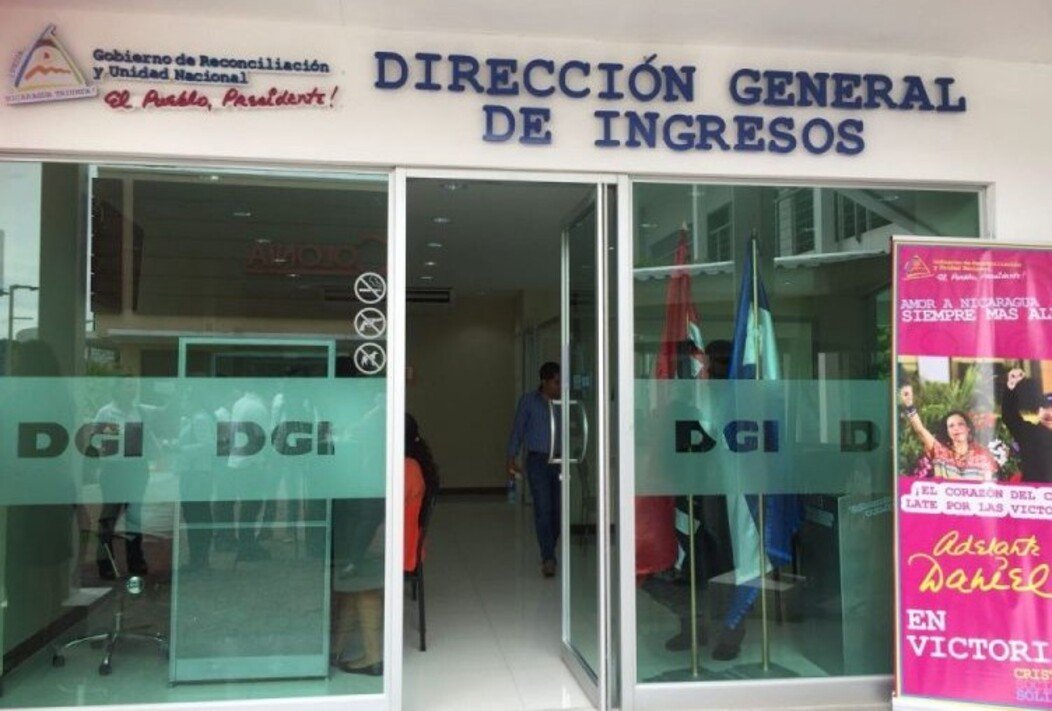
Between January and March 2026, the Ortega dictatorship collected some 62,075 million córdobas, mainly in taxes on Nicaraguan citizens and companies, according to the Budget Execution Report for the first quarter of the year, prepared by the Ministry of Finance and Public Credit (MHCP).
According to the entity, tax income reached 58,812.9 million córdobas —a record figure for the first quarter of the year—, while in loans and donations they received 3,262.1 million córdobas.
A simple division shows that the regime brought in about 689.7 million córdobas daily, which is equivalent to about 18.8 million dollars per day. If this pace is maintained, the regime will collect a quarter of a billion córdobas throughout 2026.
Tax revenues exceeded by 13,142 million (28.8%) what was collected in the same period of 2025, which was 45,671 million.
Tax revenue was collected as follows:
- 34 716.4 million córdobas for Income Tax (IR)
- 15 909.7 million córdobas for Value Added Tax (VAT)
- 4189.9 million córdobas for the Selective Consumption Tax (ISC).
- 2193.8 million córdobas for the combined tax on fuels
- 1543.3 million córdobas for Foreign Trade Taxes
- 213.5 million córdobas for “Other Tax Income”
- 46.2 million córdobas for the special tax on gaming machines.
The IR increased its collection by 10,538 million córdobas compared to the same period in 2025, going from 23,638.4 in the first quarter of 2025 to 34,716 million between January and March 2026.
Unusual tax collection
The 62,075 million córdobas represent an unusual jump in terms of tax collection and revenue collection in general. In particular, if it is considered that the goal for the first quarter of 2026 was 47,520 million córdobas. The document offers a very simplistic explanation for such a complex scenario, ensuring that “the above is explained by the dynamic evolution of collection and the prudent and responsible management of public spending.”
Juan Sebastián Chamorro, former Deputy Minister of Finance, maintains that it is “very difficult to explain with any degree of certainty” the performance of the budget throughout the first quarter, due to the lack of detailed information in the document.
What is clear is that things do not change so quickly in tax matters. “Collections—particularly tax collections, which depend on the level of sales, or the level of income of the companies—generally do not change overnight by 30% as they are reporting. That is why this Report leaves more doubts about how that income was generated, if it was generated,” he said.
That is why the economist does not rule out that part of the explanation is tax extortion that both companies and importers have been denouncing for years.
“We can’t know, but It cannot be ruled out that there is a component of tax extortion that helps explain this over-collection,” he ventures.
“Tax extortion is not something they are inventing right nowbut some particularly large extortions may have occurred in these first months,” he says.
“I would not rule out,” he continues, “that Some company has had to pay a fairly high amount. That could also be the explanation.”
Revenue exceeds that of 2025
The 62,075 million córdobas in income that the Central Government obtained, exceeded by 14,555 million (30.6%), the goal programmed in the 2026 Budgetapproved at the end of 2025. That sum also exceeded by 13,487.5 million (27.8%), the amounts collected in the first quarter of 2025. Almost 400 million dollars more.
Those additional revenues earned in 2026 were not used to accelerate ongoing projects. Not even to propose new works. Instead, an “increase in availability” was ordered for 30,950 million córdobas. These resources were deposited in the accounts of the Central Government, in the Central Bank of Nicaragua and in commercial banks, the document highlights.
Chamorro explains that this practice has been carried out in recent years. The regime allocates these additional amounts “to create those buffers they call availability. It is a difficult concept to understand because money that is not budgeted is simply not executed,” he says. The rationale for creating these availabilities It is having reserves in the event of possible crises or exchange problems, he added.
He explains that they cannot be used for new works because the execution of the projects cannot be accelerated to a level equivalent to that 30%. Although there is the option to reallocate funds or accelerate some expenses, “public investment does not work like that, but rather it does so based on the technical execution of the projects,” he describes.
Little money in loans and donations
The document lists that the main sources of loans and donations were:
- The Chinese company CAMC Engineering Co., Ltd (CAMCE) with 1,385 million (19.4% of what was promised for all of 2026)
- The Central American Bank for Economic Integration (CABEI) disbursed 1,182 million (15.5% of the total committed)
- The Inter-American Development Bank (IDB) with 326.6 million (69.5% of what was scheduled)
- The Japan International Cooperation Agency, with 119.3 million (33.4% of the commitment).
Until the end of March, another almost 18,888 million contracted for 2026 had not been received. Among the most important amounts that are pending to be received, some 11,627 million from four Chinese companies stand out, plus 6,450 from CABEI.
In that same period, the international community had been notably slow in terms of donations: only 16.5 million córdobas had been received, which is 8.2% of the 201.1 million promised. The largest contributor was the United Nations Office for Project Services (UNOPS) with 7.5 million, which was the total promised. Then CABEI with 5.1 million (27%); and two United Nations agencies, with 1.8 and 1.2 million respectively.
By country, Russia has already sent everything it had offered as a donation: one hundred thousand córdobas. China also sent the same amount, although in its case it represents only 2.6% of the commitment for 2026. At the end of March, Kuwait (34.4 million) and Spain (9.2 million) had not disbursed anything.
Chinese loan disbursements they carry 10.6% execution
Regarding projectsthe Budget Execution Report details that of the 13,012 million scheduled in various Chinese loans for 2026, at the end of the first quarter they only received 1,385 million córdobas. 10.6% of the total.
“Regardless of the number we review, the Chinese partners will always be the subject of doubt,” says Chamorro. The origin of your doubt is that the document does not specify the origin of the funds, which adds one more element. The coincidence that Chinese loans include the obligation that The State of Nicaragua has to contribute 20% of the cost of the projectand that the amount included in the Budget is equivalent to 19.4%.
The economist refers to the contribution of 1,385 million córdobas noted in the Budget as a contribution from the Chinese company CAMC Engineering Co., Ltd (CAMCE), to build the Punta Huete airport. The total scheduled for the entire year is 7,123 million. “Interestingly, an execution of 19.4% is reported, which is an amount similar to what Nicaragua promised to deliver,” he points out.
He adds that “it could well be that this execution is being financed with resources from the national counterpart. With the opacity that exists in Nicaragua, it is not possible to ensure this, but it could well be.”