How do we develop a sustainable basis for football?
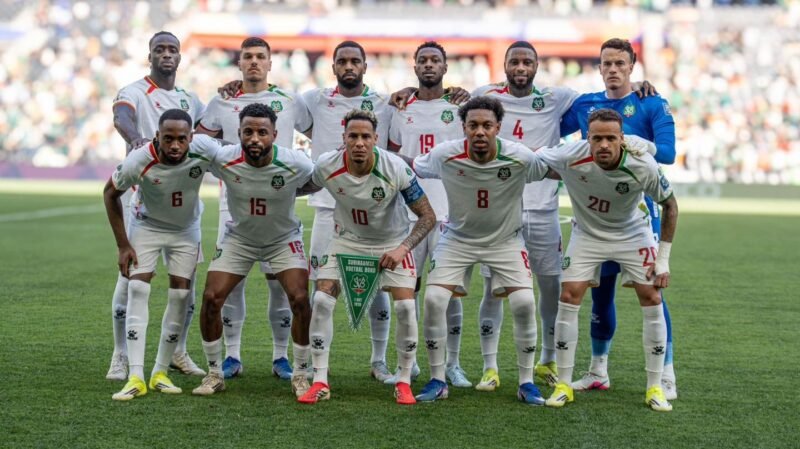
The saying ‘the mountain gave birth to a mouse’ fits perfectly with our National team, which lost to Bolivia with its slogan ‘Bribi na krakti’. The saying means that after enormous fanfare a poor result is achieved. This happened to the national football selection on March 26, 2026, with a team implanted in Suriname from Europe that has little connection with Suriname and South America. The irony is that Bolivia – with the highest percentage of indigenous people of South American countries – controlled and won the match against ‘Natio’ with a predominantly indigenous team. As a training ground for failing ‘Natio’, the Surinamese swimming sport around the time of independence serves as an example of well-thought-out and successful sports development.
Text Jack Menke
Image FB SVB
There was no shortage of optimistic Surinamese slogans to boost ‘Natio’ against Bolivia. In addition to the slogan ‘Bribi na krakti’, some journalists and so-called football experts used strong language to drag the Surinamese public into a false hope with the team implanted from Europe.
“The development of football in Suriname will never get off the ground sustainably by simply transplanting players and staff from Europe“
These include the words of Natio national coach Henk ten Cate: “There is no room for pessimism or negativism. There is only room for positivism and optimism.” And another illustrative quote: “The national football selection of Suriname is preparing for Thursday’s important intercontinental play-off match against Bolivia in Monterrey, Mexico. When the ball starts rolling in the BBVA Stadium with a capacity of 53,000 seats, only one thing counts: winning!”
Lamentation after loss
After Natio was sent home 1-2 by a better-playing Bolivia, the ‘Kraka Natio’ hit was replaced by an endless lament by various Surinamese media. Crooked reasoning was used to lament the best opportunities that Natio would have left unused.
Many ears were broken by the unsubstantiated statement “that Bolivia had not won, but that Suriname had given away the match”. And then on top of this came a cool justification for the loss: “We missed too many chances, big chances, to score. The score of, say, 3-1 for Suriname at half-time would have been normal, given the number of chances we had.”
Lessons to learn
Suriname must learn lessons from the failed Natio experiment.
1) From the inception of Natio, there was no proper participation of important Surinamese actors, such as knowledge institutes, sports experts, football clubs and unions for policy and strategy formulation.
2) Natio is nothing more than a team with staff transplanted from Europe to Suriname with no ties to our South American region.
3) The Surinamese Football Association (SVB) lacks a clearly developed development vision of football sport and thoughtlessly relied on players and trainers from the Netherlands/Europe.
4) The many quasi-expert media workers in Suriname promoted a false optimism among the Surinamese public with an abundance of European-style football information about an implanted Natio team.
The most important lesson to be learned from this is that the development of football in Suriname will never get off the ground by simply transplanting players and staff from Europe.
Talent development initiatives
After the failure of a Natio transplanted from Europe, we must secure the development of Surinamese football with an appropriate foundation. In order to plant seeds for sustainable football development, the first question is: How do you discover sports talent and how do you bring this talent to the national and international top?
I take the reader to a report published in 2014 ‘Sports talent in Suriname: Recognition and development of potential sports talent in Suriname’. The publication shows that Suriname’s international sports performance declined for twenty years due to a shortage of framework, expertise, facilities and knowledge development.
From 1993 to 2012, Suriname won a total of 34 medals in South American and international competitions. All medals were won in individual sports, with swimming (15 medals) at the top. We did not win any medals in football and we only participated in these games once.

This report also indicates the problems and opportunities for sports development in Suriname. Despite the many problems (shortage of staff, limited expertise, facilities and a knowledge gap), some positive initiatives for sports development were taken around 2012. The then Ministry of Sports and Youth Affairs wanted to achieve this with the support of the Regional Sports Academy, including by making up for the shortage of capacity. This ultimately came to nothing, mainly due to slow decision-making and low priority of sport in government policy.
“In order to plant seeds for sustainable football development, the first question is: How do you discover sports talent and how do you bring this talent to the national and international top?”
Swimming association shining example
The well-thought-out Multi-Year Development Plan of the Surinamese Swimming Federation (SZB) is the best example of successful sports development in Suriname. With great emphasis on knowledge development and training, the foundation was laid from 1972 to 1980 for the broad development of swimming and a progression to national and international top performances.
A first step of the SZB was decolonization, or breaking away from the circle of the Royal Dutch Swimming Federation. After all, until 1972, fifty Surinamese swimming teachers were trained in Suriname under the ‘Dutch flag’. After this, the SZB took matters into its own hands and trained 130 swimming teachers from 1972 to 1980. This contributed enormously to the annual growth in the number of swimming diplomas awarded from eleven hundred around the year 1970 to 5,500 in 1980.
In addition to providing a broad base for swimming, this development also provided a strong flow-on effect to national and international competitive swimming. Swimming was also made accessible to ‘the man and woman on the street’.
This is also evident from the fact that most diplomas were increasingly awarded outside the elite swimming pools – Oase, De Dolfijn and De Witte Lotus. But the cream of the crop was that the SZB had laid a solid foundation for a first group of national and international top athletes with top athletes such as Anthony and Pauline Nesty and Giovanni and Enrico Linscheer. This carefully planned policy of our association was able to take root by based on participation and sustainability as pillars of talent development.
Suriname must learn from the success story of the Surinamese Swimming Federation to develop the sport of football in Suriname in a structured manner after the failure of the European implant model of Natio. Such a development has a chance of success if the SVB learns lessons: instead of a transplant from Europe, it should – just like the Surinamese Swimming Federation – outline a planned development strategy, which takes into account accommodation, medical guidance, public relations, financing, organization and relevant actors.