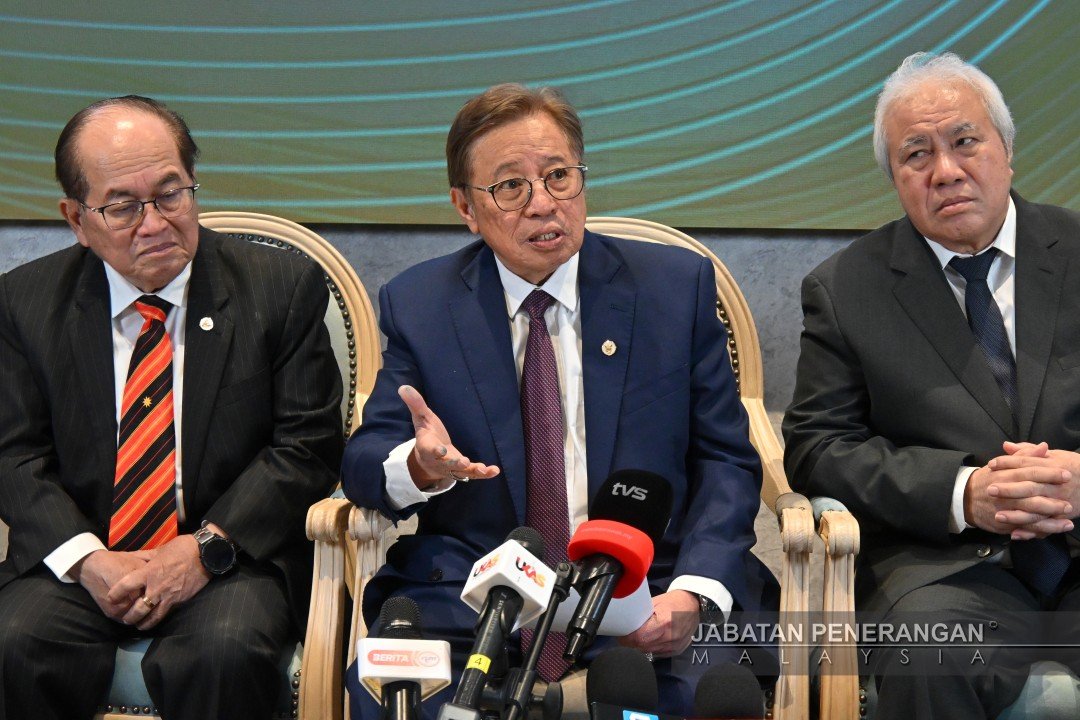

Abang Johari (centre) speaks to the media while Uggah (left) and Awang Tengah look on. – Information Department photo
KUCHING (April 16): Sarawak’s early transition towards alternative energy sources has helped cushion the state from the impact of rising global fuel prices driven by the ongoing conflict in the Middle East, said Premier Datuk Patinggi Tan Sri Abang Johari Tun Openg.
He said proactive infrastructure development, particularly through the Sarawak Alternative Rural Electrification Scheme (Sares), has enabled rural households to enjoy 24-hour electricity supply via solar energy, reducing reliance on costly and volatile diesel.
“We are grateful that we made early decisions on alternative energy and had already planned to transition to renewable energy, while other states are still relying on diesel,” he told a press conference at Satria Pertiwi Complex here.
He added that Lawas and Limbang were among the last areas in the state still dependent on diesel, with Lawas having been connected to the state grid in December and Limbang expected to follow in July.
“With this, we are no longer dependent on diesel as we can now rely on a mix of energy sources including electricity, solar, hydro, biomass and gas turbines.
“As a result, we are not significantly affected as we do not depend on diesel. Thankfully, we made the transition early,” he said.
He stressed that having multiple energy sources is essential, as reliance on a single source increases vulnerability to external shocks, noting that some regions remain heavily dependent on one type of fuel.
The Premier also said Sarawak’s plan to replace ferry services with toll-free bridges forms part of broader efforts to reduce diesel consumption.
“With six bridges completed to date and four more expected to be completed this year, the savings of millions of ringgit from discontinuing ferry operations and consequently diesel usage, can be channelled back to benefit the people,” he said.
On the impact of rising costs across sectors, Abang Johari said the construction sector is among those affected due to reliance on quarry materials and bitumen, while agriculture has also seen some impact from higher fertiliser prices.
“That is why I mentioned earlier about moving towards a circular economy, so we do not depend on imported fertilisers. We are affected, but not as severely as other places,” he said.
Responding to whether further assistance will be introduced for affected groups, he said the government has already implemented measures such as rental discounts for traders and hawkers, as well as micro, small and medium enterprises operating in local authority and statutory body premises.
He said the government will continue monitoring the situation and assess the need for additional support depending on economic conditions and business performance.
“At the moment, there is no data indicating such conditions. However, we do have data showing that some are affected by diesel prices, particularly in the construction sector, which uses diesel vehicles and machinery,” he said.
Abang Johari added that the government remains on standby to provide further assistance if necessary, especially as rising diesel prices could affect contractors handling ongoing projects.
“We will engage with organisations such as the Dayak Chamber of Commerce and Industry (DCCI), Dewan Usahawan Bumiputera Sarawak (DUBS) and other chambers of commerce to obtain feedback and respond accordingly.
“At this stage, there is no clear indication yet, but we are on standby if the situation worsens,” he said.
He also stressed that ensuring affordability of essential goods remains a priority, noting that the state government has increased the Sarawak Basic Needs Assistance (SKAS) to help households cope with rising living costs.
“We are giving a 25 per cent discount for electricity bills from April to December 2026, and the government is bearing RM188.1 million, which will be paid to Sesco.
“This will certainly help ease the burden on families,” he added.
Abang Johari said the combination of cash assistance and targeted measures reflects the government’s commitment to supporting the people, with further steps to be considered based on evolving conditions.
Also present were deputy premiers Datuk Amar Douglas Uggah Embas, Datuk Amar Awang Tengah Ali Hasan and Datuk Amar Dr Sim Kui Hian, as well as State Secretary Datuk Amar Mohamad Abu Bakar Marzuki.