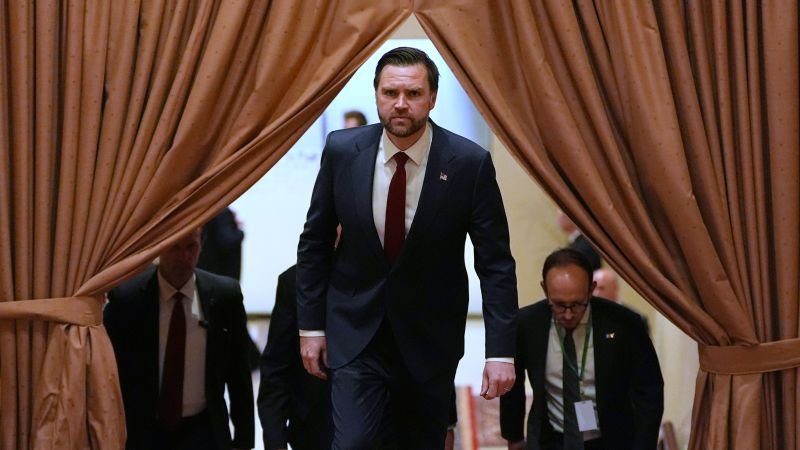
In the latter half of 2025, Vice President JD Vance’s future as the next Republican presidential nominee was looking fairly promising. That culminated in December, when potential rival and Secretary of State Marco Rubio signaled he wouldn’t even challenge the VP if Vance ran.
But since then, events — and Vance’s handling of them — have raised more and more questions about that possibility. Including a pair of high-profile failures over the weekend.
In the span of just a few days, Vance was dispatched to stump for Hungarian President Viktor Orbán in his country’s parliamentary elections and to negotiate a peace deal with Iran in Pakistan.
Neither came close.
Orbán’s party was soundly beaten in this weekend’s elections.
The Trump administration has made a habit of involving itself in foreign elections, and it had a pretty strong track record recently. It supported the winners of elections in Poland in June, Argentina in October, Honduras in December and Japan in February.
(Making the foreign interventions more problematic, the administration also often put its thumb on the scale — like by dangling a $20 billion bailout in front of voters in Argentina.)
But it went very wrong in Hungary, especially given the Trump administration’s repeated and incredibly public intervention that concluded with Vance’s high-profile, election-eve visit.

Of course, Orbán was down in the polls before Vance arrived. He acknowledged in an interview with Fox News on Monday night that the administration knew there was a “very good chance” that Orbán would lose, but said he went anyway because it was “the right thing to do, to stand behind a person who had stood by us for a very long time.”
Despite the vice president’s best efforts, the party of Orbán’s opponent, Péter Magyar, won a supermajority.
It served as a reminder that, however much Trump has invested in Vance, he’s never proved terribly exciting or compelling to voters in his own right. Vance opened his campaign speech in Hungary by calling Trump and was sent to voicemail before getting through to the president on a second try.
The other major setback came during Vance’s visit to Islamabad to negotiate a potential end to the Iran war.
In the days before, it looked like the administration was quite a bit more anxious to negotiate than the Iranians. And the two sides weren’t even able to agree on what the terms were of the ceasefire they had agreed to, hours after it began.
In other words, it didn’t appear the two sides were particularly close to agreeing on a long-term peace. And the immediate results of those talks support that assumption.
It’s certainly possible the two sides can eventually come together. And maybe Vance will ultimately have played a major role in crafting a peace deal that he can then hail as a signal of his political fortitude.
But the Iran war is an increasingly sizable problem for Vance’s aspirations.
After the vice president built a reputation for himself as a committed noninterventionist, Trump has in recent months set about a very different type of approach. That includes not just the Iran war but also his efforts to take over Greenland and the military operation that ousted Venezuelan President Nicolás Maduro.

Vance’s response has been to, well, try to have it both ways.
Word keeps leaking out of the administration that Vance hasn’t wholeheartedly supported the war, and he’s been remarkably careful about his public commentary. But he’s also insisted he trusts Trump’s judgment. He initially resisted the war, but also said if they were going to do it, they should hit Iran hard.
It’s an approach that seems calculated to alienate nobody, but that might ultimately please about the same number of people.
If the war backfires politically on Republicans, is Vance going to win people over by arguing that he politely and privately disagreed? And if it remains popular among Republicans, there wouldn’t seem to be much of a market for Vance’s foreign policy in the first place.
He’s also just attained some real ownership over the results of a war that appears fraught and highly unpredictable right now.
“So, if [a peace deal] doesn’t happen, I’m blaming JD Vance,” Trump quipped recently, to laughter. “If it does happen, I’m taking full credit.”
A joke — but one that might have some truth buried in it.
As Trump has delved further into this more aggressive and militaristic foreign policy, there’s a real risk that the party could opt for someone more aligned with that approach in the future.
It would seem no coincidence that the more hawkish Rubio gained substantial ground in the Conservative Political Action Conference straw poll two weeks ago — going from 3% in 2025 to 35% this year.
Vance still won the straw poll, which is unscientific and focused on a very small but passionate element of the conservative base. But he dropped from 61% to 53% and saw his margin of victory shrink substantially.
The political appeal of being vice president is self-evident; it’s who people think of when they think about who’s next in line.
But that also means vice presidents sometimes have to be associated with things they’d rather not be — and that they often get saddled with jobs that don’t do them many favors. (See: Harris, Kamala.) They can also shoulder the blame for failures — and presidencies — they have little real control over.
Vance is getting a hefty dose of that now. And it should serve as a reminder that no campaign is over a year before it begins.