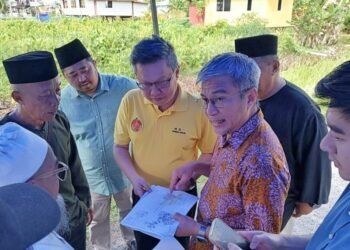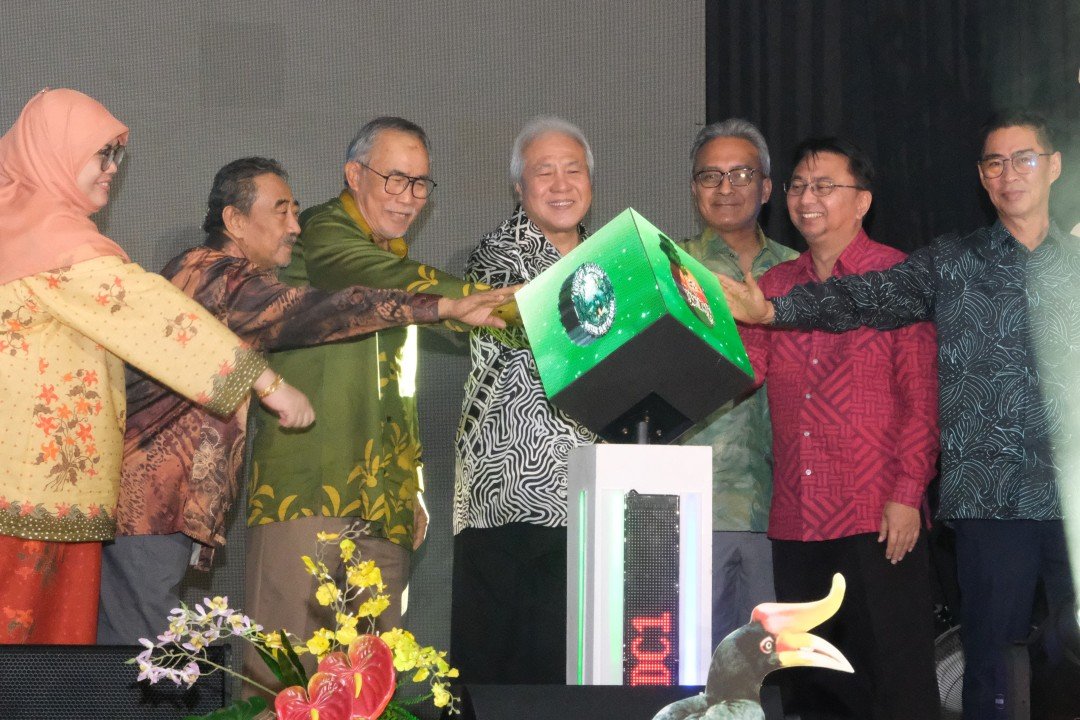

(From second left) Len Talif, Awang Tengah and other dignitaries jointly officiate the seminar.
KUCHING (April 16): Sarawak will continue to balance development and environmental conservation through sustainable forest management, as its vast tropical forests are now a strategic asset for future growth, said Deputy Premier Datuk Amar Awang Tengah Ali Hasan.
He said this approach ensures that economic progress does not come at the expense of environmental degradation, particularly amid global concerns over climate change and biodiversity loss.
“Sarawak has taken a clear stand that development cannot be built on environmental destruction.
“Instead, both must move in tandem through sustainable policies,” he said when officiating at the Sabal and Simunjan Forest Reserves Expedition Seminar recently.
Awang Tengah, who is also State Second Minister of Natural Resources and Urban Development, said Sarawak is among the last strongholds of tropical rainforest in the world, with more than 7.6 million hectares of forest cover, representing about 62 per cent of the state’s total land area.
Of this, about 7 million hectares have been designated for sustainable forest management and conservation under the state’s land use policy, including over two million hectares gazetted as Totally Protected Areas.
Awang Tengah said environmental sustainability has been placed as a core pillar under the Post Covid-19 Development Strategy (PCDS 2030), alongside economic prosperity and social inclusivity.
He added that the forestry sector continues to contribute to the state’s economy, with timber product exports valued at around RM2.5 billion, showing that sustainable practices can support economic growth.
However, he stressed that Sarawak is moving beyond a timber-based approach, recognising forests as strategic assets that generate value through ecosystem services, carbon storage, biodiversity and bioeconomy potential.
“In this regard, Sarawak has taken proactive steps in developing its carbon economy through the Forest Carbon Activity Rules 2022, positioning the state as a leader in forest carbon initiatives in Malaysia,” he said.
Awang Tengah also highlighted the significance of non-timber forest products such as honey, bamboo and herbs, as well as eco-tourism, in creating alternative income streams for local communities.
Among ongoing efforts, he said the development of the Sabal Complex under the 13th Malaysia Plan (13MP) is expected to strengthen the area as a centre for research, education and nature-based tourism.
Awang Tengah further revealed that Sarawak aims to plant 50 million trees between 2026 and 2030 as part of its commitment to green development and climate change mitigation.
On the seminar, he said it served as a platform to share knowledge and present findings from scientific expeditions conducted in the Sabal Forest Reserve and Simunjan Forest Reserve.
The expeditions, held from Nov 17 to 30, 2024, in Sabal and Aug 16 to 25, 2025, in Simunjan, involved multidisciplinary studies covering flora, fauna, ecology and hydrology, with participation of over 200 researchers and participants from agencies including Universiti Malaysia Sarawak (Unimas), the Sarawak Forestry Corporation and the Natural Resources and Environment Board.
Awang Tengah also emphasised that scientific research remains central to effective forest management, noting that such expeditions play a vital role in uncovering new species, ecosystems and potential applications in medicine and biotechnology.
He called for greater collaboration between research institutions, universities and the private sector to responsibly explore the state’s forest resources.
Awang Tengah further pointed out that Sarawak’s conservation efforts have gained international recognition, including from organisations such as the World Wide Fund for Nature and the International Union for Conservation of Nature, as well as through collaborations with Japan’s National Institute for Environmental Studies.
Also present were State Deputy Minister of Natural Resources and Urban Development Datuk Len Talif Salleh, the Ministry’s permanent secretary Datu Abdullah Julaihi and Sarawak Forest Department director Datu Hamden Mohammad.