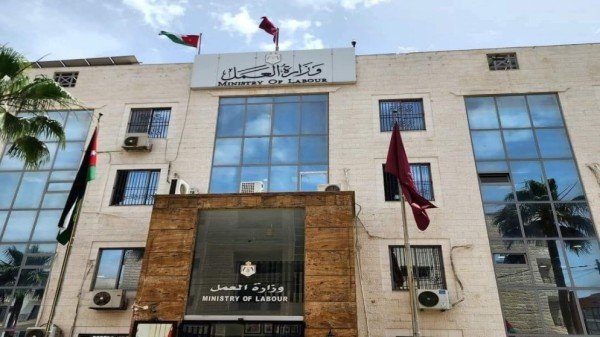
The spokesman for the Ministry of Labor, Muhammad Al-Zyoud, revealed on Thursday that 7,000 illegal workers had been deported from 2025 until the first quarter of this year, adding that the agricultural sector ranks high (at the top of the list) in terms of the number of permits, and it is also the sector from which labor leaks from employers to other sectors.
Al-Zyoud added that the decision to stop bringing in non-Jordanian workers is linked to the market need.
Al-Zyoud described the decision as “normal” and came after continuous communication with the relevant authorities regarding the needs of non-Jordanian workers.
He explained that recruitment in the past was not open, but was tied to employing Jordanians.
He pointed out that the labor market’s need was met to ensure business continuity.
He said that the decision is flexible and will continue until further notice, and targets all nationalities.
Regarding the fate of non-Jordanian workers inside Jordan after the decision, he said that the recruitment section relates to workers coming from abroad, but those who are inside Jordan and are committed to the provisions of the law, remain at their jobs and renew their permits, and there is no reservation about any nationality.
For his part, the Director General of the Farmers Union, Mahmoud Al-Oran, stressed the need for expatriate workers in light of the current agricultural conditions and the start of the harvest season.
He stressed the need for true partnership before making any decision, specifically when it comes to the agricultural sector that needs expatriate workers.
He said that the Union was surprised by the Ministry of Labor’s decision to stop recruiting workers.
Al-Oran added that with the harvest season, there is a fear of labor shortages.
Al-Zayoud responded to Al-Oran that there are 72,000 valid work permits in the agricultural sector, in addition to the presence of expired permits that have not been renewed.
Al-Zyoud said: “The sector, no matter what you give it, will say you did not give it to me,” stressing that the ministry does not neglect the agricultural sector because it represents national and food security.
Regarding communication with the Federation, Al-Zyoud said that he is not talking about communication regarding this decision only, but rather about continuous communication over the course of a year and a half.
He continued: “According to the number of valid permits, the agricultural sector ranks high (at the top of the list), and it is also the sector in which labor leaks from employers to other sectors, such as construction.”
He stressed that the ministry aims to reduce labor leakage.
He added: “I do not want to flood the agricultural sector with workers and then let them leak again. We are interested in monitoring the agricultural sector and meeting its needs without its workers leaking to other sectors.”
And he decided The Minister of Labor, Khaled Al-Bakkar, stopped the recruitment of non-Jordanian workers in most sectors and economic activities, including recruitment based on agreements to employ Jordanians, as of June 1, 2026.
According to the decision issued by the Ministry of Labor, the domestic workers sector, the clothing and knitting industry sector, and the industry of production inputs complementary to the sector were excluded from the decision to stop recruitment of the domestic workers, for projects registered in development zones with the Ministry of Investment, in qualified industrial zones (QIZ), or in free zones, in addition to professions with specialized skills.
The decision stipulates that the procedures for recruitment approvals granted before the date of its issuance must be completed in accordance with the rules.
The Ministry of Labor’s media spokesman, Muhammad Al-Zyoud, said that the decision was based on the Ministry’s assessment of the labor market’s needs for non-Jordanian workers and the needs of employers, explaining that the Ministry can open the door for recruitment when the market and various sectors need non-Jordanian workers, and also close this door according to its continuous follow-up of the market’s needs, so that recruitment will be stopped if the sectors are satisfied with non-Jordanian workers.
He stressed that the Ministry is keen not to flood the labor market with non-Jordanian workers, and that it only meets the minimum needs of the various sectors of this labor, stressing that the Ministry’s priority is to employ Jordanians and network male and female job seekers with employers.