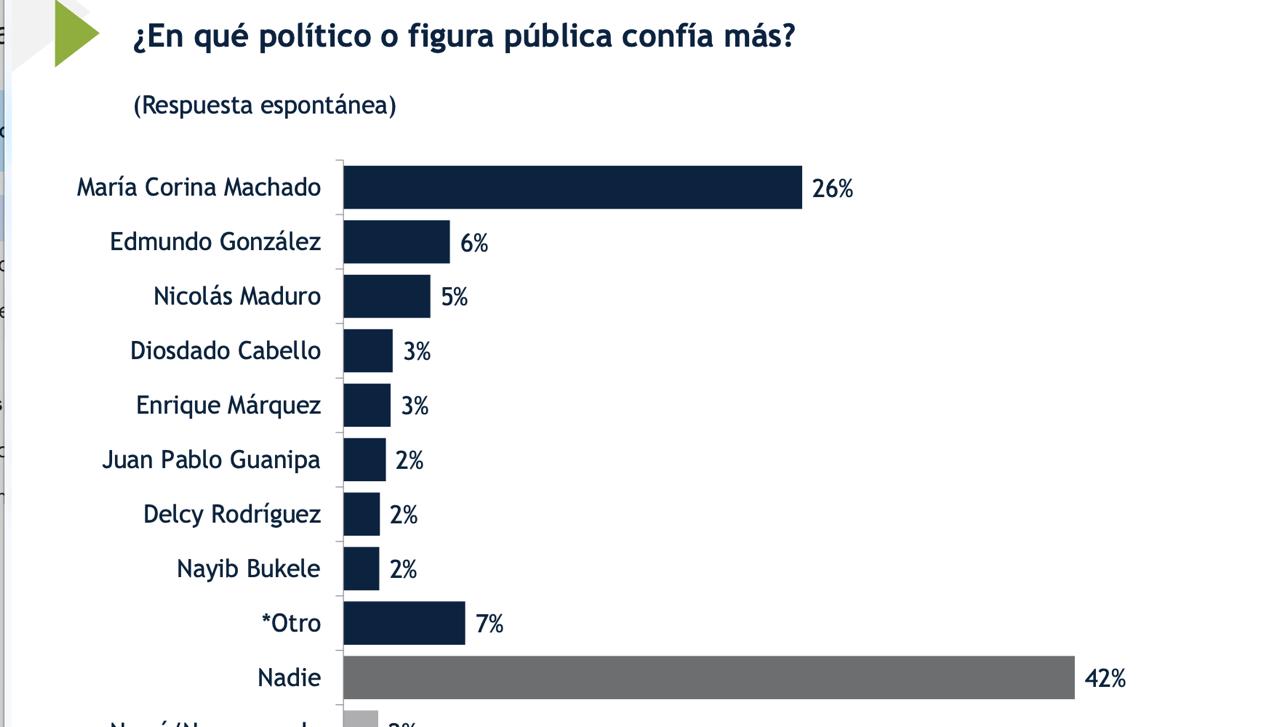
42% of Venezuelans do not have a defined candidate for the elections upcoming presidential elections or claims not to currently trust any political leader. This data is according to a survey conducted by CID Gallup for the Center for Insights in Survey Research (CISR) of the International Republican Institute (IRI).
The study was carried out between June 12 and July 15, 2026 with a sample of 1,203 adults in Venezuela. Furthermore, it shows that María Corina Machado concentrates 26% of the preferences among the political figures consulted. They are followed by Edmundo González, with 6%, and Nicolás Maduro, with 5%.
Other Venezuelan leaders
The measurement also includes other Venezuelan leaders. Diosdado Cabello and Enrique Márquez appear with 3% each. On the other hand, Juan Pablo Guanipa, Delcy Rodríguez and the president of El Salvador, Nayib Bukele, register 2% respectively.
The results show a considerable difference between the first option mentioned and the rest of the leaders included in the consultation. At the same time, a significant percentage of respondents do not identify any politician as their choice.
The survey also addressed Venezuelans’ expectations about the country’s political direction. 62% believe that there should be a major change in the political system and leadership during the next 12 months. If those who prefer gradual changes are incorporated, the proportion reaches 82%.
The survey also asked about the assessment of Chavismo. A 80% of those consulted rated its effects negatively on the history of the country.: 69% considered them “very negative” and 11% “somewhat negative”.
Most consider that democracy is the best option
Despite the differences on the political scene, support for democracy appears as one of the main results of the study. 74% of those surveyed consider that this system represents the best form of government for Venezuela.
The survey also asked about when presidential elections should be held. 45% were in favor of carrying them out as soon as possible. However, 52% consider that they should be carried out after certain conditions are met. Among these are the expiration of the original period in 2031, mentioned by 24%. Furthermore, the release of political prisoners represents 19%, and economic recovery represents 9%.
Regarding an eventual national reconciliation, 25% of those consulted consider a change of government necessary. Additionally, 21% mention accountability and judicial processes. 19% point out the recognition of errors by the State. Likewise, 13% consider the release of all political prisoners necessary.
The survey was conducted through computer-assisted telephone interviews throughout the national territory. The study excluded the population of Federal Agencies and has a margin of error of up to ±3.9 percentage points, with a confidence level of 95%.