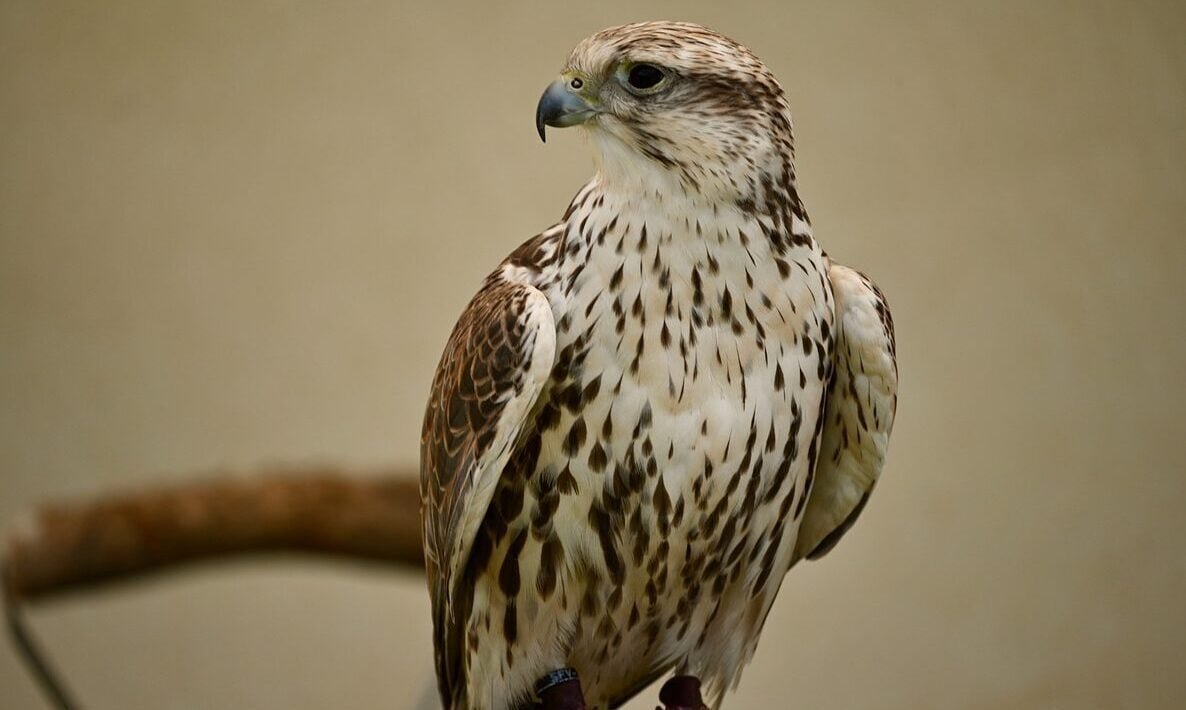

As part of the EU project “LIFE SakerRoads,” this year’s ringing and tagging season for the endangered saker falcons has been successfully completed. Thanks to modern satellite technology and meticulous field research, important data was collected that is intended to strengthen the long-term protection of these majestic birds of prey.
As the Hungarian Society for Ornithology and Nature Conservation (MME) announced Monday, experts fitted a total of 17 young birds from five different nests with state-of-the-art satellite transmitters during this year’s season. The tiny GPS devices weigh 11 grams.
Compared to earlier models, they place a minimal burden on the falcons but provide precise data on the birds’ daily routes, spatial use, and survival rates.
This year, the focus was particularly on the special bird protection areas of the central and eastern Hungarian areas such as “Dévaványai-sík” and “Jászság.” It is noteworthy that the young tagged birds this season come exclusively from pairs that nest in trees. Since the program began in 2024, a total of 86 saker falcon chicks have been fitted with transmitters.
For Hungarian conservationists, working with these strictly protected birds of prey is a year-round endeavor. Monitoring begins in early February when the falcons occupy their territories in Hungary. Between May and mid-June—timed to match the individual developmental stages of the young birds—the chicks are banded and their biometric data is recorded at the nest.
In addition to the technical equipment, scientific work in the laboratory was also a priority this season. At the same time as the transmitters were being fitted, veterinary samples were taken to check the chicks’ health.
Genetic samples were also collected for DNA fingerprinting analyses. These make it possible to decode the young birds’ genetic makeup and thus determine the identity of their parents beyond a doubt.
With the young birds’ fledging, the practical part of this year’s tagging campaign is complete. For the experts at MME, the digital work—the continuous analysis of the incoming data streams—now begins.
The overarching goal of the program is to identify the causes of death among saker falcons more precisely and based on data. Since the transmitters allow for daily tracking of the birds’ locations, the teams on the ground can intervene immediately in an emergency—for example, in cases of illegal persecution or accidents involving power lines. The insights gained are also of inestimable value internationally for global research on the species.
A large-scale project like this is only possible through strong partnerships.
In a press release, MME expressed its gratitude to the participating veterinarians, the Hungarian Nature Conservation Guard, and the Bükk, Hortobágy, and Körös-Maros National Park Directorates. Another key partner in the project is the power grid operator MAVIR Zrt., which plays a major role in securing nesting sites and power poles.
The “LIFE SakerRoads – Protection of the Saker Falcon in the Northern Great Plain Region” project is funded by the European Union’s LIFE program.

Via MTI; Featured image: Pixabay