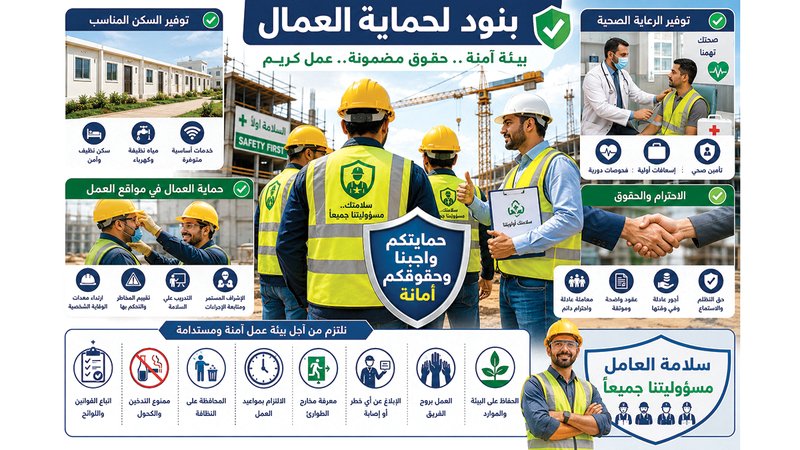
The Ministry of Human Resources and Emiratisation has identified 11 obligations and procedures that employers must adhere to, to ensure the safety, protection and health care of workers, the most prominent of which is providing appropriate and licensed housing for the worker, or disbursing a cash allowance for housing or including it in the agreed-upon wage, in addition to bearing the costs of medical care for the worker in accordance with the legislation in force in the country, within an integrated package of preventive measures that must be available at work sites and worker housing, in a way that ensures the provision of a safe and healthy work environment for workers in various sectors.
The Ministry explained, in a recently issued guide, that if a worker is exposed to a work injury or an occupational disease, the employer or his legal representative must notify the competent medical authority and the relevant police station according to the geographical scope, in addition to informing the Ministry through the designated channels within a maximum period of 48 hours from the date of his learning of the suspected occupational disease, or from the time the work injury occurred, provided that the report includes all data related to the worker, the accident, and the measures taken to aid and treat him.
In detail, the Ministry of Human Resources and Emiratisation issued the “Guide to Occupational Health and Safety in the UAE”, confirming that it has implemented an integrated system to ensure occupational health and safety in accordance with Decree Law No. 33 of 2021 regarding the organization of labor relations, its executive regulations, and the relevant ministerial decisions, as these legislation stipulate a package of preventive measures that must be available in the workplace and workers’ accommodation.
The guide includes 11 obligations and procedures that employers must adhere to to ensure workers’ safety, protection, and health care. It includes “providing appropriate means of protection to protect workers from the dangers of injuries and occupational diseases that may occur during working hours, fire dangers, and other dangers that may result from the use of machines and other work tools, and following all prevention methods determined by the Ministry, and placing detailed and clear instructions in visible places at work sites related to fire prevention methods, ways to protect workers from potential dangers while performing their work, methods of preventing them, and how to deal with them.” With accidents, in Arabic and in the language that the worker understands when needed.
The obligations included “informing workers, before starting their work, of the risks associated with the professions they will practice, and that the employer entrust the supervision of first aid to a specialist in providing medical aid, and that he must provide every first aid box with everything necessary, and provide means of fire prevention and appropriate extinguishing equipment according to the nature of the activities and materials used in the facility.”
She explained that among the obligations are also “to take the necessary means to continuously ensure that the prevailing working conditions provide adequate protection for the health and safety of workers, and to take appropriate practical means to prevent, reduce or eliminate health risks present in the work environment, and to take the necessary precautions to protect workers from the dangers of falling or falling objects and tools, flying fragments, sharp objects, hot or caustic liquid materials, flammable or explosive materials, and providing protection from the dangers of electricity, compressed gases, and electricity.”
The obligations also included “obliging the employer to hang signs and technical instructions at the sites of machines and various operational processes, including the necessary instructions for operation and safety, and to provide the worker with appropriate housing licensed by the competent authorities in accordance with the rules and standards in force in the country, or to pay cash compensation for housing or for it to be included in the worker’s agreed-upon wage.”
The Ministry stressed the need to provide the highest possible levels of protection from the risks present in work sites, taking into account the comfort requirements and health status of workers, in addition to developing a special system for preserving, maintaining, cleaning and sterilizing personal protective clothing and equipment that may be exposed to contamination with toxic substances or hazardous to health.
She also stressed the need to ensure the safety of the vehicles used to transport workers, so that they are licensed, roadworthy, and designated for transporting passengers in accordance with the requirements approved by the competent authorities, and that they are air-conditioned and equipped with a number of seats commensurate with the number of workers transported.
Within the framework of strengthening the occupational safety system, the Ministry obligated industrial establishments and construction sector establishments that employ 100 workers or more to appoint an occupational health and safety officer, who is technically qualified to supervise the implementation of various risk prevention requirements and the application of occupational health and safety requirements. The Ministry also called on establishments covered by the provisions of Article (4) of Ministerial Resolution No. (44) of 2022 regarding occupational health and safety and labor housing to ensure that worker housing, whether owned or rented, is registered through the system. The designated electronic form is available on the Ministry’s website.
With regard to injuries and work accidents, the Ministry obligated the employer to bear the costs of medical care for the worker in accordance with the legislation in force in the country, stressing that if the worker suffers a work injury or occupational disease, the employer or his legal representative must do the following: inform the medical authority, and inform the competent police station according to the geographical scope. The report shall be made immediately in the event of a work injury as a result of an accident or any injury other than an occupational disease. The report shall also be from the date the employer learns of the existence of the suspicion of occupational disease.
She stressed the need to inform the Ministry through the channels designated for this purpose within a maximum period of 48 hours from the date on which the employer learns of the suspicion of occupational disease or from the time of the occurrence of any other work-related injury, provided that the report includes the worker’s name, age, profession, nationality, place of work, ID number, and a brief description of the accident or occupational disease, its circumstances, and the procedures that were taken to aid and treat the worker. Injury reports are recorded through the Ministry’s application.
Regarding the policy of protecting workers from heat stress, the Ministry confirmed that the ban on performing work under the sun and in open spaces is one of the basic foundations of labor market legislation in the country, with the aim of providing a safe work environment that is compatible with the best international practices in the field of occupational health and safety.
She explained that the period of application of the ban extends annually from June 15 to September 15, and is applied daily from 12:30 noon until three in the afternoon, and includes all work performed under direct sunlight and in open spaces, in order to reduce injuries and health damage resulting from working in high temperatures during the summer months.