PARAMARIBO — A future-proof food supply does not happen automatically, but requires courage, investments and belief in our own abilities. “Today let’s choose our local producers, sustainably manage our natural resources and build a resilient, confident and food secure Suriname”! Minister Mike Noersalim of Agriculture, Livestock and Fisheries (LVV) made this call on Friday in the context of World Food Day. This day is celebrated annually on October 16. The minister says that there are five crucial pillars to build a future-proof food system.
Firstly, food security, environmental sustainability and social resilience require one coherent policy that bridges the gap between farmers, processors and consumers. The minister also says that Suriname can become less dependent on imports by scaling up local production and strategically managing storage.
“We make a special appeal to our young people: see the agricultural sector as a modern sector full of opportunities”
We also reduce food waste and reuse residual flows as raw materials for compost and animal feed, for example. According to LVV Minister Noersalim, self-sufficiency does not mean that we close ourselves off. “We are entering into smarter partnerships in the Caribbean region and beyond to share knowledge, promote fair trade and protect our market,” he mentions as the third pillar.
He further says that Suriname has fertile lands and rich water sources. By investing in climate-proof agricultural techniques, modern plant material and knowledge, we increase production and guarantee safe food. This is the fourth crucial pillar to build a future-proof food system.
As a fifth pillar, the minister indicates that the government creates the conditions, infrastructure and opportunities for entrepreneurship. “We make a special appeal to our young people: see the agricultural sector as a modern sector full of opportunities, technology and innovation, and help build the future of our country.”
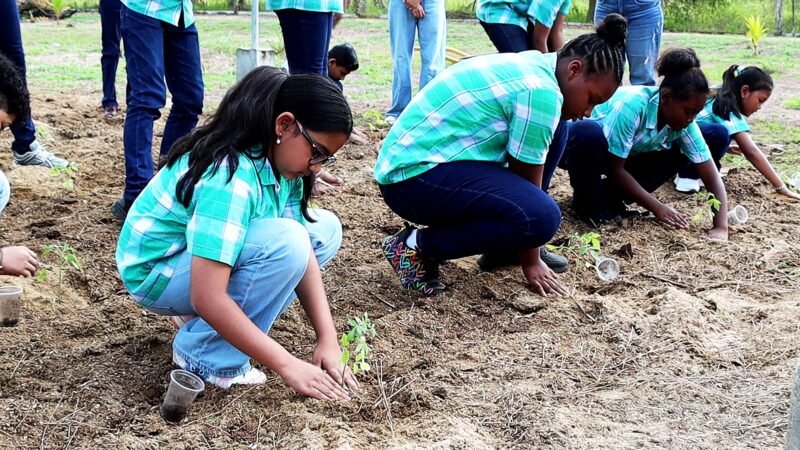
The ministry has organized numerous activities to commemorate World Food Day. For example, students from the Pandit Soerdjpal Ramjatan School were allowed to visit the citrus nursery in Tamansari. Furthermore, hydroponic systems have been donated to OS Baitul Rochman school and OS 2 Tamanredjo. Agricultural tools have also been handed over to schools to support agricultural teaching activities.
LVV deputy director Amrish Bhaggan of LandbouwOost says that with these activities the ministry wants to contribute to a healthier society and help promote food security. He emphasizes that investing in students means investing in the future.
LVV policy officer Eline Troenosemito says that it is important that students become acquainted with the different agricultural crops and also learn how to grow food themselves. The students were enthusiastic about what they learned during the visit to the Citrus Nursery. Some indicated that they were already planting at home with their parents. Others fully intend to put what they have learned into practice at home.