By Irena Beqiraj
In Albania we are living an interesting paradox, in our real estate market, apartments do not always need residents to produce value.
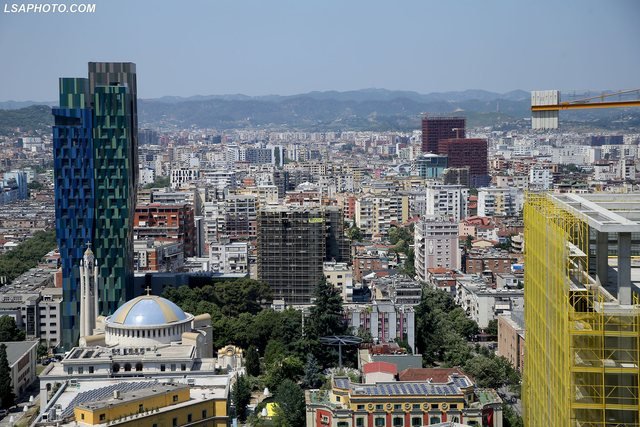
We build more and more, some apartments remain empty, prices continue to rise and citizens find it increasingly difficult to find an apartment they can afford. In short, Albania has a lot of apartments, but little affordable housing.
United Nations report, UNECE Country Profile on Urban Development, Housing and Land Management – Albania (2024), evidences exactly this paradox: a place where a part of the apartments have no residents, while a significant part of the residents do not have enough space to live.
Albania has one of the highest vacancy rates in Europe. According to the data used in the report, over 58% of the population lives in overcrowded housing. Meanwhile, social rental housing accounts for only about 0.1% of occupied housing.
To solve this paradox, the government proposes a supertax for those who buy apartments and refuse to rent them out. The argument is that the owner has the right to keep the property vacant, but must pay for this choice.
In principle, the economic logic is understandable: if keeping an empty apartment becomes more expensive, the owner may decide to sell or rent it.
If we add to this argument the sentence that “this is what all the countries of Europe do”, the argument is complete, it becomes irrefutable and ready for use. Only one small detail remains, let’s see if it works.
But will the supertax bring down apartment prices and rents, or will it simply provide the state with more income from landlords?
The second is safe. The first, not so much. And I don’t say this, but we are told by the experiences of countries that have tried it before.
In France, economist Mariona Segú’s study, published in 2020 in the *Journal of Public Economics*, analyzed the effects of the tax on empty homes, applied since 1999.
The study found that the tax reduced by about 13% the number of empty dwellings, especially those that remained unoccupied for long periods. So, the tax managed to change the behavior of some of the owners and bring the apartments back into use.
In other words, the tax succeeded in bringing more apartments into use, but did not prove to make them more affordable for those looking for a home. Another interesting case is Vancouver, where the tax on empty apartments was applied in 2017.
The Ripple Effects Study: The Impact of an Empty-Homes Tax on the Housing Market (2024)by Gherardo Caracciolo and Enrico Miglino, analyzed its effects on the housing market. The results showed that the vacancy rate decreased by about 1.4–1.5 percentage points. However, no statistically significant impact on average rents was found.
This is perhaps the most interesting lesson for our debate. Apartments came on the market, but prices and rents didn’t feel compelled to follow. This is where the problem with our policy begins: we confuse increased availability with increased affordability.
In the logic of street economists, the more apartments that come on the market, the cheaper they will automatically become. But housing economics is a bit more complicated. It is not enough to add apartments to the market. It matters what apartments it offers, where they are located and, above all, who can afford them.
If an apartment that was kept vacant comes on the market at a rent beyond the reach of a middle-income family, supply has increased, but the housing problem has not been solved.
Or if the owner chooses to rent it out by the day to accommodate 1 of those 12 million tourists who consume 12 million cucumbers and 12 million imported tomatoes, the tax may not even produce the effect it intended. In this case, the apartment no longer remains empty, but neither does it become part of the solution for families looking for a long-term residence.
In the end, we have to distinguish two objectives that are often confused: to make it more expensive to keep an empty apartment and to make housing more affordable for citizens. The first can be achieved through taxation. The second requires much more than a tax.
The second calls for social housing, affordable long-term rentals, support for low- and middle-income families, and an urban policy that does not measure city development by built-up square meters alone.
The experience of France and Vancouver shows us that the tax can work as an instrument for activating existing housing. But it also cautions us that more apartments on the market does not automatically mean lower rents or more affordable prices.
So before we present the supertax as the solution to the housing crisis, perhaps we should ask what we aim to achieve: fill empty apartments, increase state income or give citizens the opportunity to own a home?
So far, Albania does not seem to have a shortage of square meters. There is a shortage of housing that can be afforded by those who need to live in it. And, unfortunately, an apartment can become more expensive for the owner without becoming a penny cheaper for the tenant.