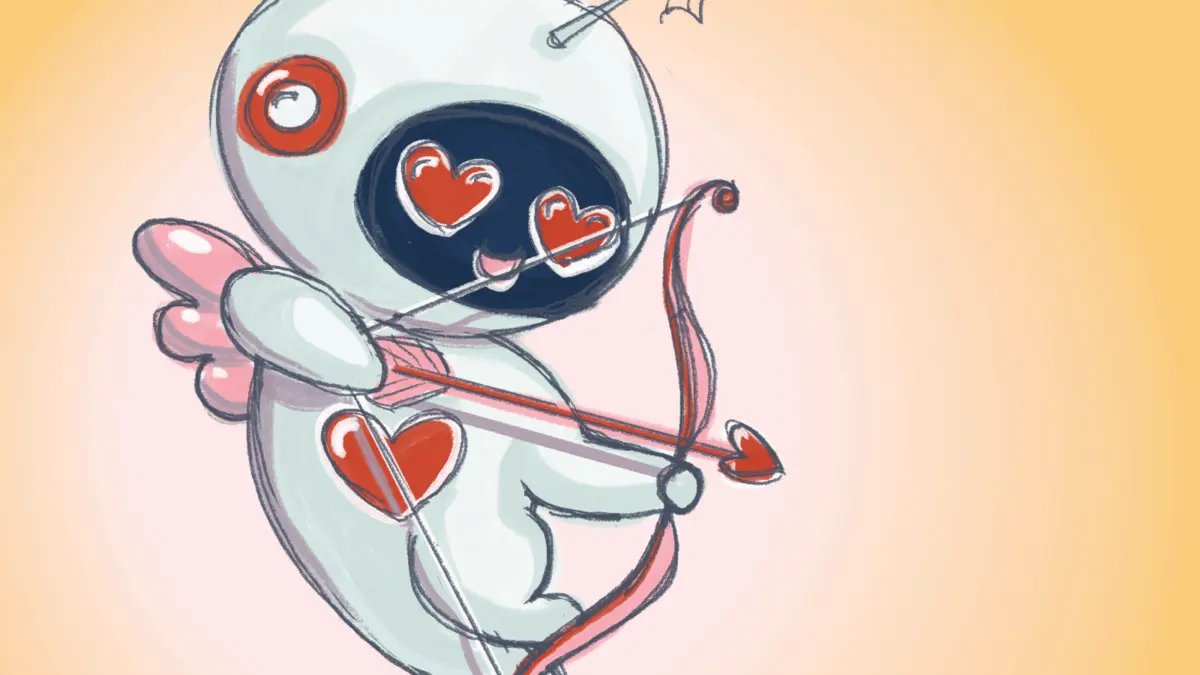
Must have been totally crazy before ‘the system’.” It’s Amy’s first date, arranged by an AI. People used to have to do this “whole relationship thing” on their own. With AI it is much easier. She decides who is with whom and for how long. The software takes insights and data from every relationship – until you find the perfect match. In 99.8 percent of cases, “the system” finds the “ultimately compatible” counterpart.
This is what the science fiction horror series “Black Mirror” predicted in 2017. The scary prognosis has not yet come true. No AI dictates anything to us when it comes to love. But denying their influence would still be naive. Bumble, at least the second most popular dating app in the Vienna area, is currently testing its AI assistant “Bee”. A busy robo-bee that is supposed to understand the user’s relationship values, select matches based on them and also justify them. The function is currently being tested on selected profiles in New York, providing broader access is planned from autumn. However, there is still no fixed start date for German-speaking countries. Europe usually lags behind the US market.
“Bee” is intended to reach a new, young target group and cheer up frustrated users. Many of them have become swipe-tired. The swiping concept that Tinder launched in 2012 has lost its appeal. Although it gave the search for a partner something playful (and a lot of addictive potential), “that’s exactly why it’s difficult for many people to take the whole thing seriously,” says Kathryn Coduto, media scientist at Boston University, via Zoom call to the “Presse”. The 34-year-old has been researching the use of dating apps and how people build relationships through digital spaces for almost ten years.
Many, she says, are exhausted by the two-dimensional search for love. According to a survey by Forbes Health, 78 percent of dating app users do. The media calls this “swiping fatigue” or dating app burnout. As a result, Tinder and its imitators such as Bumble are losing paying users, and both recorded a decline in sales in this year’s first quarter.
So, as so often, AI should help. In addition to Bumble, Tinder is also already testing an AI-supported feature that is intended to improve matchmaking by analyzing photos and certain information. Currently available in Australia, New Zealand, the USA and Canada. In general, the past two years have produced a number of AI matchmaking apps; including Fate, Sitch and Amata. Users are interviewed by the AI and are then suggested a handful of potential romantic partners. Instead of a subscription fee, you pay per arranged date; Amata charges $20 for one. The app only allows you to contact the chosen person two hours before the meeting. In addition to more accurate matches, the services are committed to lower-threshold access to professional matchmaking. In the USA you usually pay upwards of $5,000 for a marriage broker.
“The AI will never be able to take small human peculiarities into account.”
Kathryn Coduto
US media scientist
Amata co-founder Ludovic Huraux’s prediction is even more promising, saying that in just five years a… “Personal” AI matchmaker will be the norm. Researcher Coduto doesn’t think so. “Many people who date online are really uncomfortable with the explosion of artificial intelligence in this context.” She goes through the digital search for love long ago. Some of the algorithms within the apps are already AI-supported, their use is just more subtle. So far, profiles have not necessarily been ranked according to the best compatibility; rather, particularly active users have been given preference. A new AI feature in the Hinge app was more striking at the end of 2025: “Convo Starters”. It is intended to provide personalized food for thought to start the conversation. You still have to write the message yourself – in theory. According to a representative survey, one in five people in Germany uses AI to get help in formulating messages.
This is despite the fact that most people would like more authentic encounters. The hunger for happy coincidences (or be it fate) is great. This is certainly one of the reasons why the much-quoted Generation Z likes to watch old love films full of “meet-cutes”, which is the name given to charming, funny first encounters between two people who soon fall in love with each other. The popularity of romance novels (TikTok is full of them) may also play a role. In Boston, singles are actually increasingly looking for an analog partner again, says Coduto, and speed dating evenings have recently been better attended again and are often even sold out. In Great Britain, Eventbrite reported a 42 percent increase in attendance at such events in just one year, and individual analog offerings also flourished in Vienna.
AI would therefore drive us out into the world again, “because it shows us how seriously inauthentic this dating experience can be,” says Coduto. People would especially want to strongly protect their romantic relationships. The scientist still sees a benefit for AI help there: “Security on dating apps is still patchy, new technologies could really help us here.” AI could detect problematic messages and unwanted photos (keyword: Dick Pics) intercept before they are seen. Maybe even check the user information for authenticity. A bit paradoxical, as it is intended to expose the deceptions that are becoming increasingly easier to produce with its help.
Coduto is certain that dating apps are here to stay. Despite the singles’ tiredness of swiping. And despite all skepticism, AI will continue to be introduced, even if it will not be fully comprehensive: “It will never be able to take small human peculiarities into account.” Not even if she has been trained to speak and write like you do. Her arithmetic skills stop when it comes to non-verbal signals.
Focus: What lies ahead for us?
It’s been 30 years since diepresse.com went online, “Die Presse” took the step into the digital age. We are taking this anniversary as an opportunity to look forward again. Young entrepreneurs, researchers, artists and politicians are asking themselves the big questions of our time: How will our most important areas of life change in the next few decades? How will we work, believe and love? And what else do we need to know in the future?
To the focus.