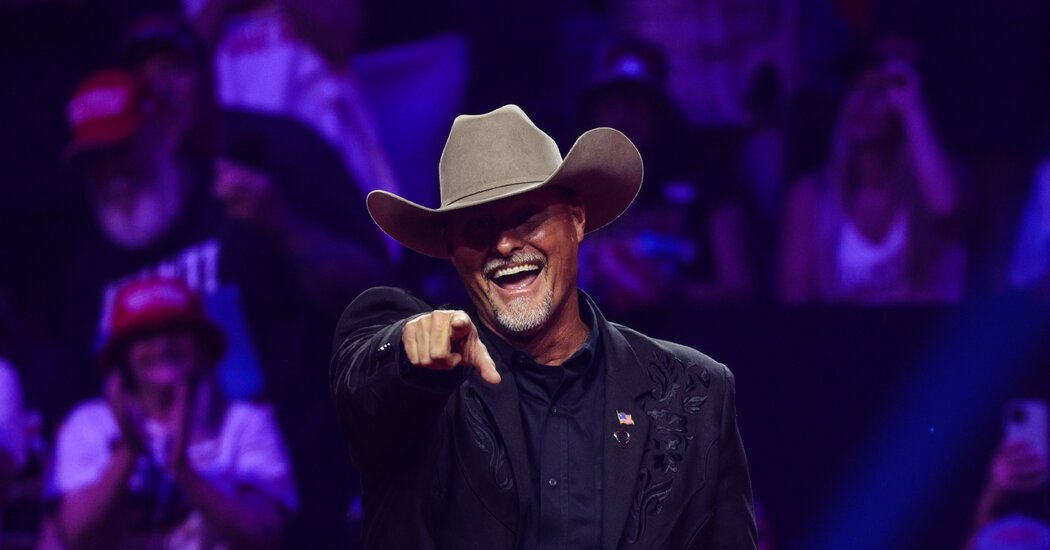
It is a sprawling and tawdry tale: a former county sheriff accused, among other things, of sexting women outside his marriage and of threatening to sic state law enforcement on one of the recipients to keep her from posting about it online.
That ex-sheriff is also the Trump-endorsed front-runner in the Republican primary for Arizona’s Fifth Congressional District.
The messy race is one of several we’re watching tomorrow, as the primaries march to the Grand Canyon State. But the contest between Mark Lamb, the former Pinal County sheriff, and a lesser-known businessman in a deeply religious part of the state is a test of the power of a Trump endorsement — and the potency of a sex scandal in a Republican primary.
Straightforward, at first
Lamb, an immigration hard-liner who branded himself the “American Sheriff,” ran for Senate against Kari Lake in 2024, losing but burnishing his name recognition in the process. He launched his campaign for the district outside Phoenix — a reliably Republican seat that Representative Andy Biggs is vacating to run for governor — last October with the slogan “God, Family, Freedom.”
By early November, President Trump had endorsed Lamb and instructed another high-profile candidate, the former Arizona Cardinals kicker Jay Feely, to high-tail it for a different district, which he did.
It all seemed pretty straightforward, until it didn’t.
In May, an investigation by The Arizona Republic laid out a complex web of allegations against Lamb. It cited women who alleged that he had sent intimate photos outside his marriage, had flirted using a campaign social media account, and had facilitated an affair between his wife and a friend who worked on his campaign and for the sheriff’s department. The Republic also reported that he made racist jokes over text, and that he seemed to be spending a lot of his time at a ranch in Tennessee 1,500 miles away. The Republic also reported that the Church of Jesus Christ of Latter-day Saints, of which Lamb is a member, had examined claims of impropriety against him.
Lamb has barely acknowledged the reports. A spokesman for Lamb, Ed Morabito, told me the allegations were “lies and slanderous and come from long-discredited individuals.”
“Sheriff Mark Lamb is endorsed by President Trump, and every independent poll has him winning easily by double digits,” Morabito added.
Quiet responses from Republicans
It takes a lot for an allegation of sexual impropriety to shake a Republican race — particularly in the Trump era, when the president has been loath to abandon candidates facing damaging allegations.
Think Ken Paxton, who was indicted and impeached (though never convicted) and accused by his wife of having an affair. Or Roy Moore, the former Alabama Supreme Court justice who maintained the president’s support in a 2017 Senate race, even after multiple women accused him of sexual misconduct or assault, sometimes when they were teenagers.
Arizona Republicans have stayed largely quiet about the reporting about Lamb. Early on, Biggs described the reports as “concerning” but said, essentially, that he was staying out of it. So is Representative David Schweikert, another candidate for governor, who initially called on Lamb to explain himself or drop out.
And, as if to put any doubt to rest, Trump reaffirmed his endorsement of Lamb on Truth Social this month.
Barrett Marson, a Republican strategist based in Arizona, downplayed the allegations and said they seemed unlikely to make a difference in the election.
“I just don’t think this is that much of a sex scandal,” Marson told me.
The lonely work of an opponent
Lamb’s main opponent, Daniel Keenan, is trying his best to make sure voters hear about the allegations. The founder of a building company, he has lent his campaign $1.65 million and has run ad after ad describing Lamb as unfit for office — and a risk to his party.
“The Republican Party can’t afford to have their version of Graham Platner,” Keenan told me over the phone yesterday. “If he somehow survives the primary,” Keenan said of Lamb, “he puts our district at risk of falling to the Democrats because they’re going to pour in millions, exploiting all of his, you know, personal allegations.”
Some of the president’s endorsements have faltered this year. But running against a candidate who has one is lonely work, even when that candidate might have been vulnerable in a bygone political era.
“You’re going against an endorsement, and so your opponent can market that,” Keenan said. He added, “There’s some challenges with that as well. But that’s why we’re outworking them, we’re outspending them.”
Not every Republican facing scandal this year has been able to weather the storm. Former Representative Tony Gonzales of Texas resigned this year after he was accused of having a coercive relationship with a member of his staff who later died by suicide, and he dropped out of his race for re-election.
That turned Brandon Herrera, a hard-right YouTuber known as “the AK guy,” into the default Republican nominee. He drew some attention this weekend after a Twitter account highlighted deeply offensive remarks he made about women and mothers in 2023; he is expected to win the deep-red district handily.
Maine Senate Race
What to know about Troy Jackson
My colleagues Tim Balk and Beth Reinhard compiled a short list of facts about Troy Jackson, the front-runner in the race to replace Graham Platner as Maine’s Democratic nominee for Senate.
-
He ran for governor this year, even receiving an endorsement from Platner, but finished third in the ranked-choice primary.
-
He is supported by progressive groups and politicians. Our Revolution, the liberal organization founded by Senator Bernie Sanders, signed off on Jackson as its candidate of choice.
-
He is seen as close to Platner on policy. Jackson’s platform calls for universal health care and the abolition of ICE, and accuses Israel of carrying out a genocide in Gaza.
-
His positions have changed over time. Jackson is a progressive who supports abortion rights, but earlier on in his political career, his voting record reflected views that were anti-abortion and against same-sex marriage.
-
He’s a fifth-generation logger from Maine’s northern reaches and has long lived in Allagash, a wooded town of 237 people.
In One Graphic
When the candidate gets to the chatbot before you do
A new A.I. tool, CampSight, is helping candidates improve their online footprints so that chatbots will produce information for users asking about them.
One case study that my colleagues Stuart Thompson and Tiffany Hsu looked at is the candidacy of Dustin Lloyd, a Democrat running for Missouri’s state legislature. CampSight determined that Lloyd’s website and his presence on Wikipedia and Ballotpedia — sites where voters regularly find information about political figures — were lacking and advised him to make changes. Below, the difference between Lloyd’s online presence before the edits and after.
your questions, answered
Recently one of our U.S. Senate candidates “suspended her campaign.” Now Graham Platner in Maine is as well. What happens to campaign donations when a candidate drops out before the election? — Dana Saxon, Grosse Pointe Farms, Mich.
Candidates who drop out (or lose) almost always hold on to the money that they’ve collected. There is no obligation to return the cash — you just can’t pocket it for personal use. Losing candidates can hold on to millions of dollars for years, transfer the money to another entity like a state party, or use it to finance future campaigns. The only time it would be refunded to donors is if a candidate accepted money specifically earmarked for the general election and didn’t make it that far. — Theodore Schleifer, who covers campaign finance
ONE LAST THING
JD and Usha Vance welcome baby No. 4
Vice President JD Vance and his wife, Usha Vance, welcomed their fourth child on Sunday. The new baby, Alec Neel Vance, marks the first known time in modern U.S. history that a sitting second lady has given birth while her husband is in office.
Theodore Schleifer and Taylor Robinson contributed reporting.
Read past editions of the newsletter here.
If you’re enjoying what you’re reading, please consider recommending it to others. They can sign up here.
Have feedback? Ideas for coverage? We’d love to hear from you. Email us at onpolitics@nytimes.com.