The war of Ukrainekept for years away from the center of power in the Kremlin, is beginning to be felt directly in the Moscow region as well. After the latest drone attacks launched by Kiev on the Russian capital and its suburbs, residents speak of panic, insecurity and a profound change in perception of the conflict, writes The New York Times.
Vadim, a 21-year-old from Khimki, a suburb of Moscow, says that until recently he viewed war as something distant. Now, however, a Ukrainian drone that exploded on the roof of his apartment building has completely changed his perspective.
“When it was happening there in Ukraine, it was one thing. But when it’s happening at home, everything becomes real in a different way,” he says.
Following the attacks on Sunday, May 24, on the region Moscowfour people died and at least 15 others were injured. In Khimki, the traces of the explosion were still visible: broken windows, damaged facades and residents still shocked by what happened.
“They seemed to be swarming above us”
Among those affected is Letizia Lorans, the owner of a beauty salon in Khimki. The woman describes the attack as “a complete nightmare”.
“And now that I remember it, my palms are sweating,” she says.
Lorans says she ran out of the house as soon as she heard the first explosions, fearing she might be trapped in the basement.
“They seemed to be swarming over us and then exploding, endlessly,” the woman says of the Ukrainian drones.
The experience left strong marks.
“I think I had a panic attack. And now, when I go to bed, I think about whether we’re going to wake up in the morning,” she confesses.
Residents say there is no effective warning system for air raids. There are no sirens, and messaging apps commonly used for alerts, such as Telegram, are affected by restrictions.
“The only way I can tell something is happening is when air traffic closes at Sheremetyevo airport,” says Lorans.
The first signs of doubt
The attacks also appear to be causing cracks in public support for the war. Tamara Aleksandrova, 84, admits she began to question whether the invasion was necessary.
“I’m already wondering if it was really necessary to start this war, which lasts longer than the Great War for the Defense of the Fatherland,” the woman says, using the Soviet name for World War II, which excludes the period from 1939 to 1941, when the Soviets and Nazis were allies.
A memorial dedicated to Russian soldiers who died both in World War II and in Ukraine was recently installed near his home.
“Look at how many young people have died and how many continue to die,” she says.
Despite the huge losses, the Kremlin continues to call the war a “special military operation”. Estimates by independent researchers show that at least 352,000 Russian soldiers have lost their lives since the beginning of the invasion.
“Everybody Wants It Over”
Grievances about the war are growing amid restrictions, inflation, and rising taxes.
A poll conducted in April by the independent Levada center shows that 62% of Russians support quick negotiations to end the conflict. In Moscow, the percentage was lower before the latest attacks, but many now say the atmosphere has changed.
“Ask anyone: they all want the war to end as quickly as possible,” says Masha, Vadim’s girlfriend, as she smokes in front of the apartment building.
The 19-year-old speaks of a generation that went straight from the COVID-19 pandemic to war.
“We cannot stop the war. We can only hope that it will end as soon as possible,” she says.
Patriotism turned into fear
In the nearby village of Starbeevo, a drone caused a house to collapse. A woman died and a man was seriously injured.
Danil, a 19-year-old student, says that at the beginning of the war he supported the actions of the Kremlin.
“In the beginning I was a patriot and I cared about my country,” he says.
But now he talks about fear and disillusionment.
“I don’t want to think about who’s right and who’s wrong. It seems like a big game, and we’re the bottom of the pyramid. I’m just a simple man, and all I’m left with from this damn war is nerves,” says the young man, choosing his words carefully, in a country where criticizing the military can lead to years in prison.
He admits that he is beginning to feel “distrust of the state”.
Moscow between fear and propaganda
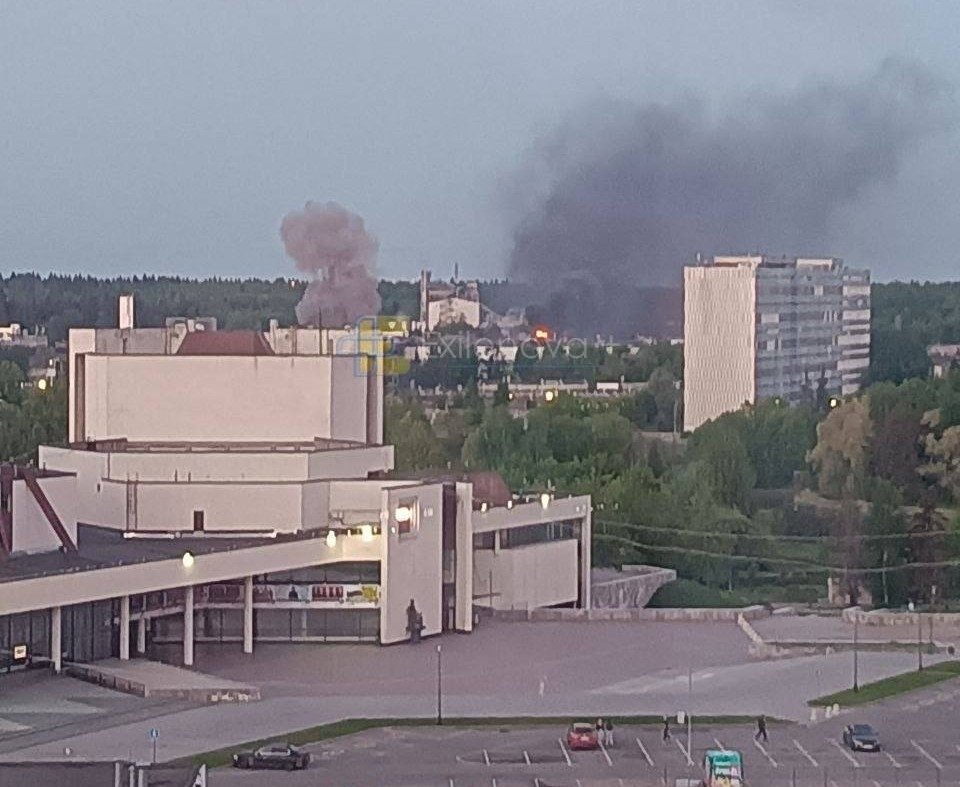
In Zelenograd, one of Russia’s main centers for microelectronics and high-tech research, several buildings and industrial facilities were hit recently.
While black smoke rose above the city after an attack on an oil depot, children and teenagers participated in a military-patriotic contest in a churchyard: they dismantled Kalashnikov weapons and practiced throwing grenades.
Priest Dmitry Poleshchiuk, who led a prayer before the competition, says the attacks bring people closer to their faith.
“When the drones are flying right over your head, that’s when you remember all the prayers you know,” he says.
Not all Moscow residents have changed their position, however. Aleksandr, a 62-year-old man originally from Odessa, says that Russia the war should continue.
He repeats the arguments constantly promoted by Russian state television, denying the existence of a distinct Ukrainian identity and accusing the West of causing the conflict. His solution is simple: “We have to be tougher.”