Loading Text-to-Speech…
“Be patient, the summit will reward you,” a climber coming down from Dirfy tells us as we continue our ascent. We’ve already been walking for about an hour and a half and we’re starting to wonder if the top is really as close as it looks.
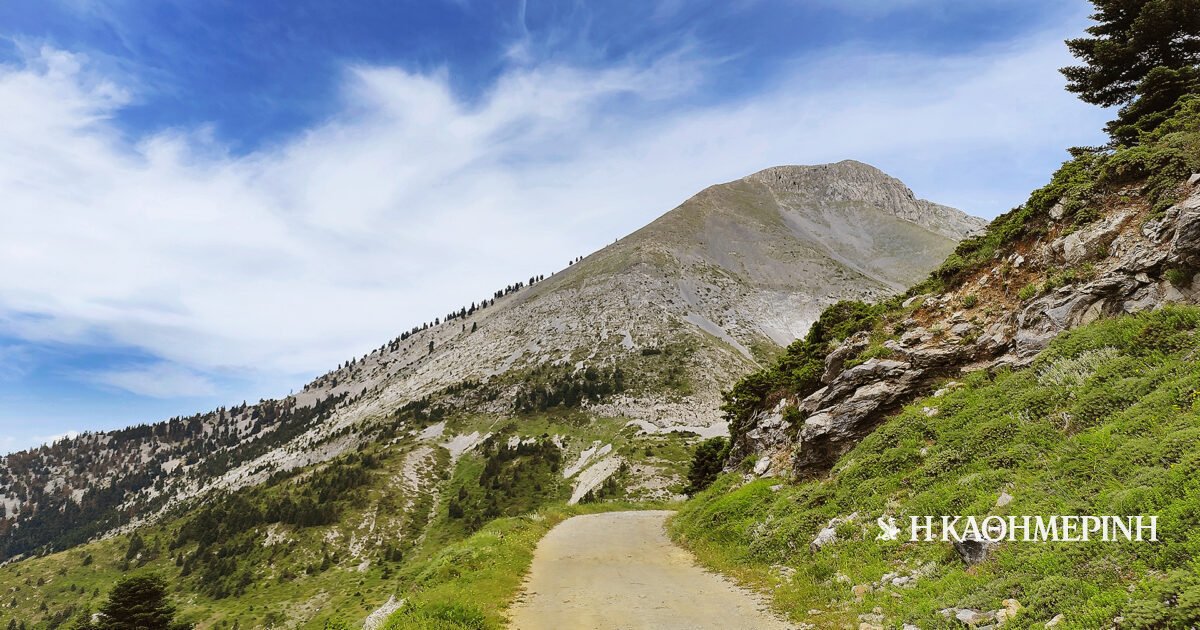
Dirfys, the highest mountain in Evia with a peak at 1,743 meters, is located in central Evia, above Steni. Although it is only a two-hour drive from Athens, the landscape gives it the feeling that you are much further away from the capital.

We started early in the morning and shortly after 10:30 we arrived at “Mihalis Nikolaou” mountain refugeon the northern slopes of the mountain, at an altitude of about 1,123 m. The refuge is the most common starting point for those who want to approach the Delphi peak (+620 meters altitude difference).
Although the route is not particularly long, Dirfys does not “give away” its measures easily. It is considered by many to be the most “alpine” mountain of island Greece, a reputation it owes to its strong winds, abrupt weather changes and its bare, rocky topography. The first meters of the course are relatively gentle, with low vegetation and an open horizon towards the surrounding slopes. But soon the landscape becomes wilder. Stops are necessary, not only for water but also to enjoy the nature around. As the climb progresses, the view towards Steni, Evia and the Aegean becomes more and more impressive.

Crossing Lakka
The most characteristic part of the climb is the crossing of Lakka, of a large natural basin formed between the steep slopes of the mountain. From there the slope becomes steeper and the path passes through stony fields. As we leave Lakka and approach the ridge, we get the feeling that the hard times are over. The path becomes gentler and the summit is now in front of us. With the view constantly opening towards the Aegean, the last few meters flow almost effortlessly. A little later, we are at 1,743 meters, at the highest point of Evia. The gaze travels in all directions. To the east stretches the Aegean, with Skyros and the Northern Sporades standing out on the horizon, while to the west the mountainous massifs of Central Greece can be seen. We got lucky because the weather conditions were perfect—a little cloud cover and a breeze helped us rest at the top.

Among the stones, our gaze rested on the scattered metal fragments, parts of an Air Force F-4 Phantom II fighter jet that crashed in the area on June 26, 2002 during a training flight. The remnants of the aircraft remain on the summit to this day, recalling a lesser-known aspect of the mountain’s history.

The return to Steni
The descent turned out to be a completely different experience. If on the ascent the attention was focused on the path, on the return we had more time to observe the mountain landscape. The bare rocks of the summit gradually gave way to the dense forests of Dirphyos, until Steni reappeared in the background, drowned in green.

The village, at the foot of the mountain, has for years been a favorite destination not only for hikers but also for meat lovers, as its grills have given Steni the reputation of one of the best-known gastronomic destinations in Evia. On the main road and around the square, between plane trees and running water, you will find taverns, cafes and small shops with local products. After more than five hours on the mountain, a meal under the plane trees or a coffee by the water seems like the ideal conclusion to the day.
Although the ascent to the top of Dirfyos does not require technical mountaineering knowledge, it would not be considered ideal for complete beginners. The route is marked, however the steep slopes and rocky terrain require good physical condition and basic mountain experience. In our backpacks we had enough water, nuts and light snacks for energy, windbreaker, hat and sunscreen. Hiking shoes are also necessary.
If you attempt the climb in the summer months, prefer to spend the night in Steni the night before, so that you can start the route at dawn to avoid the heat. In the remaining months of the year, before you start, find out about the weather conditions that prevail on the mountain, as e.g. in winter, fog and snowfall are common.