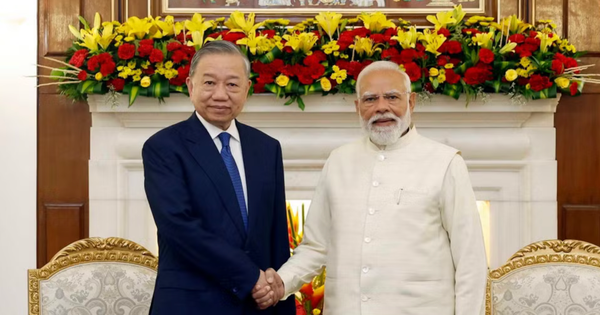
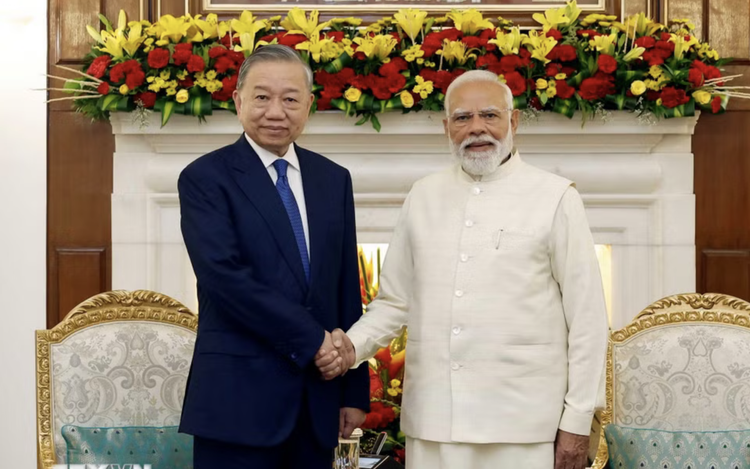
Vietnamese Party General Secretary and State President To Lam (L) shakes hands with Indian Prime Minister Narendra Modi during their meeting in New Delhi, India, May 6, 2026. Photo: Vietnam News Agency
The elevation was announced in New Delhi on Wednesday during talks between Indian Prime Minister Narendra Modi and Vietnamese Party General Secretary and State President To Lam, who arrived on Tuesday for a three-day state visit at Modi’s invitation.
Both leaders highlighted the importance of the visit and reaffirmed the priority each country attaches to bilateral relations in their foreign policies.
Enhanced partnership based on strategic alignment, pragmatic cooperation
The two sides expressed satisfaction with progress achieved across multiple areas since the establishment of the comprehensive strategic partnership a decade ago.
Lam noted that Vietnam and India still have significant potential and complementary strengths to further expand cooperation in ways that deliver practical benefits to both peoples and business communities.
He called for stronger efforts to facilitate greater business engagement in each other’s markets.
Accordingly, both sides agreed to elevate ties to an enhanced comprehensive strategic partnership, marking a new stage in relations guided by shared vision, strategic alignment, and practical cooperation.
To implement the upgraded framework, the two leaders held frank discussions and reached consensus on key directions to further deepen cooperation.
They agreed to strengthen political trust as a central pillar of relations, underpinned by shared strategic outlooks.
Both sides were also committed to maintaining regular high-level exchanges and improving the effectiveness of existing cooperation mechanisms, including the Vietnam–India Joint Committee on Bilateral Cooperation.
Defense and security cooperation was reaffirmed as an important pillar of the relationship.
The two countries agreed to expand collaboration in defense industry development, maritime and cybersecurity, information sharing and counter-terrorism.
India also pledged continued support for Vietnam in training, capacity building, and broader security enhancement.
Expanding trade, investment, technological cooperation
In economic, trade and investment relations, both sides agreed to enhance complementarity and strengthen supply chain connectivity, with a focus on deeper integration into global value chains.
They set a target of US$25 billion in bilateral trade by 2030, while working to reduce trade barriers and improve market access.
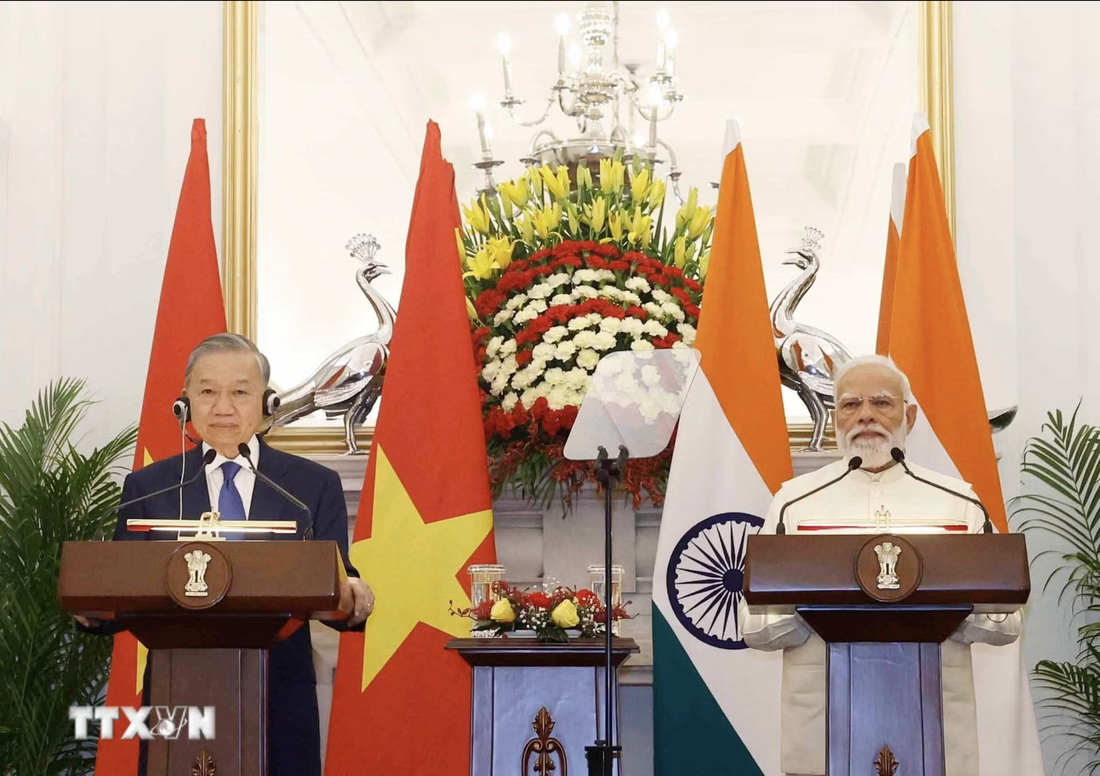
Vietnamese Party General Secretary and State President To Lam (L) and Indian Prime Minister Narendra Modi co-chair a press briefing following their talks in New Delhi, India, May 6, 2026. Photo: Vietnam News Agency
Lam said Vietnam is ready to increase imports from India to diversify production inputs, and suggested that India consider gradually easing regulatory requirements under the Bureau of Indian Standards for Vietnamese goods.
Both sides encouraged greater two-way investment in high-quality projects and agreed to create favorable conditions for major corporations to develop large-scale projects in infrastructure, renewable energy, pharmaceuticals, and high technology.
They agreed to position science, technology, innovation, and digital transformation as key drivers of the next phase in bilateral relations.
Cooperation will be expanded in core and emerging technologies, including semiconductors and critical minerals, artificial intelligence, information technology, 6G communications, healthcare, and nuclear energy for peaceful purposes.
The two sides also agreed to strengthen collaboration between technology enterprises through joint ventures, research and development centers, and innovation hubs.
Fostering social ties, multilateral coordination
The two sides agreed to further strengthen social ties through expanded cooperation in culture, tourism, and people-to-people exchanges, as well as the promotion of shared cultural, historical and religious values.
They also pledged to improve connectivity in aviation and logistics, and to enhance cooperation between localities and economic and technological centers in both countries.
Modi noted the steady flow of Vietnamese pilgrims travelling to India each year and expressed hope that tourism cooperation would continue to grow, while encouraging Vietnamese enterprises to expand investment in India’s tourism sector.
On regional and international issues, both sides agreed to maintain close coordination and support each other in multilateral forums, particularly the United Nations, ASEAN, and ASEAN-led mechanisms.
Modi praised ASEAN’s central role in the regional architecture.
Both sides emphasized the importance of maintaining peace, stability, security, safety and freedom of navigation and overflight, and of resolving disputes peacefully in accordance with international law, including the 1982 United Nations Convention on the Law of the Sea.
Lam invited Modi to visit Vietnam in the near future, and the Indian leader accepted the invitation.
Following the talks, the two leaders witnessed the signing and exchange of cooperation documents covering science and technology, critical minerals, healthcare, tourism and culture, finance, cybersecurity, local cooperation, and auditing.
The two sides also issued a 52-point joint statement elevating bilateral relations to an enhanced comprehensive strategic partnership.