The United States Treasury on Monday announced the temporary easing of sanctions on Iranian oil up to August 21 following talks with Iranian representatives in Switzerland.
The measure authorises the production, delivery and sale of crude oil, petrochemical products and petroleum products of Iranian origin, a Treasury Department statement said.
US Vice-President JD Vance said his talks with Iranian officials in Switzerland had laid a good foundation for a final peace deal, although Iran denied that it had begun discussions of its nuclear programme. The two sides, trying to build on the interim deal they signed last week, agreed to a road map towards a permanent agreement within 60 days at the talks in the Qatari-owned Swiss mountain resort of Buergenstock, mediators Pakistan and Qatar said.
The move is the largest since the start of the current Iran war on February 28. In March, the US temporarily eased sanctions on Iranian oil tankers with the aim of calming the energy markets. Oil prices rose sharply on global markets after the war effectively closed the Strait of Hormuz through which most oil and petroleum products from Iran and the Gulf States are exported. US Treasury Secretary Scott Bessent described the latest talks with Iran as “productive.” “In line with the ongoing productive talks in Switzerland, Iran has committed to free and open transit in the Strait of Hormuz and to permit International Atomic Energy Agency (IAEA) inspectors into their country,” he posted on X.
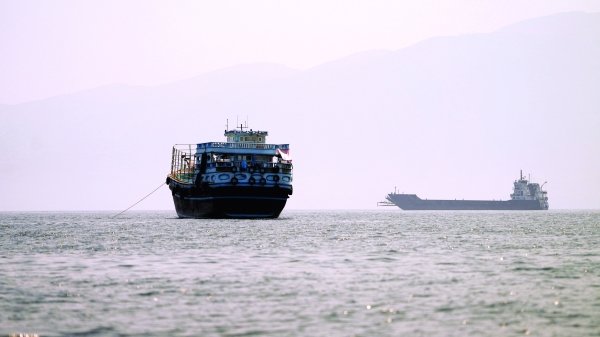
Meanwhile, maritime traffic in the Strait of Hormuz on Monday continued to flow at a faster pace. “The latest figures suggest a cautious but visible rebound in traffic following the MoU (memorandum of understanding between the United States and Iran), although the daily pattern remains volatile,” Mihail Todorov of AXSMarine, a shipping data provider, said.
As of 1530 GMT on Monday (late afternoon local time), the Kpler maritime tracking platform had already recorded 26 transits by commodity ships.
This level approached those of Thursday and Saturday, after the official signing of the agreement by US President Donald Trump and Iranian President Masoud Pezeshkian, when traffic was around 30 transits per day.
Including container ships, at least 26 commercial vessels had already transited the strait by Monday morning, according to AXSMarine navigation data.
Traffic on Saturday hit the highest levels since the start of the war, with AXSMarine recording 38 transits by commercial vessels, including 32 by commodity ships, according to Kpler.
Both records could be broken on Monday, once the day’s figures are consolidated.
The Strait of Hormuz, which Iran closed at the start of the war, reopened last week, after the US-Iranian agreement was reached. — Agencies