More than 30,000 men and women with PALM visas are working in Australia at any one time, mostly in farms and abattoirs. They leave their families behind in the Pacific and Timor-Leste, fly to Australia alongside tourists returning from holidays, then disperse across the country for short-term placements of up to nine months or long-term placements of up to four years. Overnight, they move from earning an hourly minimum wage between $1 and $4 in their home countries, to more than $26 an hour in Australia.
It has since become a cornerstone of Pacific diplomacy. Governments pitch the scheme as a win-win-win. For workers, it’s an unparalleled earning opportunity. For Pacific nations, it offers economic stability at home, thanks to the $2 billion that has been sent back in remittances. For Australia, workers ensure meat ends up at butchers, and produce on grocery shelves.
But there is a growing consensus that the architecture of the scheme puts its Pacific workers at risk of exploitation. A NSW parliamentary inquiry last week found that too many temporary migrant workers had either experienced – or were at serious risk – of modern slavery. This built on concerns raised by the UN Special Rapporteur on Contemporary Slavery, the union movement, migrant advocacy groups and academics.
We travelled to Fiji and Vanuatu to hear firsthand from workers, their families and communities about the scheme’s increasingly complex legacy. Across these countries’ small villages and settlements, we heard the success stories, such as Toro’s, as well as tales that won’t be promoted on the social media pages of high commissions. These were the workers who acquired injuries but received no compensation. Pregnant women who were left stranded because they aren’t entitled to Medicare access. Men who ran away from their employers and became undocumented in Australia.
At the heart of the issue is the fact that workers who come to Australia are tied to their employer, says James Cockayne, the NSW modern slavery commissioner – they can’t simply choose to work somewhere else. That employer is also responsible for providing the worker’s accommodation, transport and flights, but the costs are covered with compulsory deductions from the worker’s pay cheques.
“When a worker’s visa, income, housing and transport are all linked to the same employment relationship, the power imbalance becomes really significant,” says Cockayne.
……………………………………………………………………………………………………………………………………………………………………………………………………………
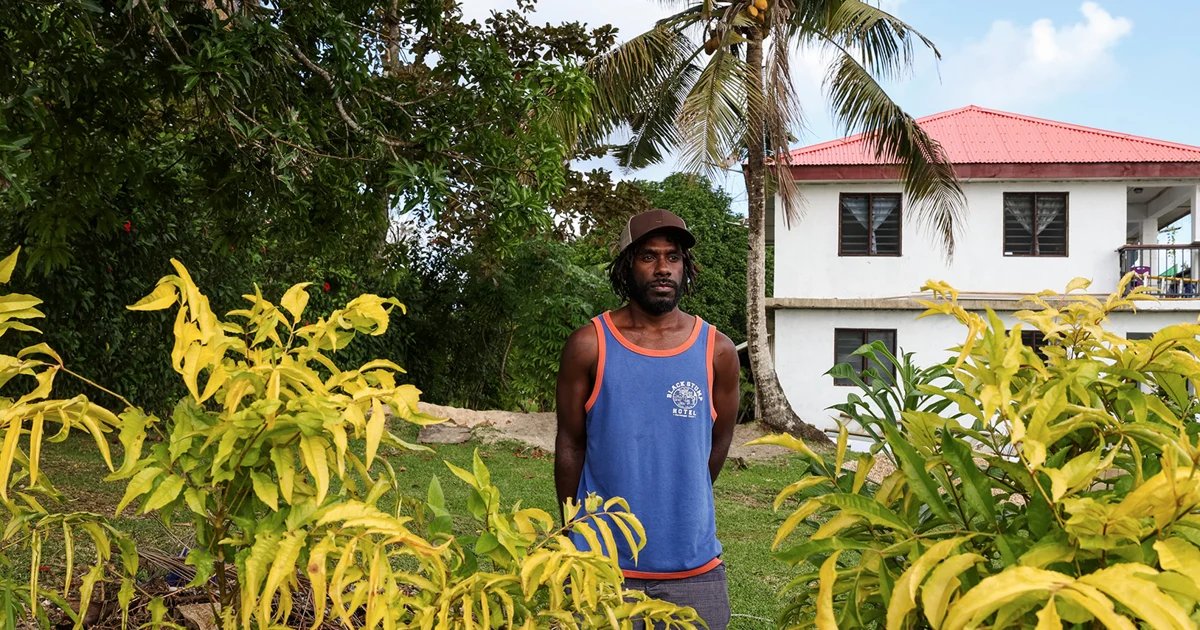
There aren’t many two-storey homes in villages around Vanuatu, so David Tau’s stands out.
Most people think he must be a public servant, or some kind of official, when they drive the dirt road towards Eratap village and see his house standing up from behind the reeds that give his property some privacy.
But that’s not the 30-year-old’s story.
Tau was also a PALM worker in Australia, although he made his earnings the unconventional way – by running away from the scheme and making more money outside it.
This is known as “disengagement”, and it’s a heated topic. A Facebook video that went viral in June, of a Fijian former PALM worker living under a bridge near a Sydney metro station, sparked furious debate online about the conditions endured by disengaged workers. Pacific ministers regularly warn their workers against absconding, insisting they must maintain their country’s reputation.
Some workers like Elizabeth flee bad employers. But oftentimes, it’s more complicated. Many leave to work off the books, where they can earn more than the minimum wage.
Five years ago, Tau was on his third short-term PALM visa in Australia, planting and harvesting sweet potatoes in Queensland. This time was different, though: he had left his pregnant wife at home, with the promise of building them a house. When he looked at his weekly paycheck, he realised it wasn’t enough. “I feel like no, this is not going to get me going with my plans,” he recalls.
Tau’s employer had brought in extra workers, so this meant less work and fewer hours individually. “We don’t make enough money. Sometimes we earn $200 a week,” he says. “But we’ve got families back home that need money every week … It’s not enough to pay for school fees and food and you want to build house as well.”
Most Pacific workers accept whatever they’re given, Tau says. “Our people, they can’t say much, they can’t talk back. They’re not in their country, they’re far from their families, they came here for work: whatever comes they have to say yes, [even] if the money’s not good.”
But Tau had a good relationship with his employer and felt confident speaking up. He was already helping with translation on the farm. So he told his boss. “You’re bringing a lot of people, and they have less work, but the deductions are the same,” Tau says.
Those issues were dismissed. “He [the farmer] just said: ‘you listen to me’. I thought, we have to work together, to make things better for everyone… When that didn’t happen, I left.”
Tau caught trains from Queensland down to NSW, and started picking oranges for $1000 a week, cash in hand in Leeton, an irrigation town in the Riverina.
This is where things can often get messy for former PALM workers. Working off books, without a visa, makes workers even more vulnerable to underpayment, overcharging and poor conditions. People lose access to accommodation, health insurance and formal income.
In Leeton, Tau saw other disengaged PALM workers drinking heavily and getting hurt. Uneasy with his unregulated condition, he wanted to find somewhere he could work and pay tax.
“Proper employment,” Tau says. “I don’t want to break the Australian law or something to work … I want to be safe in some way.”
But he couldn’t work on the books without a valid visa. He did what thousands of migrants do to prolong their stays in Australia when their options run out – he applied for refugee status, knowing full well that he would be unsuccessful, given he had every intent of returning home. He calculated the process would buy him time, at the very least. The federal government has been trying to close this loophole in the protection visa system, which has seen more than 100,000 migrants stay beyond their original visa by entering a years-long process: applying for asylum, then appealing the visa rejection.
Once Tau had a bridging visa, he found his way to Geelong, in Victoria. He wound up working in the shearing industry, where he excelled and his wages skyrocketed – he earned between $2000 and $4000 a week. For about three years, his employer treated him well, giving him a place to stay and car to use, free of charge.
When his house was completed six months ago, Tau decided his time was up and returned to Vanuatu. That’s when he met his daughter, now four, for the first time. The cottage in which his parents raised him now sits in the shadow of his family’s two-storey home.
“I feel proud,” Tau says, sitting in a clearing in the front yard, where he’s started digging up turf to build a shop next, maybe a coffee bar. “Everyone looks at me like I’m not the same as before … Most disengaged people like me will be afraid to talk. But for me I feel it’s a good story to tell. It’s my story, it’s part of me for my life. It’s how I built this.”
Tau probably won’t ever return to Australia; he’s on a visa blacklist for now and has achieved what he set out to do. Others, like Kenneth and Elizabeth, have not been so lucky.
Many more, still, will keep coming back, holding on to their own dreams of building a home – even if it means leaving their young families, or babies, behind for years at a time. Both Lewagalu and Willie, the young mothers, hope to return to Australia one day.
Toro is gazing around his lounge room, surrounded by pictures of his family and Australian souvenirs. “Now, I just stay home and relax,” he says. He’s spending more time with his five children, watching rugby with his friends – taking a reprieve from the abattoir’s early morning starts, while he waits on news about his next PALM visa application.
Asked why he’s returning to Australia, he grins again: “Just to go and earn money.”
– The Sydney Morning Herald
Natassia Chrysanthos and Alex Ellinghausen visited Fiji and Vanuatu with support from the Michael Gordon Fellowship, administered by the Melbourne Press Club.This is an excerpt from the first of a special two-part series about the Pacific Australia Labour Mobility scheme.